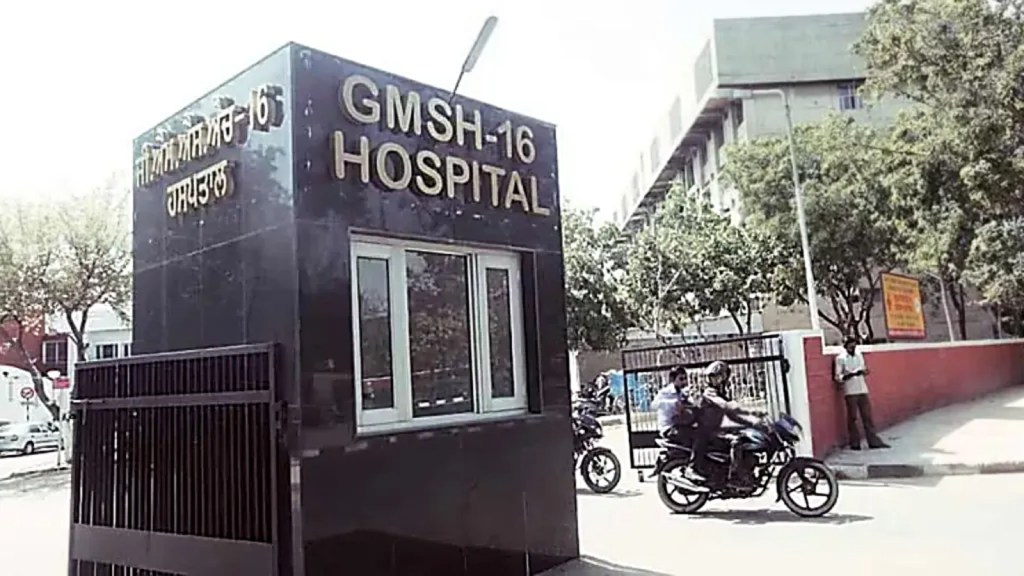
How a Chandigarh hospital sat on crores of public money and deprived poor patients
The audit said the RKS funds were “primarily meant for patient welfare and that their non-utilisation defeated the very objective of the scheme — ensuring equitable access to quality healthcare while minimising financial hardship for patients”.
The twin findings have been flagged in a government audit of the functioning of GMSH-16, pointing to a gap between the resources available with the hospital and their utilisation for patients and hospital functioning. (Source: File)
For a poor patient, the cost of getting treated does not end with the hospital bill. There is the cost of medicines, transport to hospital, and, sometimes, food and accommodation for an attendant. At Chandigarh’s Government Multi-Speciality Hospital, Sector 16 (GMSH-16), a fund meant to cushion patients against precisely these hardships never reached them.
During the year 2024-2025, Rs 38.57 crore of the Rs 40.44 crore available under the Rogi Kalyan Samiti (RKS) remained untouched even when it could have helped several, with just Rs 1.87 crore utilised in 2024-25 for patients welfare.
At the same time, fingerprint scanners worth Rs 20.40 lakh, purchased with public money, remained dumped in the hospital store for years.
The twin findings have been flagged in a government audit of the functioning of GMSH-16, pointing to a gap between the resources available with the hospital and their utilisation for patients and hospital functioning.
The audit said the RKS funds were “primarily meant for patient welfare and that their non-utilisation defeated the very objective of the scheme — ensuring equitable access to quality healthcare while minimising financial hardship for patients”.
Under the RKS guidelines, at least two-thirds of revenue generated through service provision is to be spent on patients’ welfare. The funds can be used for expenses related to treatment, transportation, diet and stay of attendants, particularly for patients from economically disadvantaged, vulnerable and marginalised groups.
It further flagged the expenditure at GMSH-16 as being in contravention of the prescribed rules.
Story continues below this ad
When the matter was raised with Dr Suman Singh, Director, Health Services, who also handles the functioning of the institute, she said there was a prescribed protocol for spending Rogi Kalyan Samiti funds and the requisite permissions had to be obtained before the money could be utilised.
“As and when we receive the funds and the required permissions, we utilise them. There is a procedure that has to be followed,” she said.
Rs 20.40 lakh scanners not used for years
The audit also found that 20 fingerprint scanners costing Rs 20.40 lakh were procured during 2021-22, but their utilisation was delayed for years and they remained dumped in the stores.
Only one scanner was issued to the Administration Block on May 8, 2023 — nearly two years after purchase. The remaining 19 scanners continued to lie unutilised in the store till March 18, 2025, before being issued to the IT Cell on March 19, 2025.
Story continues below this ad
The prolonged retention, the audit observed, indicated that the requirement for the fingerprint scanners “was not assessed realistically at the time of procurement” and resulted in blockage of government funds and loss of the warranty period “without any productive use”.
The audit termed procurement in excess of the actual requirement irregular and in contravention of the prescribed rules, which require authorities to avoid purchasing quantities beyond requirement.
Suman Singh said biometric attendance systems had now been installed at several places and at “many places, we now have fingerprint sensors as per requirement.”
R K Garg, activist who obtained the audit report said that the findings raise a “serious question” of accountability.
Story continues below this ad
“When funds are specifically earmarked for patient welfare but remain unutilised, responsibility must be fixed for the failure to use them. There should be a clear explanation from the authorities concerned, along with corrective measures to ensure that public funds meant for patients are actually put to use. Similarly, procurement should be based on genuine requirements so that taxpayers’ money does not remain blocked in unused equipment” Garg added.
Hina Rohtaki is a Special Correspondent at The Indian Express, based in Chandigarh. She is one of the most prominent journalists covering the Chandigarh Administration, civic issues, and the unique political status of the Union Territory.
Professional Background
Experience: She has been in the field for over a decade and is known for her investigative reporting on administrative waste and urban governance.
Awards: She is a recipient of the prestigious Ramnath Goenka Excellence in Journalism Award, which was presented to her by the President of India in January 2020. She was also awarded the Jethmalani prize (The Will of Steel Awards) in 2025 in the Empowerment category for a series of articles that highlighted the struggles of Covid widows.
Core Beat: Her primary focus is the Chandigarh administrative structure, the Union Territory's financial management, and urban development projects.
Recent Notable Articles (Late 2025)
Her recent work highlights a focus on government accountability, administrative expenditures, and civic trends:
1. Investigative & Financial Reporting
"Fuelling power: Senior UT IAS officers guzzled petrol worth Rs 30 lakh in 2 yrs" (Dec 14, 2025): An investigative report detailing the high fuel bills of top bureaucrats, including the Finance Secretary and Chief Secretary’s staff.
"Admn spends Rs 1.5 crore on dismantling road railings and fixing again after increasing height" (Dec 8, 2025): Highlighting administrative waste on "non-viable" solutions for pedestrian control.
"Chandigarh’s finances under ministry’s watch now" (Nov 27, 2025): Reporting on the new requirement for MHA approval for all new projects in the UT.
2. Governance & Constitutional Status
"What will it mean for Chandigarh if it is brought under Article 240?" (Nov 24, 2025): An "Explained" piece on the potential constitutional shift that would grant the President more power over the UT's governance.
"MP Manish Tewari moves Bill seeking directly elected Mayor with 5-year tenure" (Dec 6, 2025): Covering the legislative push to reform Chandigarh's municipal leadership structure.
"No proposal to increase Mayor's term in Chandigarh by 5 years: Centre" (Dec 10, 2025): Reporting on the Union government's response to demands for a longer mayoral term.
3. Urban Infrastructure & Environment
"Chandigarh admn cuts power to India's tallest air purifier, asks firm to dismantle it" (Nov 17, 2025): A critical report on the failure of a high-cost environmental project deemed "of no use" by experts.
"UT rethinks 24/7 water supply project as costs soar" (Nov 26, 2025): Detailing the financial challenges and delays in modernizing the city's water network.
"Centre 'obfuscating, covering up' MC's shifting deadlines for clearing Dadu Majra dump" (Dec 12, 2025): Reporting on the ongoing controversy surrounding the city's major waste dump.
4. Lifestyle & Local Trends
"Chandigarh turns into a Thar city as women fuel the surge" (Dec 2, 2025): A feature on a unique automotive trend in the city, with a record 600 registrations by women drivers this year.
"After fivefold spike in 2023, EV sales struggle to pick pace in Chandigarh" (Dec 2, 2025): Analyzing the slowdown in electric vehicle adoption despite previous surges.
Signature Beat
Hina is known for her meticulous tracking of RTI (Right to Information) data to expose administrative inefficiency. Her "Ground Zero" reporting on the Dadu Majra garbage dump and her scrutiny of the Chandigarh Smart City projects have made her a key figure in the city’s civil society discourse.
X (Twitter): @HinaRohtaki ... Read More