Why Himachal High Court quashed Bakrota land use change for hotel project

Himachal HC quashed a 2020 CLU permission for a Bakrota residential property, holding that commercialisation would violate the statutory Development Plan.

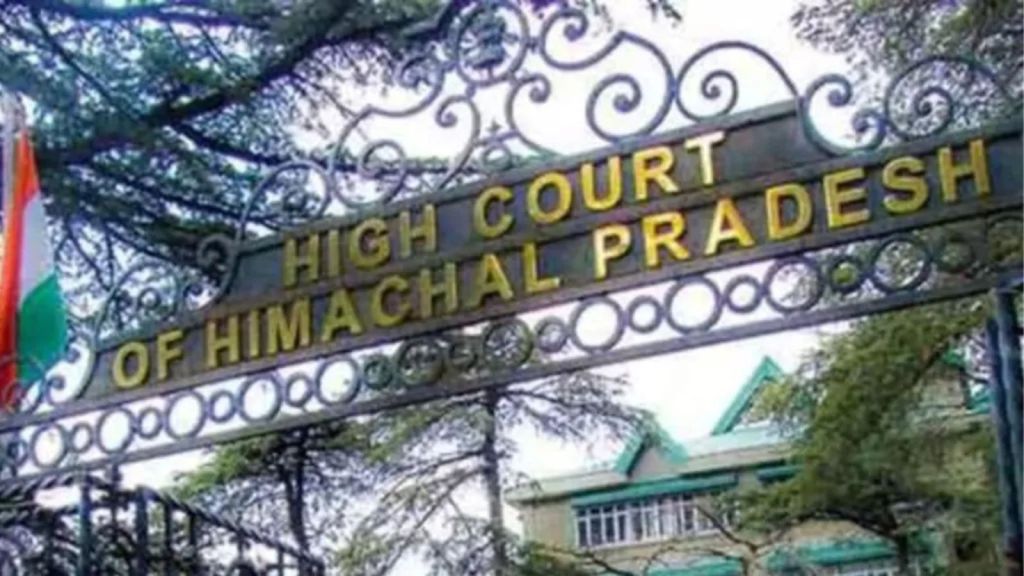
Himachal Pradesh: The Bench found that Bakrota falls within the restricted area under Dalhousie Planning Area.The Bench found that Bakrota falls within the restricted area under Dalhousie Planning Area. (File Photo)

A Division Bench of the Himachal Pradesh High Court has quashed a permission for Change of Land Use (CLU), issued in January 2020, of a residential property to commercial property in Bakrota, a small village in the close vicinity of the tourist town of Dalhousie, Chamba. The HC observed that the permission would open floodgates to the commercialisation of Bakrota

In its order on Wednesday, the Bench of Chief Justice Gurmeet Singh Sandhawalia and Justice Bipin Chander Negi stated, “This permission cannot be allowed as it violates the Development Plan, which carries statutory force. Permitting this, would open the floodgates to the commercialization of Bakrota, on the ground that permission has already been granted in one case to construct a commercial building in the form of Hotels and Guest Houses which instance has also not been given.”

The counsel for the petitioner, Advocate Devan Khanna, had argued that the notified Development Plan was sacrosanct and could not be ignored. He submitted that the action permitting the CLU was manifestly arbitrary, and that the impugned order was non-speaking and devoid of valid reasoning or having any element of public interest. He also contended that the carrying capacity of the area was not taken into consideration.

Meanwhile, Senior Advocate Shrawan Dogra, representing the respondent Prit Pal Singh, submitted that an appellate authority had exercised its powers of appeal to grant the CLU permission. He further argued that resultantly the present PIL is not maintainable.

The Bench found that Bakrota falls within the restricted area under Dalhousie Planning Area. The respondent, Prit Pal Singh, had initially constructed a residential building in Bakrota, comprising six blocks with separate bathrooms on a total coverage area of 486 square metres

The proposed structure, designed to accommodate around 24 persons, included a basement, ground floor, mezzanine, first, second and third floors.

The Town and Country Planning Department granted residential permission on September 23, 2017, while the Municipal Council, Dalhousie, approved the building plans and subsequently granted development permission on March 6, 2018.

Story continues below this ad

During the hearing, the Bench found that on October 22, 2018, the owner/respondent applied for the CLU from residential use to a hotel/guest house. The application was rejected on September 9, 2019, following recommendations of the Planning Permission Committee. The rejection followed a joint site inspection conducted in July 2019, which found 75 green trees standing on the site. The inspection also recorded that the property fell within the restricted area of the Dalhousie Planning Area.

The respondent went into the appeal, and finally a decision was made in his favor by the appellate authority.

Later, the decision of the appellate authority was also overturned, but a coordinate bench of the Himachal HC allowed the petition of Prit Pal in May 2023 on the ground that a quasi-judicial authority cannot review its own order in the absence of a specific review provision under the provisions of the Himachal Pradesh Town and Country Planning Act, 1977.

The Bench said, “The whole case revolves around the private interest of the respondent, who seeks to develop the property on a commercial basis. Merely because he owns the land and purchased it way-back in the year 1993 does not grant him a license to utilize the property for purposes other than those permitted under the notification dated 27.12.2004. In such circumstances, we are of the considered opinion that the present writ petition is liable to be allowed, and accordingly, January 3, 2020 order set-aside.”

Saurabh Parashar is an Assistant Editor at The Indian Express, primarily responsible for the publication’s coverage of Himachal Pradesh. He is a seasoned journalist with over 17 years of experience in print media, specializing in crime, legal affairs, and investigative reporting. Professional Background Education: He holds a Master’s degree in Mass Communication from Guru Jambheshwar University of Science & Technology (Hisar) and a Law degree from Himachal Pradesh University (HPU), Shimla. This legal background significantly informs his reporting on complex judicial and administrative matters. Career Path: Before joining The Indian Express in 2017, he spent 12 years with The Times of India. Core Beats: His primary focus is the socio-political landscape of the hill state, with a specific emphasis on the environment, forest conservation, drug menace (specifically "Chitta"), affairs related to tribal and archaeology and the unique challenges of governance in high-altitude regions. Recent Notable Articles (Late 2025) His recent reporting highlights the critical intersection of policy, law, and social safety in Himachal Pradesh: 1. "Himachal’s battle against Chitta: Why the border areas are most vulnerable" (Late 2025): An investigative look at the transit routes from Punjab and the impact on local youth. 2. "Shimla ropeway clears key hurdle as 820 trees face the axe :According to the Forest Survey of India’s 2021 assessment, 47.21 percent of Shimla’s 5,131 sq km geographical area is under forest cover (Nov 17, 2025). 3. "Himachal to handover 2.7427 ha of non-forest land for Shimla Ropeway: Given the land’s non-forest nature, RTDC and the state will not require permission from MoEFCC" (Nov 18, 2025) 4. "How the centuries-old Jodidara tradition is fading in Himachal’s Trans-Giri region: Jodidara: a form of fraternal polyandry—has long been part of Hatti tribal culture in the Trans-Giri region of Himachal Pradesh and adjoining Uttarakhand. It is believed to have evolved to prevent division of ancestral land and maintain unity among brothers in the harsh, mountainous terrain" (Aug 18, 2025) Legal & Agricultural Affairs "Kisan Sabha hails SC’s setting aside Himachal HC order to remove orchards from forest land" (Dec 18, 2025): Covering a major Supreme Court victory for farmers, where a High Court order to remove fruit-bearing apple orchards was overturned. "Himachal Cabinet nod to new tourism policy; focus on home-stays in tribal areas" (Dec 11, 2025): Detailing the legislative push to decentralize tourism and bring economic benefits to Lahaul-Spiti and Kinnaur. 3. Governance & Environment "Forest rights and development: Why Himachal is seeking more leeway from Centre" (Dec 19, 2025): Reporting on the legal hurdles faced by the state in infrastructure projects due to the Forest Conservation Act. "Cloudbursts and resilience: How Himachal’s remote villages are building back better" (Nov 2025): Following up on the long-term rehabilitation efforts after monsoon-related disasters. Crime especially cyber crimes, crypto currency etc: crypto currency: "Agents in uniform, motivational speeches, lavish parties: How a Himachal crypto con went unnoticed:A serial conman, a ‘Nelson Mandela Nobel Peace Award winner', and retired policemen got together to pull off a Rs 1,740-crore fraud" (Nov 10, 2023) Signature Beats Saurabh is recognized for his tenacious reporting on the state's drug epidemic. His deep familiarity with the topography and tribal culture of Himachal allows him to report from remote locations like Spiti, Pangi, Shillai, which are often overlooked by national media. His legal expertise makes him a primary choice for covering the Himachal Pradesh High Court on issues ranging from local body elections to environmental PILs. X (Twitter): @saurabh_prashar . ... Read More

Stay updated with the latest - Click here to follow us on Instagram

Advertisement
Loading Recommendations...
Advertisement
Advertisement
Latest Comment
Post Comment
Read Comments