Journalism of Courage



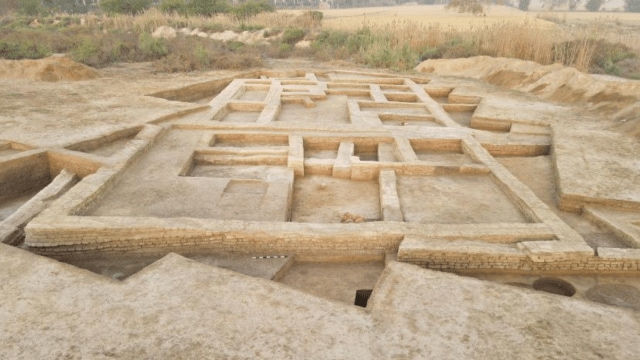 A senior officer of the state archaeology department told The Indian Express Monday now the department will take all steps to protect the site, including fencing it and deploying a guard there. (Express photo)
The Haryana government has declared two sites of over 4,400-year-old Harappan civilisation in Bhiwani district as protected monuments and archaeological sites. The two sites are situated at two neighbouring villages of Tighrana and Mitathal.
As per a notification issued by Haryana principal secretary (heritage and tourism) Kala Ramachandran on March 13 this year, the area spread over 10 acres at Mitathal will be protected. The Haryana heritage and tourism department has issued the notification under the Haryana Ancient and Historical Monuments and Archaeological Sites and Remains Act, 1964.
A senior officer of the state archaeology department told The Indian Express Monday now the department will take all steps to protect the site, including fencing it and deploying a guard there.
Welcoming the move, the head of Department of History and Archaeology at the Central University of Haryana (Mahendragarh), Narender Singh Parmar, said: “In the absence of a notification, the villagers were disturbing the site considering it as a piece of agricultural land. A considerable part of Mitathal and Tighrana has already been destroyed. There is a need for early official intervention to protect the site.”
So far, a central university team under the supervision of Parmar has excavated the site four times —2016, 2020, 2021 and 2024.
According to the official notification, the results of archaeological excavation at Mitathal conducted in 1968 have thrown light on the Copper- Bronze age culture – complex of the Indo-Gangetic divide of the 3rd-2nd millennia BCE. The site came to light for the first time in 1913 when a hoard of coins of Samudra Gupta, one of the most illustrious kings of the Gupta dynasty, was found. From 1965 to 1968, beads and copper implements were discovered at the site, yielding proto-historic material.
Officials say the excavations at Mitathal bear out the Harappan tradition in town planning, architecture and in arts and crafts. Pottery was well burnt sturdy red ware painted in black with pipal leaf, fish scale, and other geometric designs.
The site has yielded a variety of antiquities such as beads, bangles and terracotta, stone, shell, copper, ivory and bone objects.
The notification for Tighrana village site states that the remains of post-Harappan period provide insight into the evolution and continuity of human settlement in the region. The region was first inhabited by the Chalcolithic agricultural communities as early as 2,400 BCE. These early settlers (popularly known as Sothians) lived at Chang, Mitathal, Tighrana etc. in small mud-brick houses with thatched roofs. Some of their settlements may have been fortified and comprised 50 to 100 houses each. They engaged in agriculture, domesticated cows, bulls, goats etc., and used wheel-made pottery painted in bichrome with black-and-white designs. They used copper, bronze and stone implements as discovered in large numbers.
The officials say the discovery of remains from Pre-Siswal, pre-Harappan and post-Harappan settlements at Tighrana, is a significant archaeological find. The presence of beads and green carnelian bangles indicate a thriving industry of bead making and jewellery production.

 3 min read