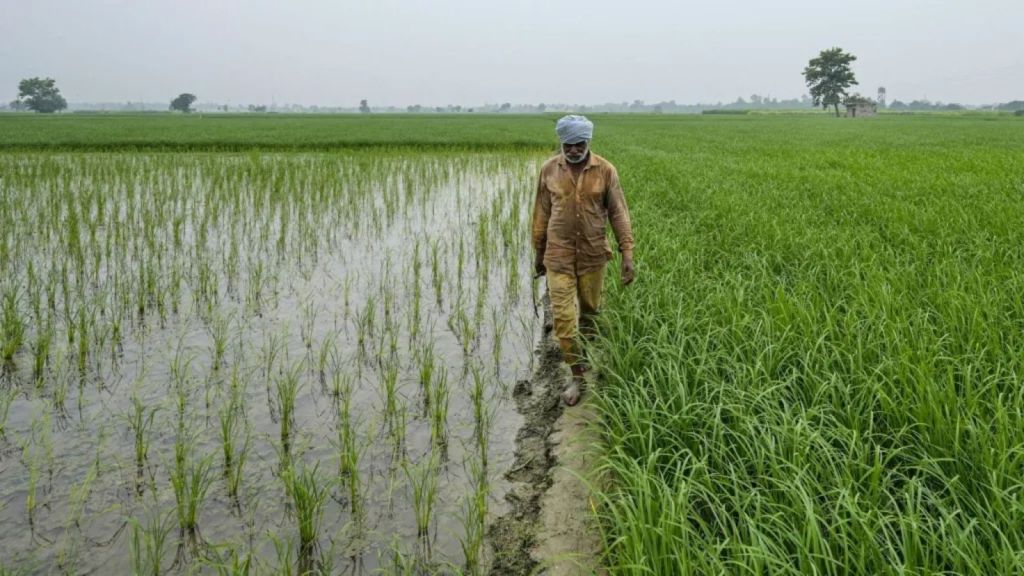
With farmers increasingly dependent on tubewells to irrigate paddy amid a deficient monsoon, Punjab’s peak power demand surged nearly 140 per cent year-on-year on Wednesday, forcing the state to purchase 2,709 lakh units (LUs) at a tentative cost of Rs 119.5 crore.
The state’s maximum demand touched 16,343 MW on September 2, compared with 6,830 MW on the corresponding day last year, an increase of 139.3 per cent. On September 1, the demand was 15,928 MW.
The Punjab State Power Corporation Limited (PSPCL), already burdened with providing subsidised power, purchased 2,709.45 lakh units at an average Rs 4.41 per unit. The purchases came as the state grappled with a combination of high agricultural demand, reduced generation from its own plants and an ongoing strike by power department employees and engineers.
The monsoon in Punjab is 36 per cent deficient, according to Finance Minister Harpal Cheema, leaving farmers highly dependent on groundwater and pump sets to sustain the water-guzzling paddy crop.
“This was bound to happen. The farmers had to depend on irrigation from underground aquifers and pump sets to irrigate the paddy crop. The heat is still unrelenting,” Cheema told The Indian Express.
Amid the ongoing strike by power department employees and engineers, several units of the state’s own thermal power plants were not functioning, forcing the PSPCL to turn to the market and outside sources.
Cheema said the government was in talks with protesting power employees and hoped they would return to work soon. “We are in talks with the employees. The dialogue is on. They will soon return to work,” he said.
Story continues below this ad
Cheema added that the state might have to continue purchasing power from outside for another two days.
A power department engineer, however, said the sharp rise in domestic consumption was also partly linked to the state’s free 300-unit power scheme. “Those residents who did not have ACs and other electrical equipment have installed these as 300 units are free. Earlier, they would consume 100 units or even lesser. This has led to a spike in demand,” the engineer said.
Industry facing cuts
The supply crunch has already begun affecting industry. PSPCL imposed 31.4 lakh units of power cuts on Wednesday, with Category-II and Category-III industrial consumers in Jalandhar, Ludhiana, Mohali, Khanna and Mandi Gobindgarh facing cuts of around three hours and 45 minutes.
According to PSPCL’s power position report, there were no scheduled cuts for Category-I industrial consumers and important cities.
Story continues below this ad
With Assembly elections approaching, the government is keen to avoid prolonged cuts in the domestic sector and has instead relied on costly power purchases to bridge the gap.
On Wednesday, Punjab had 3,316.41 lakh units available against a requirement of 3,347.81 lakh units, leaving a deficit of 31.4 lakh units. The shortfall was met through rotational cuts.
Industrialist and World MSME Forum president Badish Jindal said industries were facing both scheduled and unscheduled cuts.
“PSPCL’s decision to impose power cuts on industries from 7 pm to midnight is seriously affecting the sector,” he said, pointing out that continuous-process industries, including furnace and heat-treatment units, cannot abruptly shut machinery without risking damage to raw material, products and equipment.
Story continues below this ad
Such disruptions, he said, would reduce productivity, increase restarting costs and affect product quality. Punjab industry was already facing stiff competition from other states, he added, and prolonged power restrictions would further increase production costs and hurt competitiveness.
State generation falls short
Of the 3,316.41 lakh units available to Punjab on Wednesday, only 612.65 lakh units came from the state’s own sources, while 2,709.45 lakh units were purchased.
The state’s own availability comprised 199.46 lakh units from its thermal plants, 206.52 lakh units from hydel projects, 141.90 lakh units as Punjab’s share of BBMB hydropower after transmission losses, and 64.77 lakh units from new and renewable energy sources.
The three state-owned thermal plants together generated 199.46 lakh units. The Guru Gobind Singh Super Thermal Plant at Ropar supplied 45.19 lakh units, Guru Hargobind Thermal Plant at Lehra Mohabbat 37.48 lakh units and Goindwal Sahib 116.78 lakh units.
Story continues below this ad
The two major private thermal plants supplied another 703.65 lakh units. Nabha Power’s Rajpura plant generated 315.93 lakh units at an average cost of Rs 3.22 per unit, while Talwandi Sabo Power Ltd supplied 387.72 lakh units at Rs 3.69 per unit.
Central sector allocations supplied 933.51 lakh units after transmission losses. Punjab also received 393.64 lakh units through bilateral banking at its periphery and another 13.25 lakh units through banking arrangements with traders.
Costly short-term purchases
The shortage also forced PSPCL to rely heavily on short-term markets, some of which came at significantly higher rates. The utility purchased 134.83 lakh units through tenders and traders at an average Rs 8.10 per unit. Another 280.30 lakh units were bought from the Real-Time Market at Rs 6.08 per unit and 250.55 lakh units through the Term Ahead Market/weekly exchange at Rs 6.80 per unit.
It also purchased 3.34 lakh units through the Green Day Ahead Market at Rs 9.44 per unit and 1.86 lakh units through the Day Ahead Exchange at Rs 10.40 per unit.
Story continues below this ad
Together, these short-term exchange and trader purchases amounted to around 671 lakh units, underlining the extent to which PSPCL had to turn to the market to keep the state supplied.
The total 2,709.45 lakh units purchased on September 2 carried a tentative bill of Rs 119.49 crore, at an average cost of Rs 4.41 per unit.
Power Minister Tarunpreet Singh Sond was not available for comment.
Kanchan Vasdev is a Senior Assistant Editor in The Indian Express’ Punjab bureau. She is a highly experienced journalist with 22 years of expertise covering high-stakes politics, governance, and social issues in Northern India.
Professional Background
Role: Primary reporter covering the Punjab Chief Minister’s Office (CMO), government policies, and the Aam Aadmi Party (AAP) leadership in the state.
Experience: She previously worked with The Tribune and has played a key role in launching various city editions.
Special Projects:
Abandoned Brides: Authored a monograph on brides abandoned by NRIs as part of the Prabha Dutt Memorial Fellowship.
Environment: Worked as a Centre for Science and Environment (CSE) fellow, focusing on the pollution levels in the Satluj river.
Recent Notable Articles (Late 2025)
Her recent reporting focuses on the legislative strategies and political maneuvers of the Bhagwant Mann-led Punjab government:
1. Legislative & Governance Standoffs
"Punjab govt advances special Assembly session to pass resolution against VB-G RAM G Bill" (Dec 20, 2025): Reporting on the state's move to block the Centre's "Viksit Bharat" mission, which the state claims will undermine MGNREGA.
"Punjab govt doubles down on special sessions, sixth in January" (Dec 19, 2025): Detailing the AAP government's use of special sessions as a legislative tool amid tensions with the Governor.
"Punjab asks 'VIP teachers' working near Chandigarh to go back to border districts" (Dec 16, 2025): Reporting on CM Mann's move to end the practice of influential teachers avoiding postings in remote areas.
2. Political Analysis & Rural Polls
"Punjab rural polls: Why Akalis are likened to dinosaurs in Punjab" (Dec 19, 2025): Analyzing CM Bhagwant Mann's rhetoric against the Shiromani Akali Dal (SAD) following local body elections.
"AAP claims win in 78% Punjab zila parishads as counting continues" (Dec 18, 2025): Breaking down the results of the 2025 rural elections.
"Rahul Gandhi and Sidhu alike, says Bhagwant Mann" (Dec 13, 2025): Covering the CM's critique of the Congress leadership.
3. Law Enforcement & Bureaucracy
"Suspended Punjab IPS officer Ravjot Kaur Grewal awaits reinstatement" (Dec 10, 2025): Investigative reporting on the bureaucratic red tape involving the Election Commission and the state government.
"Punjab declines to give parole to Amritpal Singh" (Nov 27, 2025): Detailing the state government's refusal to grant parole to the radical preacher and sitting MP.
4. Welfare & Economy
"Punjab government's plan to add more freebies to 'atta-dal' scheme hits funds roadblock" (Dec 4, 2024): An analysis of the fiscal challenges facing the state's flagship food security program.
"Mann leads Punjab delegation to Japan and South Korea for investor outreach" (Dec 2, 2025).
Signature Beat
Kanchan Vasdev is known for her insider access to Punjab's political executive. Her writing provides deep insights into how state policies are formulated and the friction points between the state government and central authorities. Her dual expertise in environment and law allows her to report on complex issues like the "Farmhouse Policy" (Dec 18, 2025) and river pollution with a unique policy-oriented lens.
X (Twitter): @kanchan99 ... Read More