


Stay updated with the latest - Click here to follow us on Instagram

Journalism of Courage
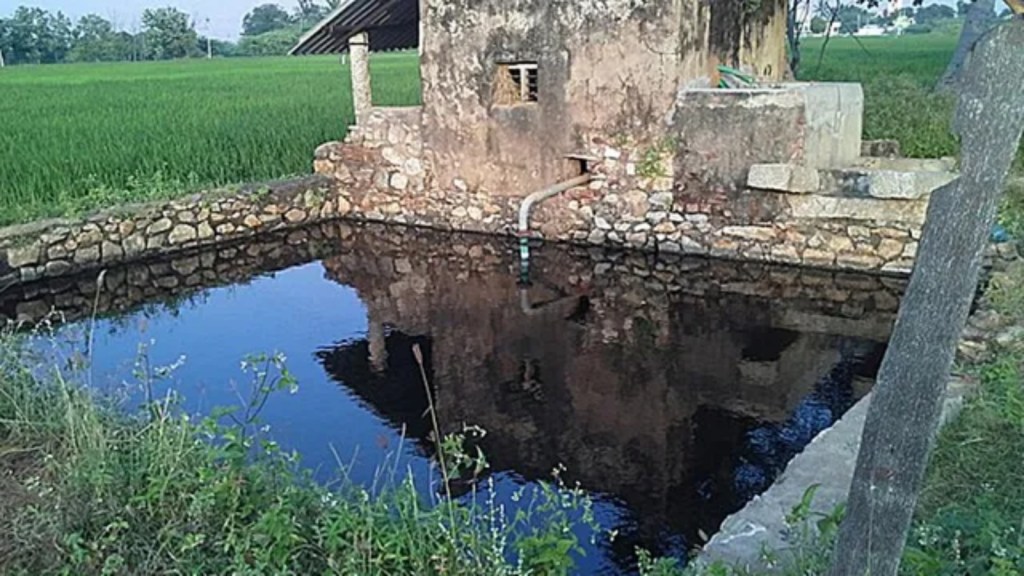 The water-level data, meanwhile, records the depth of groundwater below the ground surface at individual observation wells. (Source: File)
The Punjab government’s latest groundwater assessment has put the number of over-exploited groundwater blocks at 110 out of 153, down from 115 in the previous assessment. The Central Ground Water Board (CGWB) assessment of 2025 also recorded an improvement, putting the number of over-exploited units at 111, compared with 117 in the 2022 assessment.
However, groundwater levels at some monitoring locations have deteriorated despite the lower number of over-exploited blocks.
According to the CGWB, post-monsoon groundwater-level data from 2022 to 2025 show that the number of monitored wells with groundwater at 20 metres or deeper has fluctuated and, by 2025, was lower than in 2022. Yet the share of wells where the water level was more than 40 metres below ground level rose to 9 per cent in 2025 — the highest in the period.
The two sets of numbers measure different things.
The classification of a block as over-exploited is based on groundwater extraction in relation to the annual extractable groundwater resource. The water-level data, meanwhile, records the depth of groundwater below the ground surface at individual observation wells.
Taken together, the figures show a modest improvement in the state’s groundwater-extraction balance, even as very deep groundwater levels persist at some monitoring locations.
The CGWB’s groundwater assessment shows that out of Punjab’s 153 assessment units, 117 were classified as over-exploited in 2022. The state’s Ground Water-2024 report records 115 over-exploited units in the 2023 and 2024 assessments.
The Centre’s 2025 assessment put the number at 111.
The 2025 assessment also estimated Punjab’s annual groundwater recharge at 18.60 billion cubic metres (BCM) and its annual extractable groundwater resource at 16.80 BCM. Against this, annual groundwater extraction was estimated at 26.27 BCM, resulting in a groundwater extraction stage of 156.36 per cent.
The state government’s 2026 assessment has now put the number of over-exploited assessment units at 110. It estimates annual groundwater extraction at 26.32 BCM, against an annual extractable groundwater resource of 17.29 BCM, taking the stage of groundwater extraction to 152.22 per cent.
However, experts from the Punjab Agricultural University (PAU), Ludhiana, said the decline in the number of over-exploited blocks should not be interpreted as groundwater recovery across the state.
The deeper groundwater levels in the post-monsoon groundwater-level data provide a different picture. (see graph)
In 2022, 34.5 per cent of the monitored wells had groundwater levels at 20 metres or deeper, while 7.3 per cent were deeper than 40 metres. In 2023, the 20-metre-plus share increased to 35.3 per cent, while the proportion of wells beyond 40 metres was 6.7 per cent.
In 2024, the share at 20 metres or deeper fell to around 33 per cent, while the >40-metre category remained around 6.8 per cent.
In 2025, the share of wells at 20 metres or deeper fell further to 32.2 per cent.
But the share of wells with groundwater more than 40 metres below ground level increased to 9 per cent. In the 2025 post-monsoon monitoring, this represented 24 of 267 observation wells.
The 9 per cent figure (24 wells) needs to be understood correctly. It does not mean that 9 per cent of Punjab’s agricultural tubewells are more than 40 metres deep.
It refers to the depth of the groundwater level below ground level at monitored observation wells.
Therefore, the 2025 figure represents the distribution of groundwater levels across the 267 wells monitored for the assessment.
The CGWB sources said, “If only the 20-metre threshold and total number of over-exploited blocks are considered, the situation appears to have improved after 2023. But if the deepest category is examined, the picture is more worrying. That is why the latest data cannot simply be described as either an improvement or deterioration.”
The numbers from 2022 to 2025 do provide some evidence of improvement in the state’s groundwater-extraction balance.
But Punjab’s groundwater extraction in the CGWB 2025-assessment was still 156.36 per cent of its annual extractable resource.
A senior officer, Punjab Water Resources Department, said the decline in extraction from 2022 to 2025 also needs to be viewed against the state’s weather and surface-water conditions. In areas that witnessed prolonged flooding or waterlogging in 2025, farmers may have had less need to draw groundwater for irrigation for periods when fields remained inundated or soil moisture was high. The expert said this could have contributed to lower groundwater extraction.
In the same year, the post-monsoon data showed that the proportion of wells in the deepest category had increased.
Another CGWB expert said, “The message, therefore, is not that Punjab’s groundwater crisis has disappeared. Nor does the 9 per cent figure mean the entire state is facing water levels below 40 metres. It means that some of the deepest groundwater levels recorded by the monitoring network are becoming more prominent even as the broader extraction indicators show modest improvement.”
Also, after analysing the CGWB’s post-monsoon data from 2022 through 2025, distinct and shifting patterns of groundwater table depth emerged across Punjab districts.
Sangrur remains the most critically depleted district in the state. In 2022, 46.2 per cent of its wells were deeper than 40 meters, which surged to 66.7 per cent in 2023 and 100% in 2025.
In Patiala, the proportion of extremely deep wells (>40 m) decreased from 31.3 per cent in 2022 to 27.8 per cent in 2023. However, deep-well percentages increased to 77.8 per cent in 2023 from 43.8 per cent in 2022. In 2025, Patiala recorded 44.4% wells were under 40m and beyond.
Barnala maintained a critical level of depletion across the timeline, recording 100% of its analysed wells remaining deeper than 20m in 2022, 2023, 2024, and even 667% slipped to 40m and beyond in 2025.
Moga experienced a heavy downward shift in the very deep wells (> 40m), increasing from 10.0 per cent in 2022 to 20.0 per cent in 2023 and 40% in 2025.
Stay updated with the latest - Click here to follow us on Instagram