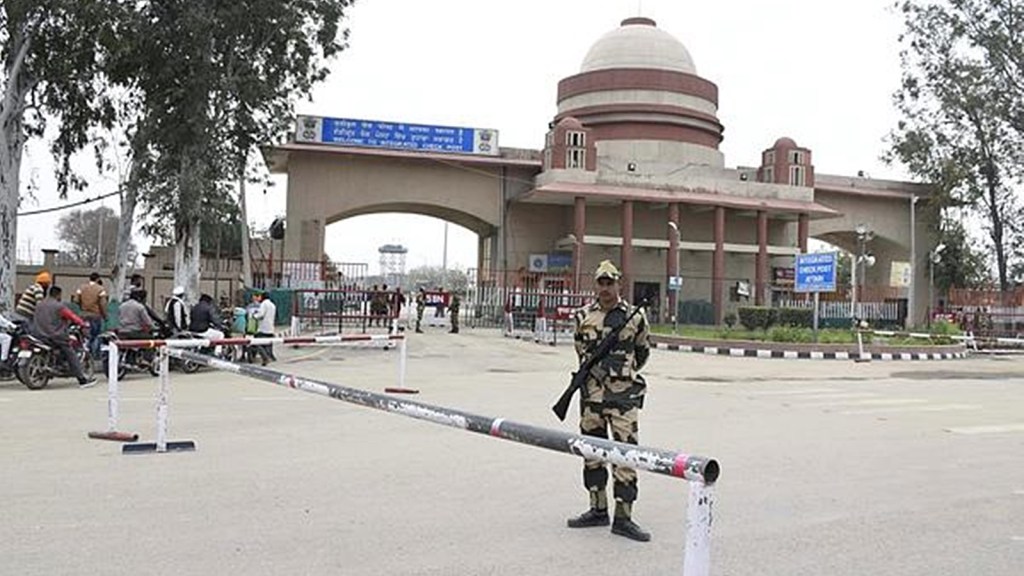
Hours after the Indian government underlined the “cross-border linkages” of the Pahalgam terrorist attack and announced that the Attari-Wagah border would be sealed, uncertainty prevailed at the Integrated Check Point (ICP) on Thursday over whether the restrictions would apply only to passenger movement or also extend to trade with Afghanistan.
“We are not sure about the status of trade with Afghanistan. Sealing the Attari border could be limited to people’s movement. There is uncertainty, and we are waiting for clarification,” an international trader who did not want to be named said.
Currently, India is only trading with Afghanistan via the Attari-Wagah border. Trade with Pakistan was suspended in August 2019 when Islamabad decided to stop the same following the abrogation of Article 370 in Jammu and Kashmir.
Meanwhile, the retreat ceremonies at the Attari-Wagah and Hussainiwala borders are likely to continue. Border Security Force sources said that there was no mention of retreat ceremonies in the statement released on Wednesday night.
Following the Pahalgam terror attack that left 26 people dead, India on Wednesday “held in abeyance” the Indus Waters Treaty, downgraded diplomatic relations with Pakistan, expelled diplomats and defence forces officials from the Pakistan High Commission in Delhi, and cancelled all visas granted to Pakistan nationals, asking them to leave in 48 hours.
The Attari-Wagah land route was first opened in 2005, and truck movement began in 2007. The ICP at Attari was inaugurated on April 13, 2012, under the then UPA government, with provisions for facilities for fast and cost-effective land trade.
Trade and passenger movement via the Attari land port has seen significant fluctuations over the last seven years.
According to official data, passenger movement across the border declined significantly over the last few years: from 80,314 crossings in 2017-18 and 78,675 crossings in 2019-20, the numbers fell drastically during the COVID-19 pandemic, plummeting to just 6,177 in 2020-21. The figures gradually improved to 71,563 crossings in 2023-24, though still below pre-pandemic levels.
According to sources, around 500 Indians are in Pakistan and are likely to return before May 1.
The trade data also reflects the impact of political tensions and global disruptions while also indicating a gradual revival in recent years.
While total trade peaked in 2018-19 at Rs 4,370.78 crore, it witnessed a sharp drop in subsequent years. In 2019-20, trade declined to Rs 2,772.04 crore, and further dipped to Rs 2,639.95 crore in 2020-21, coinciding with the COVID-19 pandemic. The lowest trade figure was recorded in 2022-23 at Rs 2,257.55 crore. However, the figures showed signs of recovery in 2023-24, reaching Rs 3,886.53 crore.
Cargo movement via Attari followed a similar trend. From over 48,000 cargo movements in 2017-18 and 2018-19, the numbers fell drastically in the following years, dropping to 6,655 in 2019-20 and further down to 3,827 in 2022-23. In 2023-24, cargo movement rose slightly to 6,871, indicating a partial resumption of trade activity.
Confusion on OCI cardholders
Meanwhile, according to sources in Pakistan, several Overseas Citizen of India (OCI) cardholders who want to return to India have been asked to wait. These include some Sikh pilgrims. Sources said that immigration officials have no clarity yet as to whether OCI cardholders could be allowed entry into India.
On Wednesday, India suspended the SAARC Visa Exemption Scheme (SVES) for Pakistani nationals, cancelled previously issued SVES visas, and asked Pakistani nationals to leave the country within 48 hours. Those Indians who have crossed over to Pakistan with valid documents will be allowed to return by May 1, the government added.
There is no clarification on whether OCI cardholders will be allowed entry into India.



 Share


