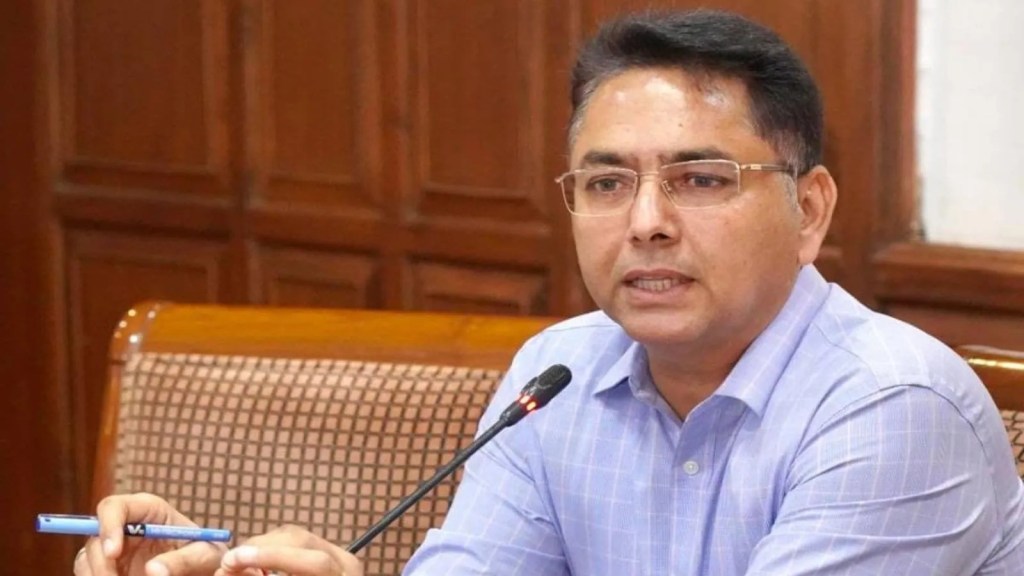
Ahead of fresh stir, Punjab proposes to hike DA of 85,000 employees to 60%

The decision to hike the DA was taken by a three-member Cabinet Sub-Committee comprising Finance Minister Harpal Singh Cheema, Industries and Commerce Minister Arora and Social Security Minister Baljit Kaur.

Aman AroraCabinet Minister Aman Arora

Punjab government will raise the Dearness Allowance (DA) of around 85,000 employees from 42 per cent to 60 per cent, at par with the Central pay pattern, Cabinet Minister Aman Arora said Friday, three days after the AAP dispensation challenged a Punjab and Haryana High Court order on the pending arrears in the Supreme Court,

The fresh decision covers employees recruited after July 17, 2020, whose basic pay is based on the Central government’s 7th Pay Commission matrix, but whose DA is based on Punjab’s pay pattern. It comes just four days before government employees are set to launch another round of agitation over pending DA instalments and arrears. Employee organisations have called for mass casual leave from September 8 if the government does not withdraw its disciplinary action notice against those who participated in the August 27 statewide strike.

The move also comes a day after the government had defended its position on the wider DA dispute, arguing that Punjab employees in several major cadres already receive salaries substantially higher than their Central government counterparts and that the state’s financial position did not permit an immediate settlement of all their demands.

The decision to hike the DA was taken by a three-member Cabinet Sub-Committee comprising Finance Minister Harpal Singh Cheema, Industries and Commerce Minister Arora and Social Security Minister Baljit Kaur. The recommendation will now be sent to Chief Minister Bhagwant Mann for final approval.

Arora said the government could not ignore the disparity faced by employees recruited after July 17, 2020. Under a change in the state’s recruitment pay structure, fresh recruits were brought under the Central government’s 7th Pay Commission pattern, resulting in lower entry-level basic pay than that enjoyed by employees governed by Punjab’s pay scales. However, their DA continued to be calculated at Punjab’s rate of 42 per cent.

“Employees recruited before July 2020 continue to benefit from Punjab’s higher basic pay scale. Employees recruited post-July 2020 were brought under the Central Pay Scale pattern but continued to receive Punjab’s DA at 42 per cent. This distinction could not be ignored,” Arora said, calling the proposal a “Janmashtami gift”.

The beneficiaries of the proposal include teachers, constables, clerks, nurses, health workers, medical officers, patwaris and junior engineers. The enhanced DA is expected to be reflected in their September salaries and will entail an additional annual financial liability of around Rs 900 crore, according to a government source.

Story continues below this ad

The government has maintained that Punjab employees in several major cadres receive 30 to 70 per cent higher salaries than Central employees because of the state’s higher pay scales. Arora, however, acknowledged that this argument was less applicable to post-2020 recruits because their entry pay was itself linked to the Central pay structure. “The situation is different for employees recruited post-July 2020. They do not enjoy the higher Punjab entry pay scales. Therefore, the argument that a lower DA is offset by a substantially higher basic pay is far less applicable to this category,” he said.

The timing of the decision is politically significant. On Thursday, Arora and Cheema had sought to defend the government’s position on the DA issue, even as the state had moved the Supreme Court against the High Court ruling. The government has been reluctant to make a one-time payment of the accumulated arrears, citing its financial position, and has been exploring ways to spread the burden.

The concession, however, has failed to satisfy employee organisations, which described it as an attempt to divide the workforce.

“This is a divide-and-rule policy of the government. They think that they can break away 85,000 employees from us. However, this will not happen,” said Sukhchain Singh Khaira, convener of the Joint Employees Front.

Story continues below this ad

Khaira said employees were demanding implementation of Punjab Pay Scale rules by withdrawing the July 17, 2020 notification that shifted new recruits to the Central pay structure. “Still, we are thankful that the government has enhanced the DA of 85,000 employees,” he said, adding that the unions would announce their next course of action on Monday.

The wider dispute involves more than three lakh government employees demanding release of pending DA instalments and arrears, including the 18 per cent DA they claim remains unpaid. The employees had gone on a statewide strike on August 27, disrupting government functioning and suspending several public services. The government subsequently issued a notice seeking details of employees who were absent from duty, prompting the unions to announce the September 8 mass casual leave call. They have given the government until September 7 to withdraw the notice.

The DA decision is also likely to carry political weight with the Punjab Assembly elections due next year. While the government has managed to address the immediate disparity affecting post-2020 recruits, the much larger question of pending DA and arrears for the wider employee community remains unresolved.

Taking a swipe at the Opposition, Arora also targeted Congress and BJP leaders who have invoked Article 14 of the Constitution while demanding pay parity for Punjab employees. “If they truly believe in Article 14, let them first ask their own state governments to bring their employees’ pay and allowances at par with the Central pay scales before preaching to Punjab,” he said.


Kanchan Vasdev is a Senior Assistant Editor in The Indian Express’ Punjab bureau. She is a highly experienced journalist with 22 years of expertise covering high-stakes politics, governance, and social issues in Northern India. Professional Background Role: Primary reporter covering the Punjab Chief Minister’s Office (CMO), government policies, and the Aam Aadmi Party (AAP) leadership in the state. Experience: She previously worked with The Tribune and has played a key role in launching various city editions. Special Projects: Abandoned Brides: Authored a monograph on brides abandoned by NRIs as part of the Prabha Dutt Memorial Fellowship. Environment: Worked as a Centre for Science and Environment (CSE) fellow, focusing on the pollution levels in the Satluj river. Recent Notable Articles (Late 2025) Her recent reporting focuses on the legislative strategies and political maneuvers of the Bhagwant Mann-led Punjab government: 1. Legislative & Governance Standoffs "Punjab govt advances special Assembly session to pass resolution against VB-G RAM G Bill" (Dec 20, 2025): Reporting on the state's move to block the Centre's "Viksit Bharat" mission, which the state claims will undermine MGNREGA. "Punjab govt doubles down on special sessions, sixth in January" (Dec 19, 2025): Detailing the AAP government's use of special sessions as a legislative tool amid tensions with the Governor. "Punjab asks 'VIP teachers' working near Chandigarh to go back to border districts" (Dec 16, 2025): Reporting on CM Mann's move to end the practice of influential teachers avoiding postings in remote areas. 2. Political Analysis & Rural Polls "Punjab rural polls: Why Akalis are likened to dinosaurs in Punjab" (Dec 19, 2025): Analyzing CM Bhagwant Mann's rhetoric against the Shiromani Akali Dal (SAD) following local body elections. "AAP claims win in 78% Punjab zila parishads as counting continues" (Dec 18, 2025): Breaking down the results of the 2025 rural elections. "Rahul Gandhi and Sidhu alike, says Bhagwant Mann" (Dec 13, 2025): Covering the CM's critique of the Congress leadership. 3. Law Enforcement & Bureaucracy "Suspended Punjab IPS officer Ravjot Kaur Grewal awaits reinstatement" (Dec 10, 2025): Investigative reporting on the bureaucratic red tape involving the Election Commission and the state government. "Punjab declines to give parole to Amritpal Singh" (Nov 27, 2025): Detailing the state government's refusal to grant parole to the radical preacher and sitting MP. 4. Welfare & Economy "Punjab government's plan to add more freebies to 'atta-dal' scheme hits funds roadblock" (Dec 4, 2024): An analysis of the fiscal challenges facing the state's flagship food security program. "Mann leads Punjab delegation to Japan and South Korea for investor outreach" (Dec 2, 2025). Signature Beat Kanchan Vasdev is known for her insider access to Punjab's political executive. Her writing provides deep insights into how state policies are formulated and the friction points between the state government and central authorities. Her dual expertise in environment and law allows her to report on complex issues like the "Farmhouse Policy" (Dec 18, 2025) and river pollution with a unique policy-oriented lens. X (Twitter): @kanchan99 ... Read More

Stay updated with the latest - Click here to follow us on Instagram

Advertisement
Loading Recommendations...
Advertisement
Advertisement
Latest Comment
Post Comment
Read Comments