


Stay updated with the latest - Click here to follow us on Instagram

Journalism of Courage
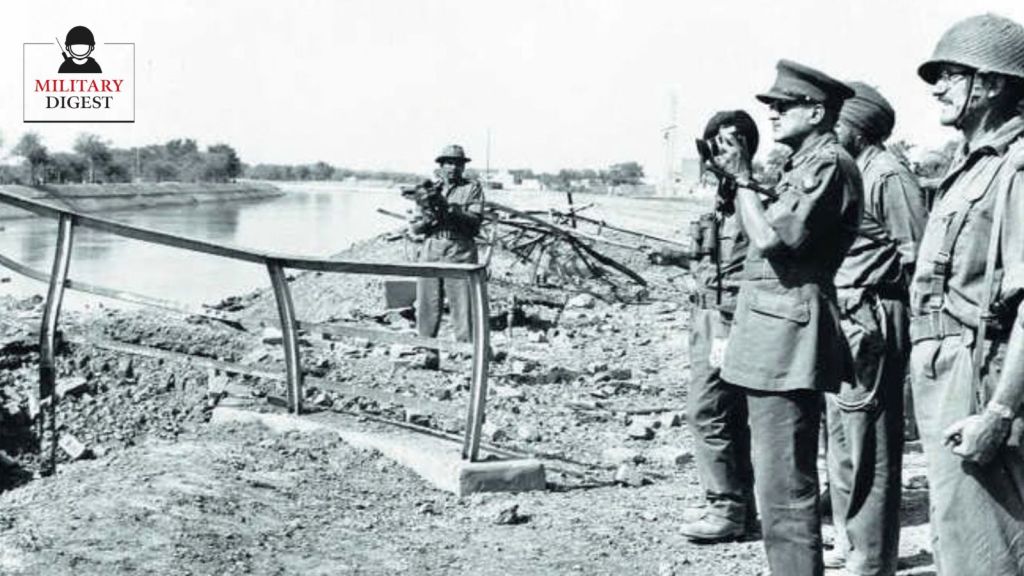 Indian Army officers on the east bank of the Ichhogil canal after the ceasefire in the 1965 war.
In any conflict, there are many stories that never get written or are forgotten in the years that follow. There are versions and counter-versions that make it into books written by military authors and combatants themselves, but there are also narratives that more reticent individuals never make public.
In this week’s column, we will hear the words of a veteran who was deeply involved in the military operations of the 1965 war with Pakistan and died two decades ago. More than 20 years ago, while writing on the 40th anniversary of the war, this writer had the opportunity to interview Maj Gen Narinder Singh (retd), who served as the director of military operations (DMO), now known as director general of military operations (DGMO), during the war. The general, then in his mid-80s, recalled certain points that shed light on several events before and after the commencement of operations in the war.
Maj Gen Narinder was DMO in the rank of brigadier and recalled accompanying then Chief of Army Staff Gen JN ‘Muchhu’ Chaudhuri on his tour of Western Command formations well before the war broke out. The formations had already been mobilised, and it was in June or July 1965 that the Army chief visited the headquarters of 11 Corps and the headquarters of the 4 Mountain Division, 7 Infantry Division, 15 Infantry Division and 26 Infantry Division, he recalled.
Command tensions before the war
“There were a lot of airy-fairy briefings at some of the division headquarters, which left the Western Army Commander Lt Gen Harbaksh Singh visibly upset,” Maj Gen Narinder recalled. He also remembered the general officer commanding (GOC) of the 15 Infantry Division, Maj Gen Niranjan Prasad, at the Amritsar airfield carrying a bundle of papers and trying to speak to the Army chief. That bundle was perhaps his representation regarding his removal from command of a division in the Northeast during the 1962 war, which he was carrying with him even during the battle and which was captured by the Pakistan Army along with his jeep in the offensive in the Lahore sector later in the war,” said the former DMO. “Back at the 11 Corps headquarters, we were all sitting together and talking when the Army commander told the chief that he wanted some division commanders changed before the war broke out,” recalled Maj Gen Narinder. He further said the demand annoyed the chief, who retorted, “Who should I get to fight the war? Do you want me to ask the British to come back and fight the war for us?” Nothing more was said on the subject, as per Maj Gen Narinder.
The then Western Army commander, Lt Gen Harbaksh Singh, wrote in his book, War Despatches, that a meeting with the chief of the Army staff (COAS) took place in Jalandhar on May 14-15, 1965. He wrote that the COAS asked him to examine the possibility of using the 1 Armoured Division and the 6 Mountain Division for a limited offensive into the Shakargarh salient from the general area of Samba.
Lt Gen Harbaksh, however, thought that it would be better to launch the two divisions through the Nainakot and Narot crossings over the Ravi river. The COAS ruled him out.
Setback in Khemkaran
The former DMO also shared interesting information about how the Army headquarters learnt about the Pakistani breakthrough in the Khemkaran sector and the setbacks suffered by the 4 Mountain Division. He said that a senior staff officer in Army headquarters looking after logistics had been despatched to the 11 Corps area of operations and saw first-hand what happened in the general area of Khemkaran. According to Maj Gen Narinder Singh, this officer telephoned the Army headquarters and informed them about the unfolding Pakistani offensive. “We were taken aback getting this news,” said Maj Gen Narinder.
The former DMO was also critical of the conduct of some brigade-level formations and battalions that he felt had not dug in and shown resilience in the face of counter-attacks by the Pakistan army. “One battalion that had crossed over to the western bank of Ichogil canal and captured Pakistani defences by routing them promptly returned to the east bank when attacked by some Pakistan air force planes. The unit’s officers had sat down for a nice breakfast on the west bank with white sheets laid out on the table and all finery. The battalion needed to stay entrenched on the west bank and firmly occupy it,” he recalled.
Maj Gen Narinder Singh was commissioned into 8 Cavalry in 1942 and later commanded 20 Lancers. His other assignments included commanding the 163 Infantry Brigade in Ladakh and serving as GOC of the 19 Infantry Division in Baramulla and the GOC of the Srinagar sector. He later served in the Border Security Force after retiring from the Army and served as the Inspector-General (Operations) at the BSF Headquarters during the 1971 India-Pakistan war. He went on to serve as the IG (Kashmir) in the BSF before finally hanging his boots. He died in October 2005 aged 86.
Stay updated with the latest - Click here to follow us on Instagram