


Stay updated with the latest - Click here to follow us on Instagram

Journalism of Courage
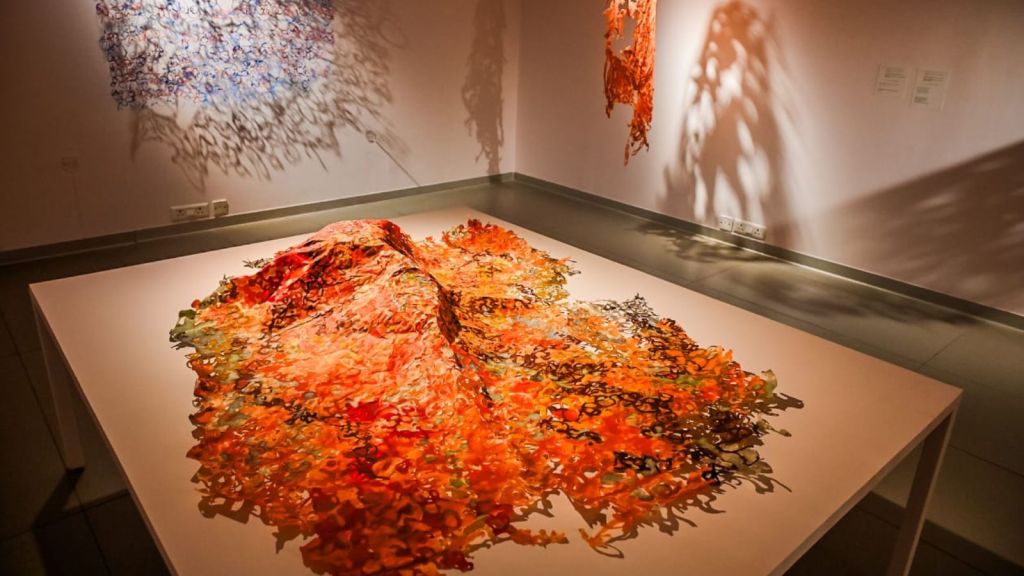 "We don’t end at our edges" is an immersive exhibition featuring artworks by Bengaluru-based artist, writer and educator Ravikumar Kashi at MAP Bengaluru.
(Express photos by Jithendra M.)
When thinking of art, one might not consider paper as a source of inspiration. But at the Museum of Art and Photography’s latest exhibition, the artworks on display are composed entirely of paper pulp from various materials. The displays are the brainchild of Bengaluru artist Ravikumar Kashi, who has been working in the medium of paper art for decades.
Early on, Ravikumar Kashi studied making paper by hand in 2001 at the Glasgow School of Art, later studying Korean-style hanji papermaking at the Jang Ji Bang papermill in South Korea. Visitors may note the influence of the Kannada language in some of his artworks on display. Kashi, whose work has been exhibited across the world, also received the Karnataka Sahitya Akademi Award in 2015 for Kannele, a Kannada book on art.
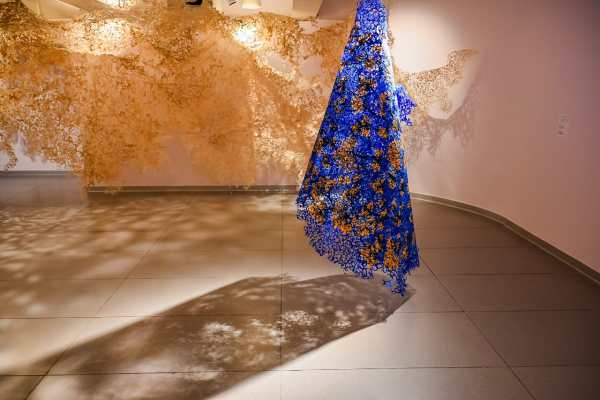 “We don’t end at our edges” is an immersive exhibition featuring artworks by Bengaluru-based artist, writer and educator Ravikumar Kashi at MAP Bengaluru. (Express Photo by Jithendra M)
Speaking to indianexpress.com, Ravikumar Kashi said, “I work with the pulp stage. Normally a lot of artists work on ready paper. If I want to make it smooth or rough, translucent or opaque, all that kind of controlling happens in the pulp stage. Once the pulp is ready, I ‘paint’ it onto a plastic surface and it becomes a separate piece as it dries up.”
The delicate paper structures on display at the exhibition defy easy description: while some bear elements of recognisable themes such as Kannada lettering, others are not quite as easy to pin down, aside from a brief placard noting some of the artist’s thoughts before the artwork was made. This is an aspect that Kashi seems to have embraced; he prefers to let the viewer come to their own understanding of what the art is about. The exhibits are composed of a mix of cotton fibres, paper derived from Daphne plants in the Himalayan belt, and hanji.
With regard to some of his work incorporating Kannada, he said, “The idea is not to let the visitor read the language but to invoke the idea of language, which is porous and allows things to come in and go out. When I say we don’t end at our edges – we think that skin is the end. But it is so porous that things can go in and come out.”
Even the orientation of a display can change what one perceives from it. One of the displays might give a very different impression in alternative lighting and spaces, he said.
The displays also include a book featuring various materials that Ravikumar Kashi has worked with, complete with Braille labelling for visually impaired visitors. The book is intended to showcase the textures and feel of these materials, such as paper made from onion skin or banana fibres.
The exhibition opened on the ground floor of the museum on March 8 and will end on June 15.
Stay updated with the latest - Click here to follow us on Instagram