


Stay updated with the latest - Click here to follow us on Instagram

Journalism of Courage
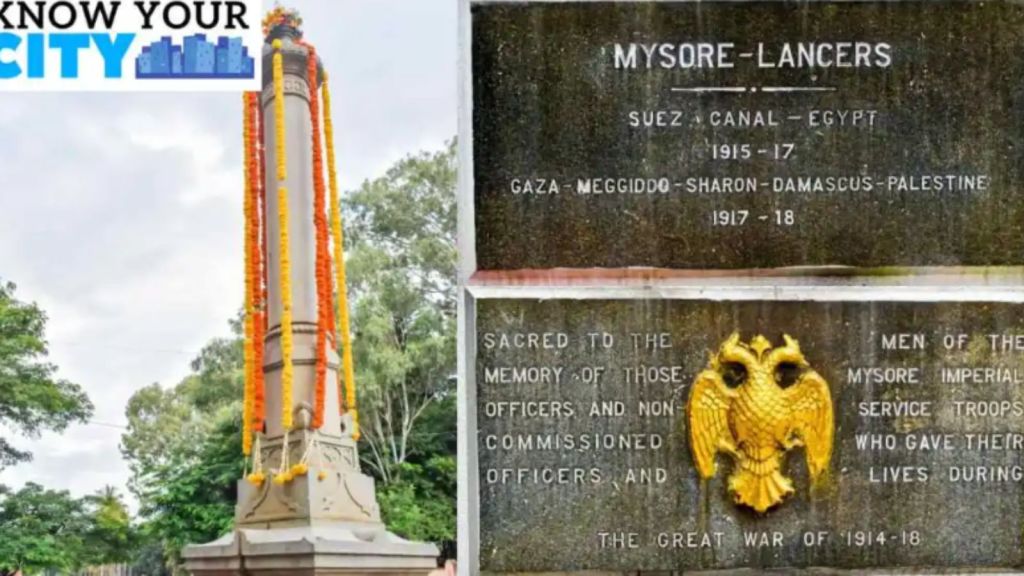 The memorial to the Mysore Lancers in Bengaluru. (Express photo)
A sharp lance in hand may seem a poor weapon when put up against bolt-action rifles and machine guns. Yet it was these weapons the horsemen of the ‘Mysore Lancers’, on behalf of the British, drove home in battle against Ottoman forces during World War I, on September 23, 1918, with little help but their own mastery of horsemanship.
In one of the final successful open-warfare cavalry charges in history, the Indian horsemen operating under the 15th (Imperial Service) Cavalry Brigade, from the princely states of Mysore and Jodhpur, captured the strategic port city of Haifa in modern Israel (Haifa was part of British Palestine after WW1) from the Ottoman Empire as part of the British Army’s Palestine Offensive.
This was already the twilight of the horse in open warfare.
Horsemen from today’s Karnataka and Rajasthan – in the form of the Mysore and Jodhpur Lancers, raised by the rulers of the then princely states thus led one of the final successful cavalry attacks during the period. The Mysore contingent was led by Colonel Desaraj Urs. Interestingly, Colonel Urs was also the first Indian permitted into the Bangalore Club — then a military club.
Contrary to the theories of many generals before 1914, there were very few situations in the battlefields of this war where horsemen could be put to effective use. They needed enough space to maneuver, and ground that was relatively unobstructed. They were faced with increasingly efficient firearms, as the various types of modern machine guns were put to use on the battlefield for the first time.
While horses would still be used for transport in World War 2, the few cavalry charges of World War 1 were their last showing in open warfare.
It was in the dying days of the First World War, then, that these horsemen would cover themselves in glory at Haifa on September 23, 1918. The direct attack on the Ottomans defending Haifa and the capture of the city itself would fall to the Jodhpur Lancers. This was a difficult task in itself. However, it was complicated by a strong defensive position of the Central Powers on the nearby Mount Carmel. Austrian and German forces had set up an artillery position here, with 77 mm light field guns. The defenses of Haifa itself also included 10 machine gun positions covering the approaches to the town.
To learn what happened, we may refer to the writings of the overall commander, General Edmund Allenby, and his dispatches back to headquarters. He recorded at the time, “Some two miles before Haifa is reached, the road is confined between a spur of Mount Carmel on the left, and the marshy banks of the River Kishon and its tributaries on the right. When the 5th Cavalry Division reached this point on September 23, it was shelled from the slopes of Mount Carmel, and found the road and the river crossings defended by numerous machine guns.”
What could have been a long-drawn affair was swiftly resolved by the Indian cavalry of the 15th. The Jodhpur Lancers overran the machine gun positions and broke through into Haifa itself. They were able to do this because of a Mysorean attack on the mountain against the German and Austrian positions. General Allenby records, “A squadron of the Mysore Lancers was sent over Mt Carmel at the same time to turn the town from the south. They captured two Turkish naval guns mounted on the ridge of Carmel and also made a gallant charge in the face of heavy machine-gun fire. The Turks made a very stubborn defence at Haifa, and, but for the … 15th (Imperial Service) Cavalry Brigade, might have held out for a considerable time.”
Once the Mysore and Jodhpur forces had mopped up their foes, 17 artillery guns were captured as well as over a thousand Ottoman soldiers.
The Indian cavalry had performed very well, enough that their valour was recognised at Parliament in London. The Earl of Mayo (a descendant of that same Lord Mayo who Mayo Hall is named after) rose on May 21, 1919, to inquire why they were not given more credit, saying, “I do not suppose that any more brilliant campaign was ever carried out before. General Allenby marched as a conqueror into Jerusalem. What I should like to ask is why the Indian Cavalry did not get sufficient credit for what they had done. They fought the Turk, and they beat the Turk….” He was politely rebuked by the Viscount Peel, who stated that the Indian horsemen had been given high praise and honours, including mentions in several dispatches by General Allenby.
Today, memorials to the victory at Haifa stand both in Haifa and Bengaluru, and are the site of memorial events on most anniversaries of the event – such as this Wednesday. The successor unit of both the Jodhpur and Mysore Lancers survives to this day in the Indian Armed Forces in the form of the 61st Cavalry Regiment, one of the last military units in the world that still includes mounted soldiers. Their regimental emblem is derived from the Gandaberunda bird, the royal Mysore symbol, which still represents Karnataka in many places today.
Stay updated with the latest - Click here to follow us on Instagram