


Stay updated with the latest - Click here to follow us on Instagram

Journalism of Courage
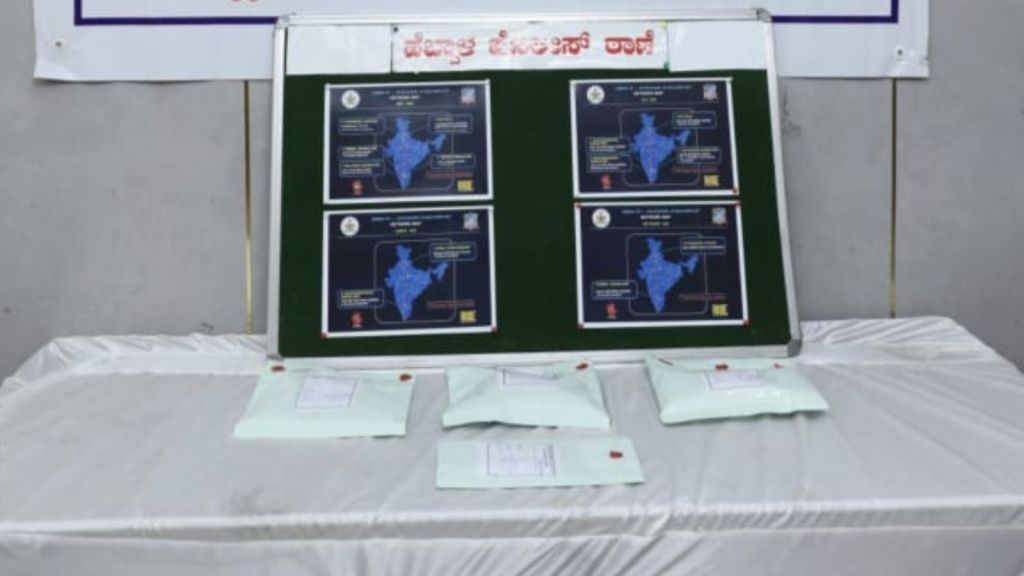 The Bengaluru police display some of the drugs seized in the latest operations. (Photo by special arrangement)
The Bengaluru police arrested six people, including a foreign national and three people from outside Karnataka, and seized 5.48 kg of MDMA worth Rs 10.96 crore in three operations in Girinagar, Hebbal, and Vidyaranyapura, officials said Tuesday.
The police said the accused sourced the synthetic drug from foreign countries, other states, and different parts of Karnataka and sold it to customers, including college students.
The arrests come amid an intensified anti-narcotics drive in the city. Police Commissioner Seemant Kumar Singh said that 79.5 kg of MDMA and 1,000 ecstasy tablets, collectively valued at Rs 161 crore, were seized between April and September.
The police seized 35.7 kg of MDMA in 2024. In 2025, more than 17 kg had been seized in the first six months, while a further 10.36 kg was seized in three Central Crime Branch (CCB) operations by December. This year, the police seized 79.5 kg of MDMA between April and September. The 2026 seizures include 17.5 kg recovered in May and 21.6 kg seized during an August crackdown.
MDMA comes mostly from Delhi-NCR
Police officers said ganja continues to account for a substantial share of the drug trade in Bengaluru and elsewhere in Karnataka. Investigations have traced ganja consignments to the Northeast and other parts of the country, with drugs being brought into the city through interstate road and rail networks. In one recent case, the CCB seized around 300 kg of ganja while investigating an interstate supply network.
The quantity of ganja seized has fluctuated. The Bengaluru police seized 3,746 kg of ganja in 2022, rising to 5,252 kg in 2023 before falling to 1,849 kg in 2024. The decline in conventional ganja seizures has coincided with a growing focus on synthetic drugs.
MDMA is generally transported in smaller consignments because of its higher value. Police investigations have repeatedly identified Delhi and the National Capital Region as sources of the drug being brought to Bengaluru. In May, the police seized 17.5 kg of MDMA worth nearly Rs 35 crore and found that it had allegedly been procured in Delhi.
Investigators have also found synthetic drugs being moved through railway and parcel networks. The Directorate of Revenue Intelligence has intercepted passengers carrying synthetic drugs at the KSR Bengaluru railway station, while police investigations have identified consignments being brought into the city by road.
Unemployed men hired as carriers
According to a senior police officer, drug networks that earlier relied on flights and subsequently trains are now increasingly using buses to move consignments, making it harder for investigators to identify the movement of drugs.
The police have also found that suppliers often avoid transporting the drugs themselves and instead recruit carriers for individual consignments. Investigators said financially vulnerable and unemployed young men, including some from the Delhi-NCR region, have been hired for the job, with some being paid Rs 30,000 to Rs 40,000 per trip.
Once the consignments reach Bengaluru, local associates allegedly receive them and pass them on to peddlers for distribution. The police said some Nigerian nationals suspected of involvement in the trade have contacts who help receive and distribute drugs across the city.
The police have also found cases where Bengaluru served as a transit point, with consignments being moved onward to other districts in Karnataka and neighbouring states.
Distribution hub for hydroponic cannabis
The sourcing pattern differs for other narcotics. Investigations into opium cases have traced supplies to Rajasthan, while ganja has been linked to multiple source regions. Investigators are also examining international parcels suspected to contain high-potency cannabis originating overseas.
Alongside conventional ganja, Bengaluru has also seen a significant inflow of hydroponic cannabis through international routes. Bengaluru Customs seized 858 kg of hydroponic ganja in 114 cases at Kempegowda International Airport during 2025-26 up to February 13, with most cases linked to flights from Bangkok. In October 2025, the Narcotics Control Bureau’s Bengaluru unit seized 45.4 kg of hydroponic ganja in an operation involving passengers travelling from Thailand via Colombo. More seizures have followed this year, including 26.2 kg in April and 10.2 kg in June by Customs.
Senior officers said these investigations indicate that Bengaluru is not only a destination for narcotics but also a distribution and transit hub.
From consumers to supply chain
As part of the anti-narcotics investigation, the Bengaluru police are increasingly using information obtained from consumers to trace peddlers and suppliers.
The police said questioning consumers can help investigators establish how drugs are ordered, whom they are purchased from, how payments are made and where they are delivered. This information can then be used to move further up the supply chain, from consumers to peddlers and local distributors and eventually to the suppliers.
“Consumers are victims of drug abuse. We see them as people who need help and, wherever possible, we send them for rehabilitation. But while dealing with them, we have also understood that the distribution network is much larger than what it appeared to be,” Raja Imam Khasim, Deputy Commissioner of Police (Crime), Bengaluru, told indianexpress.com.
The police said the profile of consumers also differs across substances. MDMA is increasingly being encountered in cases involving young working professionals and college students, while ganja has a wider consumer base. Cocaine, according to the police, continues to be seized from relatively affluent consumers. Officers, however, cautioned that these observations are based on police investigations and seizures and do not by themselves indicate the overall prevalence of drug use in the city.
The police registered 32 cases against drug consumers in 2024. The number increased to 900 in 2025, and stood at 2,951 as of August 23, 2026. Cases against peddlers stood at 498 in 2024, 501 in 2025, and 474 as of August 23, 2026.
The overall number of Narcotic Drugs and Psychotropic Substances (NDPS) Act cases rose from 530 in 2024 to 1,401 in 2025 and 3,425 as of August 23, 2026.
Synthetic drugs drive up seizure value
The changing nature of the drug market is also reflected in the value of narcotics seized across Karnataka. The police seized 6,666.12 kg of narcotics worth Rs 102.02 crore in 2024 and 7,421.88 kg worth Rs 174.88 crore in 2025. In 2026, they have seized 5,256.94 kg so far, with the value estimated at Rs 280.755 crore.
While the quantity seized so far in 2026 is lower than the previous year, the value is considerably higher, with seizures including a larger share of high-value synthetic drugs.
Bengaluru accounted for 4,027 of Karnataka’s 6,406 NDPS cases in 2022 and 3,443 of the state’s 6,764 cases in 2023. More recent data shows the state recorded 4,148 convictions in NDPS cases in 2023, 2,078 in 2024, and 2,600 in 2025, while 730 convictions were reported between January and May 2026.
The police have also been using information from the public through initiatives such as Operation RISE and Beda Bro to identify drug activity and trace the networks behind peddlers.
Stay updated with the latest - Click here to follow us on Instagram