Last week, hundreds of dead fish were found floating in the Seetharampalya lake. Experts cited the entry of untreated sewage into the lake as one of the major reasons behind fish kill.
It is the fourth incident of fish kill to have happened this year. Similar incidents took place at Kothnur lake twice and once at Iblur lake this year.

Located in Hoodi, the 25 acre Seetharampalya lake was rejuvenated in 2015 by the Bangalore Development Authority (BDA) with the help of a private company.
Raghavendra B Pachhapur, senior lead projects with NGO ActionAid Association, said 102 species of birds have visited the lake in the last 10 years. Acting on his complaint, the Karnataka State Pollution Control Board (KSPCB) collected the water samples of the lake for a detailed analysis. This would reveal the reason behind fish kill.
“Three nearly threatened species (IUCN 3.1) — painted stork, oriental darter and black-headed ibis are the lake’s visitors. It has a fairly good diversity of bird species. I have registered a case of fish kill with the KSPCB. The officials from KSPCB’s office at Mahadevapura responded and collected water samples. I am awaiting a detailed water quality analysis,” he said.
Sewage entry into lakes has been the major reason for death of fish across lakes in Bengaluru. (Express Photo by Jithendra M)
“Shockingly, we have noticed smaller fish dying at Seetharampalya Lake, which hints at lack of dissolved oxygen in the lake water. It seems sewage has been continuously entering the lake for a long period resulting in eutrophication and algal formation (water colour changing to green),” Pachhapur added.
He opined that sewage entry into lakes has been the major reason for death of fish across lakes in Bengaluru. In 2022, he documented 16 fish kill incidents in the city lakes.
The monthly water quality report of the lakes by the KSPCB stated that the water quality at Seetharampalya has been poorly managed. “In the last 36 months, it has been noticed that 19 times the lake has been under Class-D (fit for propagation of wildlife and fisheries) and 17 times under Class-E (water suitable for industrial cooling and irrigation). Death of fishes could have been averted at the lake if there was better coordination between Bruhat Bengaluru Mahanagara Palike (BBMP) and KSPCB,” he added.
The monthly water quality report of the lakes by the KSPCB stated that the water quality at Seetharampalya has been poorly managed. (Express Photo by Jithendra M)
According to the BBMP, the Seetharampalya Lake will be restored this year. “We have plans to carry out development works at more than 60 lakes and Seetharampalya Lake is one of them,” a BBMP official said.
Pachchapur also added that the BBMP has failed to monitor the water quality of the lakes. “They don’t have mechanisms to monitor inlets. The palike also fails to act swiftly when informed by the local communities that sewage is entering the lake. Kothanur lake is a classic example,” he said.



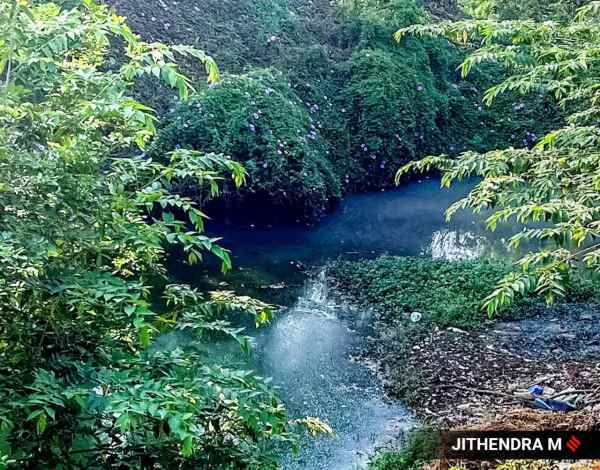 Sewage entry into lakes has been the major reason for death of fish across lakes in Bengaluru. (Express Photo by Jithendra M)
 The monthly water quality report of the lakes by the KSPCB stated that the water quality at Seetharampalya has been poorly managed. (Express Photo by Jithendra M)

 Share


