


Stay updated with the latest - Click here to follow us on Instagram

Journalism of Courage
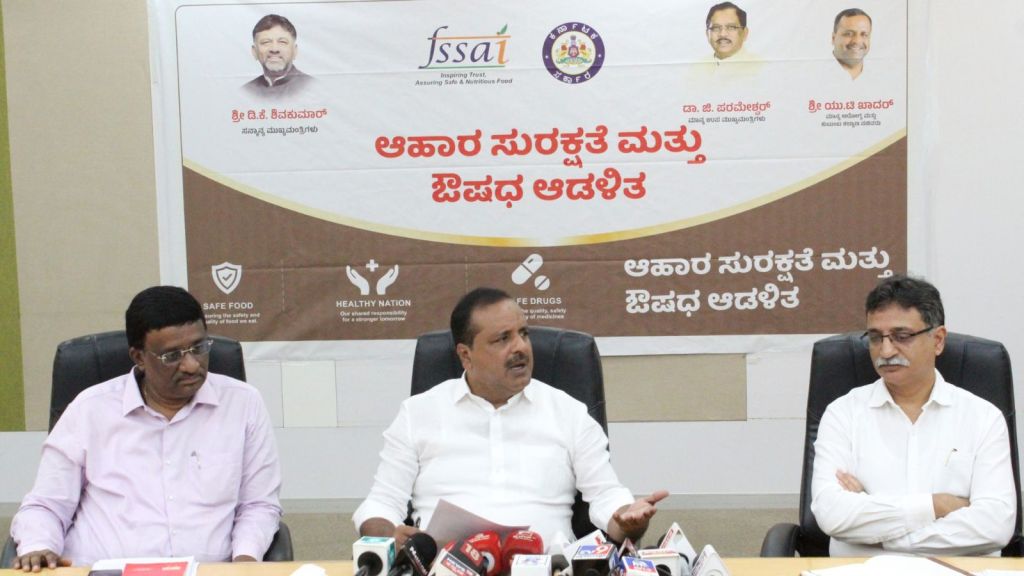 Karnataka Health Minister U T Khader, while addressing the press, said that the FDA has found that hospitals across the state are billing patients, including those undergoing cancer treatment, up to 52 times what the drugs actually cost to procure. (Express photo/Special Arrangement)
A patient admitted to a private hospital in Karnataka was billed Rs 4,528 for Gufipol—an antibiotic with a landing cost of just Rs 80 — marking a 5,165 per cent price jump. Gufipol is among scores of high-value medicines sold at exorbitant prices to in-patients, according to a verification drive by Karnataka’s Food Safety and Drug Administration (FDA).
Addressing a press conference on Thursday, Health Minister U T Khader said that the FDA has found that hospitals across the state are billing patients, including those undergoing cancer treatment, up to 52 times what the drugs actually cost to procure, and the state government has written to the Union Health Ministry seeking urgent national-level intervention.
He said, “The findings emerged from inspections of hospitals treating cancer, where high-cost drugs are routinely used. According to the FDA, pharmaceutical companies supply medicines to hospitals at heavily discounted institutional, or “landing,” prices, but patients are then billed at or near the printed Maximum Retail Price (MRP) — resulting in markups ranging from 10 times to over 52 times the actual procurement cost.”
Nebuliser mask, IV set too in blacklist
Apart from Gufipol, other sharp disparities cited were Guficycline-50 injection that costs Rs 160 but is billed at Rs 7,110 (44.4 times); and Terlitis that costs Rs 118 against an MRP of Rs 4,416 (37.4 times). Even commonly used hospital consumables showed steep markups: an adult nebuliser mask costing Rs 44.50 is billed at Rs 950 (21.3 times), and an IV set costing Rs 14.75 is billed at Rs 295 (20 times).
In a letter dated September 23, Khader wrote to the Union Health Minister, seeking national action against what the state called exorbitant patient billing, and provided details of 253 drugs showing extreme pricing anomalies.
Demands sought by state
U T Khader said that they have asked the Centre to mandate that hospitals display both landing cost and MRP on patient bills, expand the list of drugs under price control, regulate trade margins on high-value medicines and consumables, set up an inter-ministerial expert group, and commission a national data study. It has also sought amendments to the Drugs (Prices Control) Order, 2013, an expanded National List of Essential Medicines, treatment of all back-end discounts as part of acquisition cost, and a dedicated audit and enforcement mechanism.
While scheduled drugs under the Drug Price Control Order (DPCO) have ceiling prices fixed by the National Pharmaceutical Pricing Authority with a capped 16 per cent retailer margin, non-scheduled drugs carry no ceiling on trade margins, leaving the manufacturer-printed Maximum Retail Price (MRP) as the only legal upper limit.
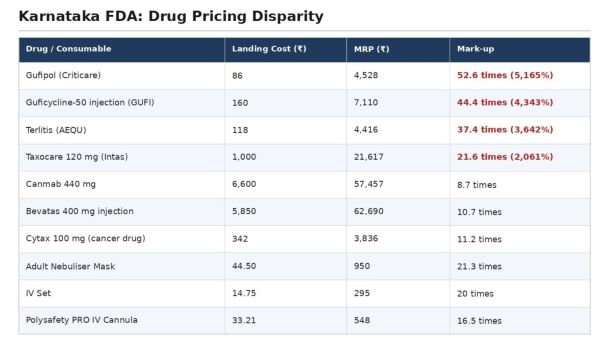 FDA’s list of medicines showing huge disparity in pricing
Limited control on medical devices, consumables
Medical devices and consumables face limited price control, and hospital pharmacies are not required to pass on institutional discounts to patients, he added.
The report was released after drug enforcement officers across Karnataka conducted a special verification drive on September 25 and 26 at wholesale premises, hospitals and other establishments in Bengaluru and across the state’s districts.
Preliminary findings again pointed to substantial differences between landing cost, MRP and actual sale price at various points in the supply chain. The drive covered more than 768 consumable items and 189 high-cost drugs, and the findings will be shared with the Central Government.
Verification exercise to continue
The department said it will continue the verification exercise in phases, with the next round focusing on antiretroviral drugs, higher-generation and critical antibiotics, medical devices, and hospital consumables with significant financial implications for patients.
The state government said hospitals and pharmaceutical establishments are expected to maintain complete transparency in billing and ensure patients and their families receive proper information about what they are being charged for medicines, devices, and consumables.
“Affordability of essential and life-saving healthcare is a matter of serious public importance, and the Government of Karnataka will take all measures available within its jurisdiction to protect patients from unjustified financial burden,” Khader said.
Stay updated with the latest - Click here to follow us on Instagram