


Stay updated with the latest - Click here to follow us on Instagram

Journalism of Courage
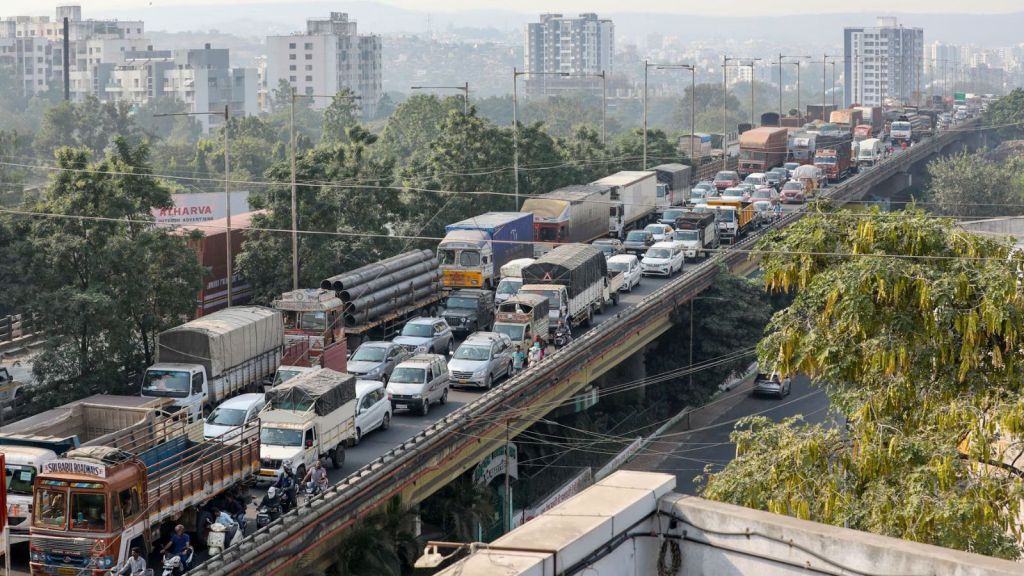 The Hebbal tunnel project in Bengaluru may require felling 1,139 trees (File photo).
Days after the Indian Institute of Science (IISc) published a report stating that the proposed short tunnel at Hebbal Junction in Bengaluru will not resolve traffic congestion but relocate it to new choke points, a study by a professor at the Indian Institute of Technology (IIT) Bombay has recommended constructing the tunnel along with a flyover.
In his study for Rithwik Projects Private Limited, Prof Archak Mittal of IIT Bombay examined the road network around Mekhri Circle, Ballari Road (NH 44), CBI Junction, Veterinary College and the Hebbal interchange—an area that funnels traffic from the airport and Yelahanka, the city centre, Yeshwanthpura, and K R Puram onto the surface roads.
The report stated 32,770 vehicles pass through Hebbal Junction and 28,493 through Mekhri Circle between 9 and 10 am. Converted to standard traffic units, this works out to volume-to-capacity ratios of 2.65 and 2.14 at key movements—meaning demand is more than double what the roads can actually handle.
According to the report, speed surveys painted an even starker picture: traffic between Anand Nagar and Hebbal crawled at an average of 4.29 kmph, and the stretch from Esteem Mall to the Hebbal down ramp near Baptist Hospital averaged just 3.57 kmph— barely faster than walking pace.
The report of the “integrated traffic microsimulation study” says the flyover and tunnel would work best as complementary rather than competing projects, since each can absorb the traffic the other cannot handle during peak periods, and recommends building both together. It cautions, however, that the benefits depend on actually getting a large share of drivers to divert onto the new routes—which will require good signage, lane design at the tunnel approach and ramps, and careful management of where the two facilities feed traffic back onto surface roads. If only one project can go ahead first, the study recommends prioritising the elevated corridor, since it delivers the larger share of the benefit on its own.
The report also recommends increasing the separation between the bridge and tunnel structures to at least 250 metres, and calls for further studies—including a proper origin-destination survey, evening peak-hour data, and pedestrian and traffic counts—to sharpen the analysis before final design decisions are made.
The report also said that an elevated corridor running 1.78 km from Mekhri Circle to Veterinary College, Hebbal, with four lanes and four entry/exit ramps, tying into a rotary at Mekhri Circle and an underground tunnel, about 2.2 km long, offering three lanes for bidirectional traffic between the Hebbal flyover junction and Veterinary College via the Gandhi Krishi Vignana Kendra campus, aimed mainly at local and medium-distance trips, would complement each other.
Rather than treating these as rival options, the study modelled them as a single integrated system, since vehicles would be able to choose between the surface roads, the elevated corridor and the tunnel depending on which route was faster, the report said.
‘Biased in favour of building tunnel and elevated corridor’
The IISc Sustainable Transportation Lab called Professor Mittal’s report “biased in favour of building a tunnel and an elevated corridor”. It said the report did not consider the fact that the flyover will reduce the capacity of the existing road because its piers will occupy part of the roadway.
Ashish Verma of the IISC’s Department of Civil Engineering said the report’s recommendations provide “extremely limited relief and add to the new congestion points”. “Furthermore, the recommendations are not scientifically supported by the microsimulation model’s results due to methodology gaps and inconsistencies in data and results. The suggested provision for a 250m gap between the elevated corridor and the tunnel is also not supported by any scientific approach in the report,” he said.
Stay updated with the latest - Click here to follow us on Instagram