


Stay updated with the latest - Click here to follow us on Instagram

Journalism of Courage
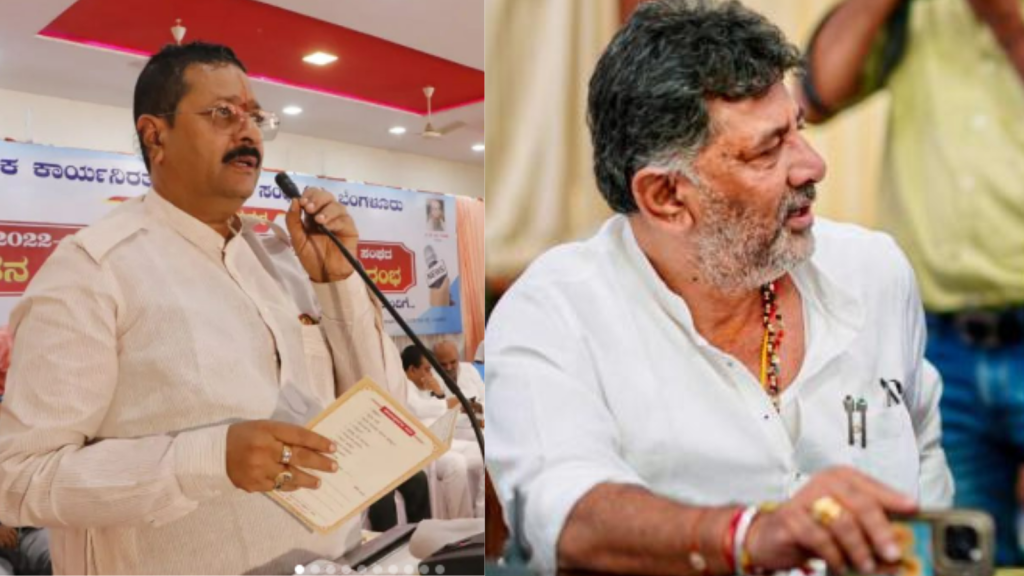 BJP MLA Basanagouda Patil Yatnal (right), Deputy Chief Minister D K Shivakumar (left). (Photo: instagram/@basanagoudapatilyatnal01)
Karnataka BJP MLA Basanagouda Patil Yatnal recently filed a Special Leave Petition (criminal) in the Supreme Court seeking a Central Bureau of Investigation (CBI) probe into the disproportionate assets case against state Congress chief and Deputy Chief Minister D K Shivakumar. Patil’s petition for a CBI probe against Shivakumar was rejected by the Karnataka High Court last month.
The Supreme Court registered the matter on September 6, and a date for hearing was yet to be assigned. The BJP MLA named the Karnataka government, the CBI and the Karnataka Police as respondents, besides Shivakumar.
On August 29, a division bench of the Karnataka High Court dismissed pleas filed by Yatnal and the CBI against a decision of the Congress government in Karnataka to withdraw consent for the investigation of a corruption case against Shivakumar as “non-maintainable”.
A bench of Justices K Somashekhar and Umesh Adiga dismissed the CBI challenge to the Congress government’s November 28, 2023, decision to withdraw consent to probe Shivakumar’s alleged illegal assets and a December 26, 2023, state order to refer the matter to the Karnataka Lokayukta for a probe. The BJP MLA’s similar plea was also dismissed.
In a 67-page judgment on August 29, the high court stated that the issues raised in the pleas needed to be addressed by the Supreme Court, which was already dealing with similar matters in other petitions.
The CBI plea to allow an investigation of corruption charges, along with a similar petition filed by Yatnal, was referred earlier this year to the division bench by a single-judge bench due to the involvement of serious legal issues.
“In these two cases, marathon arguments have been heard by both the sides…the court, after carefully considering the arguments and the relevant legal provisions, notes that the dispute essentially involves a conflict between the State Government and the CBI. It operates under the superintendence of the Central Government. The issues raised concern the interpretation of statutory provisions like the Delhi Special Police Establishment Act and the Prevention of Money Laundering Act. ….and the relationship with constitutional provisions regarding the division of powers between the Central and State Government,” the high court said in its orders rejecting the pleas of the CBI and Yatnal on August 29. The court noted that the petitions fell within the ambit of Article 131 of the Constitution, which deals with the jurisdiction of the Supreme Court.
The bench explained, ” …concerning the Central Government’s authority to deploy the CBI within a state that has withdrawn its consent. The resolution of this dispute will directly impact the legal rights/jurisdictions of both central and State Governments making it a fit subject for adjudication under the Supreme Court’s original jurisdiction…..in the light of these considerations, we hold that the present writ petitions are not maintainable.”
The court added that the petitioners were at liberty to pursue the matter before the Supreme Court.
“I am very happy with the verdict. It is a victory for the people of Karnataka. The CBI’s permission for investigation was withdrawn by the government and given to Lokayukta. The Karnataka government has not withdrawn the case but has transferred it to the Lokayukta. Giving the case to the CBI was a political move of the BJP,” Shivakumar said after the verdict.
The CBI has not officially filed its plea against the high court order in the Supreme Court.
The CBI and the BJP MLA approached the Karnataka High Court over the Congress government’s move to withdraw consent and referred to Supreme Court orders allowing CBI investigations to continue after the withdrawal of state consent.
The counsels for Shivakumar have argued that the original September 25, 2019 order of the state government—during the BJP’s tenure —granting CBI sanction for investigation “reeks of malafide.”
The entry of the CBI into the state based on a void consent order would be a violation of federalism, which is part of the basic structure of the Constitution, the counsels argued. While the Khazi Dorji case of 1994 involved general consent, the case of Shivakumar involved specific consent for a CBI investigation, it was argued.
The CBI filed a disproportionate assets case against Shivakumar on October 3, 2020, with the consent of the previous BJP government on September 25, 2019. This action was taken following a request by the Enforcement Directorate (ED) to investigate corruption charges discovered during an Income Tax (I-T) Department probe.
The Congress government in Karnataka, which took over from the BJP in May 2023, revoked the consent given to the CBI in 2019 to investigate allegations of disproportionate assets against Shivakumar. This decision was made after a cabinet meeting on November 23, 2023. The Congress has indicated that the case was referred to the CBI in 2019 even before an FIR was filed in 2020.
The CBI has alleged that Shivakumar accumulated Rs 74.93 crore of wealth disproportionate to known sources of income from April 2013 to April 2018, while serving as the energy minister in a previous Congress government.
Shivakumar was arrested by the ED in September 2019 on money laundering charges that emerged from an Income Tax department probe against the Congress leader between 2017 and 2019. He was released on bail in the ED case in October 2019.
In 2019, the ED requested the Karnataka BJP government consider the possibility of corruption in Shivakumar’s money laundering case. Following this, the B S Yediyurappa-led BJP government granted consent for a CBI probe into the corruption charges.
On March 5 this year, the Supreme Court dismissed the ED proceedings against Shivakumar. The court cited its own judgment from November 29, 2023, in the Pavana Dibbur case. It ruled that the ED can only initiate money laundering proceedings if the laundered funds are linked to a major or scheduled crime.
In November 2023, the Supreme Court ruled in the Pavana Dibbur case from Karnataka that charges under the Prevention of Money Laundering Act (PMLA) require the involvement of a serious predicate offence. The court clarified that PMLA charges cannot be brought without a serious crime being linked to the funds alleged to be laundered.
Shivakumar was charged under the PMLA and spent a month in Tihar jail in 2019. The charge was brought by the ED based on an allegation that the Congress leader and his associates were involved in a criminal conspiracy to evade income tax on their earnings.
The Supreme Court ruled in the Pavana Dibbur case that “The offence punishable under Section 120 B of the IPC (criminal conspiracy) will become a scheduled offence only if the conspiracy alleged is of committing an offence which is specifically included in the Schedule”.
The ED initiated legal action in a money laundering case against Shivakumar in 2018. This came after I-T searches were conducted between August 2, 2017, and August 5, 2017, at about 70 locations connected to Shivakumar. At that time, Shivakumar held the position of energy minister in the Congress government in Karnataka.
During the I-T searches, Shivakumar was providing shelter to 42 Gujarat Congress MLAs ahead of a Rajya Sabha poll, aiming to protect them from potential poaching attempts by the BJP in Gujarat.
The cancellation of numerous cases lodged against Shivakumar, particularly those related to corruption and money laundering, is viewed as a significant development that could support the Congress leader’s pursuit of becoming the chief minister of Karnataka under the current Congress administration.
Stay updated with the latest - Click here to follow us on Instagram