


Stay updated with the latest - Click here to follow us on Instagram

Journalism of Courage
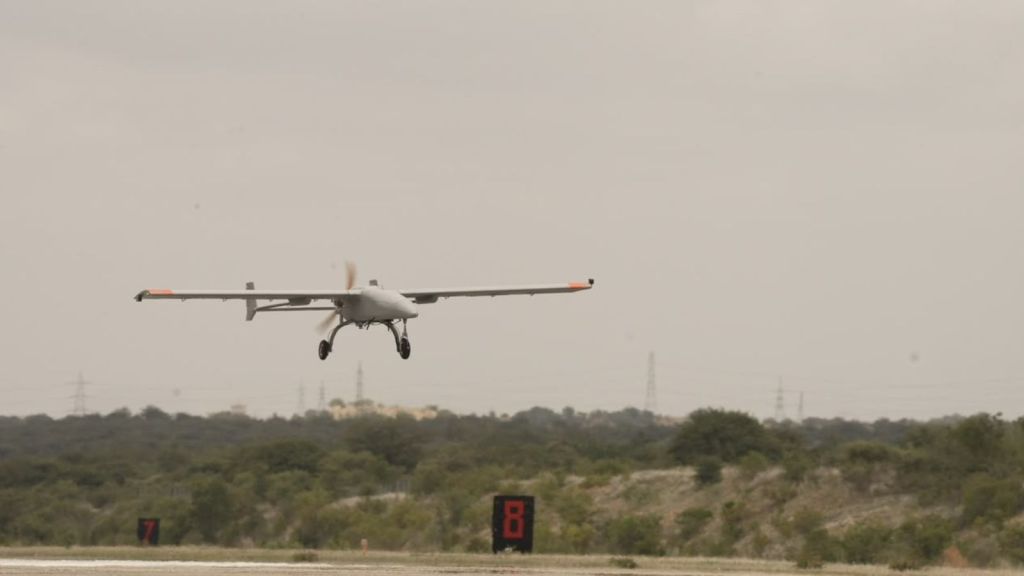 Bengaluru-based Flying Wedge Defence and Aerospace's Kaal Bhairava Lite has completed 100 cumulative flight-testing hours (Express photo/Special arrangement).
Bengaluru-based Flying Wedge Defence and Aerospace (FWDA) has completed 100 cumulative hours of flight testing for Kaal Bhairava Lite, India’s first indigenous, AI-powered Medium Altitude Long Endurance (MALE) autonomous combat aircraft.
Located in Electronic City, FWDA is the first Indian firm to secure Directorate General of Civil Aviation (DGCA)-type certification for an indigenous unmanned aerial vehicle (UAV). The defence technology company focuses on AI-driven warfare systems and next-generation combat aviation solutions.
According to FWDA, Kaal Bhairava Lite operates under a dual-role doctrine: the same platform can execute long-endurance intelligence, surveillance, and reconnaissance (ISR) missions or be configured as a long-range precision-strike loitering munition. Designed to provide a common ship-deployable platform for maritime surveillance and strike tasks, it offers a targeted reach exceeding 1,000 km with an endurance of eight to 10 hours.
The platform’s specific configuration is built around a 1,200 km-class range. During testing, the aircraft demonstrated climb rates of 7–8 m/s, cruise speeds between 100 and 120 km/h, and take-off and landing capabilities requiring less than 120 metres.
While the Indian Navy has not placed orders, it is currently at the Request for Information (RFI) stage for long-range ship- and shore-launched loitering munitions requiring ranges over 1,000 km and endurance exceeding nine hours. FWDA intends to participate and is evaluating the Kaal Bhairava architecture to meet these requirements.
The aircraft has undergone testing under challenging operational conditions, including 25–30 knot wind gusts over the Bay of Bengal to gather data on aircraft control in adverse weather. FWDA has also conducted demonstration flights in Jammu and Kashmir.
“One hundred hours of flight testing gives us an extensively tested indigenous aircraft architecture,” said Suhas Tejaskanda, FWDA founder and CEO.
“Kaal Bhairava has demonstrated its short-field capability, strong climb performance and operation in demanding wind conditions. With a 1,200-km-class design and 8–10 hours of endurance, we believe the platform has significant potential for both the Indian Navy requirement and international markets.”
FWDA is developing a pneumatic-assisted launch configuration for Kaal Bhairava Lite to enable deployment from ships and remote locations without relying on conventional runway infrastructure.
The company previously secured an export order from a South Asian country and has established its first international manufacturing node in Portugal. The European facility serves as an entry point to engage opportunities across the wider European and NATO defence ecosystem.
FWDA previously unveiled India’s first unmanned bomber aircraft, the FWD-200B, which completed its maiden flight on September 3, 2024. Also, on August 22, 2025, FWDA announced the readiness of the Kaal Bhairava E2A2 programme, an indigenous MALE aircraft engineered for up to 30 hours of endurance and a 3,000 km range, designed for precision strikes, swarm operations, and real-time ISR.
Stay updated with the latest - Click here to follow us on Instagram