


Stay updated with the latest - Click here to follow us on Instagram

Journalism of Courage
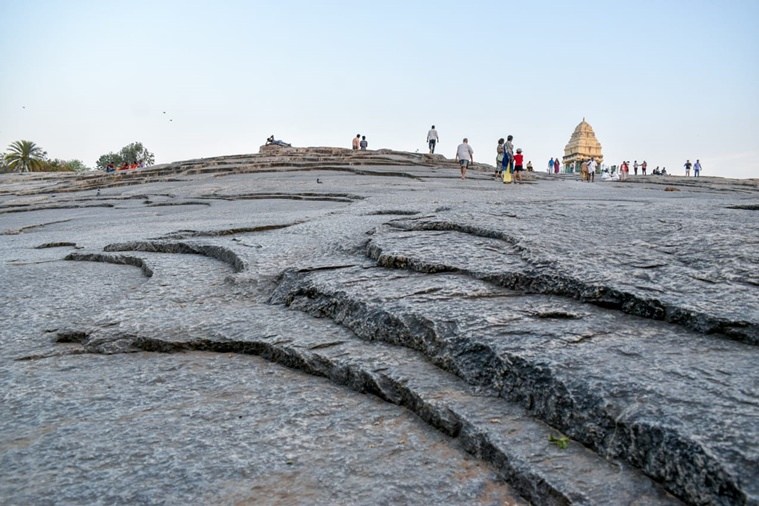 The ancient Peninsular Gneiss rock formation is over 3 billion years old and classified as a Geological Monument. (File Photo)
The Geological Survey of India (GSI) has informed the Karnataka High Court that the proposed 16.7-km-long Hebbal underground tunnel might pose a risk to the three-billion-year-old Peninsular Gneiss rock formation inside the Lalbagh Botanical Garden in Bengaluru.
The GSI made the claim Thursday in a report submitted before the Karnataka High Court in connection with the Public Interest Litigation (PIL) filed by actor-activist Prakash Belawadi challenging the proposed tunnel.
The Central government body said it analysed the Detailed Project Report and claimed that shafts for Tunnel Boring Machines will have to be dug near the ancient rock formation.
The GSI thereafter warned that the resulting vibration and stress redistribution could risk inducing new fractures or widening existing ones in the ancient rock mass.
In its 27-page report, the GSI also noted that the construction could lower the groundwater table or alter flow paths, potentially affecting Lalbagh Lake and fracture-controlled aquifers in the area, with knock-on effects for ground stability near the ramp zones.
The report comes even as the state government initially approved an amendment to the Karnataka Government Parks (Preservation) Act, 1975, to allow using 5 per cent of government park land for public utility construction. However, the Karnataka cabinet soon withdrew the amendment following protests at Lalbagh.
Bengaluru has around 1,353 parks, including the 240-acre Lalbagh Botanical Garden and the 197-acre Cubbon Park.
Stay updated with the latest - Click here to follow us on Instagram