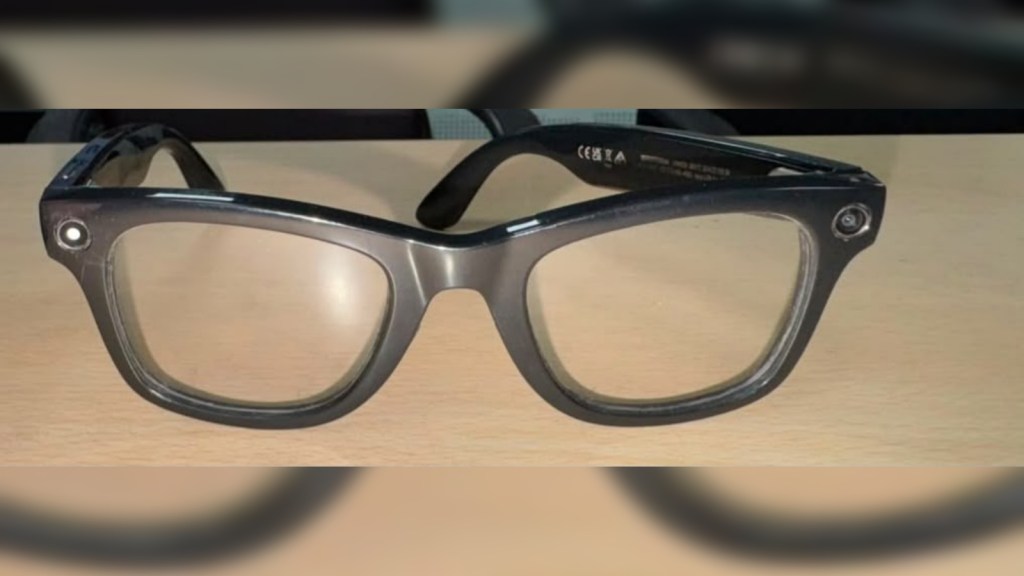
A first-year Bachelor of Business Administration (BBA) student in Surat has been banned for a year from sitting for an examination in which he was caught allegedly cheating with the help of a pair of ‘smart’ artificial intelligence (AI) spectacles.
The alleged incident took place during examinations held in March-April this year in the college located in the Varachha area of Surat, but it came to public knowledge only about a week ago when the student appeared before college authorities for a hearing.
He student has confessed to having attempted to cheat using the AI glasses, and a penalty has been imposed on him, sources in the college, which is affiliated to the Veer Narmad South Gujarat University (VNSGU), said.
The use of smart or AI-powered glasses to cheat in exams has been an increasingly visible trend over the past few months on campuses around the world. A number of such incidents have been reported in countries such as Korea, Taiwan, China, the UK and the US.
Universities and government education authorities have been grappling to find the best ways to deal with such situations, as well as to integrate this revolutionary new technology into educational and administrative practices in positive ways.
Before Surat, there was a similar incident in Pune
The incident involving smart glasses in Surat is the first of its kind reported in Gujarat. A previous incident of the use of smart glasses to allegedly cheat in exams in India was reported in Pune, where two engineering students were found wearing Ray-Ban Meta smart glasses during an exam at the Symbiosis Institute of Technology on May 19 this year.
A Symbiosis official had said in a statement that these glasses “cannot be [allowed to be] worn because they can be used for other purposes like using ChatGPT or clicking pictures, etc”. And while “no evidence as such was found of the students doing anything like that”, they had “obviously been debarred from that paper”.
Story continues below this ad
Sources in the Surat college said the alleged cheating attempt was detected by the anti-cheating ‘flying squad’ of the university which found the first-year BBA student “handling his reading glasses in an unusual way”. The officials realised that they were “AI-enabled Meta glasses”, the sources said.
The student is learned to have been then taken to another room and questioned in the presence of the college principal and professors. The sources said that the student had demonstrated to the teachers and administrators how the glasses worked.
“The camera captured an image of the question paper, and then AI generated the answers, which the student could hear through open-ear speakers. The principal took away the glasses and asked the student to give a written apology. The student was also booked for copying,” the sources said.
A professor in the college said: “The student’s parents were called in, and he was asked to pay Rs 10,000 as penalty for cheating in the exams using AI-generated reading glasses. He was also informed that he was barred from taking the exam in that subject for one year.”
Story continues below this ad
The smart glasses, which are estimated to cost around Rs 35,000, were in the custody of the college authorities until a week ago. They were returned to the student after he paid the penalty, the sources said. The principal of the college declined to comment on the incident.
Dr K N Chavda, Vice Chancellor of VNSGU, told The Indian Express, “We have come across such an incident. The college is affiliated to VNSGU. I don’t have more information about the incident.”
How smart glasses can aid unfair practices in examinations
Smart glasses such as the Ray-Ban Meta, Rokid, or Even Realities G1 combine several high-tech components into what looks like a normal spectacles frame. Meta’s AI-enabled glasses, built with Ray-Ban, became available first in late 2023, and new versions have been released since then. In 2025, the company sold about 7 million pairs of these glasses.
On its website, Meta describes smart glasses as “normal-looking eyewear with discreetly integrated glasses technology”. These glasses “look like normal sunglasses or prescription glasses, but inside, they include tiny speakers, microphones, a lightweight camera or even a small display that sits within your field of view”, Meta says.
Story continues below this ad
One or more cameras are built into the spectacles frame, usually near the temple, which can photograph or record whatever the wearer is looking at. The microphones and speakers commonly use bone-conduction technology in which sound waves are transmitted to the inner ear through the bones of the skull, ensuring only the wearer hears the audio. In the models with a display, a tiny projector beams text and images onto the lens.
The glasses connect to a phone or directly to the Internet using Bluetooth or WiFi, and the captured image or audio is sent to an AI model such as GPT-4o or Gemini, which processes it and sends back a response almost instantly.
Investigations into the reported cases of cheating in exams using these glasses have typically shown the camera to have captured what the wearer saw, transmitted it to an AI model, and received the answer as text on the lens display or as audio in less than 30 seconds. Officials and invigilators typically find it difficult to deal with these cases because there is no phone, no visible screen, or no sound that can be associated with the use of the device.
Concerns and regulation, in India and elsewhere
Incidents of using electronic devices – though not smart glasses specifically – to cheat in examinations have been reported in India at least since September 2021, when a candidate showed up at a Rajasthan Eligibility Examination for Teachers (REET) centre in Kishangarh, Ajmer, wearing flip-flops with a Bluetooth device concealed in them. The mobile phone and transmitter in the slippers connected wirelessly to a micro earpiece that the suspect was wearing, police had said at the time.
Story continues below this ad
Since then, many such instances of the unfair use of technology in exams have come to light in various states of the country, and the alleged use of smart glasses this year in Pune and Surat marks a new innovation using the latest available technology.
In February this year, the University Grants Commission (UGC) circulated to higher educational institutions a set of “Jammer Guidelines” that it received from the Cabinet Secretariat in December 2025. The guidelines said that “statutory/ Govt. recognized examination conducting bodies” were allowed to deploy “low powered jammers/ classroom jammers to prevent cheating and other malpractices during examinations, by leasing the jammers through the empanelled PSUs”.
In June 2026, a CNN report said “test-obsessed Asia” was the “ground zero” of the incidents of “AI glasses aiding cheating in exams”. The report mentioned two instances in the previous month in which individuals in South Korea writing a test of proficiency in English were caught using these glasses, and an incident in Taiwan in which a student sitting for an exam to enter a top medical school was caught out “after proctors noticed the student staring oddly at the test, leading to an inspection that revealed the frame was emitting heat”.
Chinese authorities in Beijing and several provinces issued strict instructions ahead of the high-stakes ‘gaokao’ college entrance examination held in June this year, tightening scrutiny to check for the use of smart glasses.
Story continues below this ad
In the US, the nonprofit College Board, which administers SAT, the widely used test for college admissions, banned smart glasses, including prescription models, earlier this year, treating them as an extension of its existing ban on wearables like AirPods and Apple Watches.
In the UK, Sir Ian Bauckham, the chief regulator of Ofqual, the exam watchdog, warned in June that AI glasses and smart devices like earpieces could worsen cheating in exams.