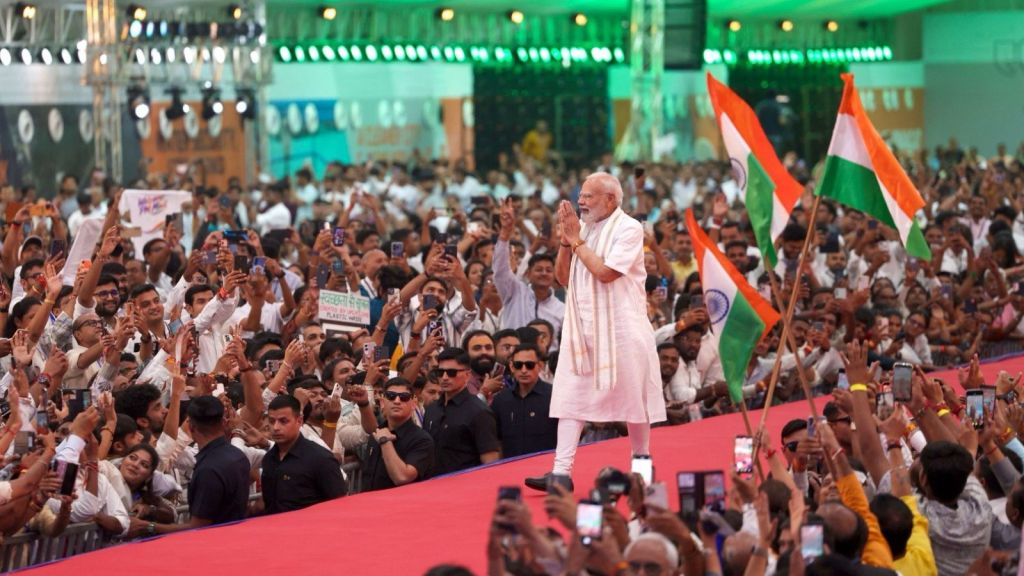
India lost several years to “administrative inertia”, as files for key infrastructure projects kept moving from one office to another, Prime Minister Narendra Modi said on Tuesday as he criticised the UPA era that preceded his term.
The Prime Minister addressed a “NaMo for Viksit Bharat” gathering in Vadodara after inaugurating three key sections of the 1,500-km Western Dedicated Freight Corridor connecting Jawaharlal Nehru Port Trust (JNPT) in Navi Mumbai with Dadri near Noida in Uttar Pradesh.
The Dedicated Freight Corridor project, comprising 2,800 km of high-speed railway lines along the eastern and western corridors, was now complete, the Prime Minister said.
“This is a major milestone for Gati Shakti and India’s logistics transformation”, and a “historic achievement for 21st century India”, he said.
The Prime Minister described the completion of the Dedicated Freight Corridor as evidence of the way in which the country’s work culture had changed since his government came to power 12 years ago.
The idea of a Dedicated Freight Corridor to streamline the movement of cargo across the country was conceived in 2004, and two years later, a dedicated company was set up to execute it, the Prime Minister said.
But “until 2014, the files simply kept moving from one place to another, from one desk to the other… To the misfortune of the files, there was no dedicated corridor for them,” he said.
Story continues below this ad
The earlier government’s approach was such that “not even one kilometre of the freight corridor could be completed in seven or eight years”, the PM said. “Filein atakti thi, latakti thi, bhatakti thi (Files would keep getting stuck, lost, or were kept hanging),” he said.
Addressing the younger people among the 6,000-strong gathering of students, state ministers, MLAs, BJP leaders, and social media influencers at the Pavilion Ground of The Maharaja Sayajirao University of Baroda, Modi said: “Had the country been run in their (UPA’s) way, who knows, perhaps three or four generations would have come after you, even then [this project] would not have been completed.”
The PM cited figures to underline the impact of the Dedicated Freight Corridors: more than 430 goods trains now run daily on the Eastern and Western corridors, and a train that took six-and-a-half hours to cover 100 km now does that distance in less than half that time, he said.
Modi noted that a single double-stack container train had recently transported a load from JNPT to Vadodara that would have required more than 250 trucks to carry. However, “naaraz fufas (grumpy uncles)” would start screaming, “what will happen to truckers”, he said, using the same expression that he had used in his speech at Shri Ram College of Commerce in Delhi on September 5 to mock older people who were allegedly unable to think positively.
Story continues below this ad
Later in his speech, the Prime Minister used the expression “Jhooth ki Goonj”, seemingly a reference to Leader of Opposition Rahul Gandhi’s “Chhatron ki Goonj’ youth outreach, and declared that the youth of India were guided by the “roar of truth”.
At a time when the BJP and the central government face significant anger from younger voters on a range of issues led by the state of education and leaks of competitive examination question papers, Modi’s message to the youth was clear: They were too young to know the crises that had gripped the country before the NDA’s rule, his tenure as Prime Minister brought better governance, and those critical of him were naysayers and out of sync with the aspirations of the youth.
Modi also spoke about artificial intelligence (AI), and said India faced a race against time to prepare for the transformation that this new technology was bringing.
“We want the coming generation of our young people to be prepared for AI… If we want to become a superpower in AI, then the country will have to prepare for it and build its ecosystem,” he said.
Story continues below this ad
The PM urged the youth to understand that AI skills were not confined to the technology sector. A person equipped with the right skills “can develop new AI solutions for agriculture, create technology for the healthcare sector, improve productivity in manufacturing, or launch a startup in robotics”, he said.
For almost 150 years, Vadodara had demonstrated how “education, skills and industry” could come together, the PM said. “A journey that began with textiles and tiles later expanded into oil and petrochemicals… Vadodara emerged as a major MSME hub over the past two to two-and-a-half decades. Today, look at how dramatically things have changed… India’s first Made-in-India military transport aircraft, the first flight of the C-295 aircraft has taken to the skies from here,” he said.
During his visit to Vadodara, Modi inaugurated, laid the foundation stones for, and flagged off projects adding up to more than Rs 35,200 crore. These included development projects worth more than Rs 30,766 crore under Railways.
Later, he inaugurated the BJP’s new ‘Namo Kamalam’ office in Navsari town of South Gujarat.
Aditi Raja is an Assistant Editor with The Indian Express, stationed in Vadodara, Gujarat, with over 20 years in the field. She has been reporting from the region of Central Gujarat and Narmada district for this newspaper since 2013, which establishes her as a highly Authoritative and Trustworthy source on regional politics, administration, and critical socio-economic and environmental issues.
Expertise:
Core Authority & Specialization: Her reporting is characterized by a comprehensive grasp of the complex factors shaping Central Gujarat, which comprises a vast tribal population, including:
Politics and Administration: In-depth analysis of dynamics within factions of political parties and how it affects the affairs in the region, visits of national leaders making prominent statements, and government policy decisions impacting the population on ground.
Crucial Regional Projects: She consistently reports on the socio-economic and political impact of infrastructure projects in the region, especially the Statue of Unity, the Sardar Sarovar Project on the Narmada River, the Mumbai-Ahmedabad High Speed Rail bullet train project as well as the National Highway infrastructure.
Social Justice and Human Rights: Her reporting offers deep coverage of sensitive human-interest topics, including gender, crime, and tribal issues. Her reports cover legal proceedings from various district courts as well as the Gujarat High Court (e.g., the Bilkis Bano case remission, POCSO court orders, Public Interest Litigations), the plight of tribal communities, and broader social conflicts (e.g., Kheda flogging case).
Local Impact & Disaster Reporting: Excels in documenting the immediate impact of events on communities, such as the political and civic fallout of the Vadodara floods, the subsequent public anger, and the long-delayed river redevelopment projects, Harni Boat Tragedy, Air India crash, bringing out a blend of stories from the investigations as well as human emotions.
Special Interest Beat: She tracks incidents concerning Non-Resident Gujaratis (NRIs) including crime and legal battles abroad, issues of illegal immigration and deportations, as well as social events connecting the local Gujarati experience to the global diaspora. ... Read More