At Govind Nagar Industrial Estate in Surat’s Udhna suburb, home to more than 500 powerloom units, Kesarali Peerzada has been running a textile weaving unit for nearly 25 years. His factory, Mallika Textiles, is in a ground-plus-two building where he keeps watch over the shop floor from a part-wood, part-glass office, backed up by CCTV cameras across the shop floor.
The unit houses 48 powerloom machines, along with machines for twisting yarn into thread and a warping machine that threads yarn through small holes to form a beam, which is then fed into the looms to produce grey (unfinished) fabric. A total of 25 workers keep the operation running.

The rising costs of running his unit, he says, are directly linked to the West Asia conflict and the resulting shortage of Liquefied Petroleum Gas (LPG) following the disruption in crude oil supply. When LPG, which lit the kitchen fires in the quarters of the labourers working in the power loom unit, ran short, the workforce headed homeward to the states of Bihar, Uttar Pradesh, Jharkhand, Odisha, and West Bengal.
In April this year, the Udhna railway station was teeming with migrants queuing to go home, breaking through barricades to board already packed trains. At one point, there were over 20,000 people on the platform and its premises, spending the night with their baggage to make it on time for the train.
“These workers don’t have local documentation and were dependent on the black market for their supply of cooking gas. When the gas containers ran short and prices went through the roof, they migrated to their native place and returned a month later, during which our factory remained shut. Before the gas shortage, we were paying Rs. 1.80 a metre (of fabric woven) to the labourers, and after they returned from their native place, they demanded a salary hike, and we are now paying Rs 1.95 a metre”, says Peerzada.
Peerzada, a commerce graduate, says, “Even though crude prices have actually eased from a wartime peak of roughly USD 120 a barrel to around USD 95, the price of POY (Partially Oriented Yarn) hasn’t followed suit — it remains stuck around Rs 180 per kilogram, up from the Rs 140-150 range it was earlier” . He attributes this partly to the fact that yarn pricing in India isn’t overseen by any regulatory body but controlled by a “cartel involving big players”.
Adding to this was the cost of power to run the mills. Dakshin Gujarat Vij Company Limited (DGVCL), the state power distribution company, raised tariffs from Rs 7.30 a unit to Rs 9.15 a unit this year.
Story continues below this ad
The squeeze runs both directions: while costs for yarn, labour and power have all climbed, buyers further down the chain, the textile traders, who get grey fabric dyed and printed, have resisted paying more, insisting on old rates. Peerzada says, Some traders understand and adjust, but increased competition has actually pushed the price of grey fabric bales (roughly 110 metres each) down slightly, from Rs 13 to Rs 12.80 per metre. Producing a 120-metre bale of unprinted fabric requires about 3,700 kg of partially-oriented yarn (POY).
Powerloom factory lane at Udhna. (Express Photos by Hanif Malek.)
Earning in Surat — for family in UP
Kunwarlal Verma, 42, moved to Surat from Pratapgarh, Uttar Pradesh, two decades ago and has worked at Peerzada’s factory for the last three years, while his wife and two children remain with his parents back home — his father, a farmer with a small landholding, supports the family alongside Verma’s two younger brothers. Verma sends home Rs 12,000-15,000 a month to cover his children’s education; His daughter is finishing Class 12, while his son, a recent graduate, now works at a private firm in Ahmedabad.
Verma said, “Here, we work and stay in a rented room and cook for ourselves. Due to the LPG shortage, I went back to my hometown and stayed there for two months. Before the crisis, I was getting around Rs. 22,000 per month. The salary depends on production. Earlier, we were getting Rs. 1.80 per metre. After my return, I demanded more, so the owner increased it by 15 paise per metre, and now I am getting Rs 1.95 per metre. The salary depends on the work done as per production. Daily we are getting Rs 700 to Rs 750 per day. We get one day off a week, and if I work on off days, I get paid extra.”
He shares a small rented room with three other workers in Limbayat, splitting the Rs 2,000 monthly rent equally, and commutes by bicycle for roughly 15 minutes. Verma says his priority is his children’s future—he has pushed his son toward competitive exams for banking, railway or state government jobs, hoping to spare him the hardships he has faced.
Story continues below this ad
“I work in 12-hour shifts which sometimes extend to 36 hours if my reliever does not show up for two consecutive days. Earlier, I used to go home once a year, but for the last few years, I go twice: on Holi and Diwali. I don’t spend money here in Surat; I save it for my children. One of my brothers runs a samosa shop in my village, while another helps my father in the fields. I miss my family, but I have to compromise as I am the only earning member of the family. Every day before going to work and after returning back home from duty hours, I talk to my wife and children,” says Verma.
Dyeing and printing mills raise charges
Compounding pressures further, the Southern Gujarat Textile Processing Association (SGTPA), representing roughly 400 dyeing and printing mills in Surat, met on August 28 and announced a 15 per cent increase in charges for processing unfinished fabric, effective September 7. This raises the cost traders pay to get grey fabric dyed, cleaned and softened by about Rs 1.50 per metre, on top of the existing Rs 10-15 range.
SGTPA president Jitubhai Vakhariya linked the hike to the jump in coal prices (over the year) driven by Strait of Hormuz disruptions affecting imported supplies from Indonesia. Mills rely on coal-fired steam, generated at high temperature, to fix dyes and chemicals onto fabric, using a roughly 60:40 blend of lower-grade lignite and higher-calorific imported coal.
Monsoon-season restrictions on lignite mining have pushed mills toward greater reliance on the more expensive imported variety — its calorific value nearly double that of lignite, says Vakhariya.
Story continues below this ad
Vakhariya said imported coal prices have risen by as much as 50 per cent since the geopolitical situation changed in February, following the Iran-Israel-US war. He says (non-coking) coal prices rose from around Rs 6,000 to Rs 9,500 per tonne, with individual mills burning 30-50 tons daily.
The hike has not gone down well with traders who are a critical link in the supply chain. The Federation of Surat Textile Traders Association (FOSTTA) met on September 2 and rejected the increase outright. Secretary Dinesh Katariya argued that the SGTPA acted unilaterally without first consulting traders and has formally asked the association to roll back the change before it takes effect.
Govindnagar industrial estate lane where seiries of multistorey building where powerloom machines runs in Udhna, Surat. (Express Photos by Hanif Malek)
From Surat to South India: Mill to the market
Rangnath Sharda, joint secretary of the Surat Textile Market, the city’s oldest, inaugurated by then-Prime Minister Morarji Desai in 1972 as the Surat Lok Sabha MP, described the roughly 30 per cent price increase as unprecedented in the market’s history.
“A saree that sold for Rs 200 last Diwali will likely fetch Rs 260 this year. The market itself represents over 75,000 shops and roughly 5 lakh people, with sarees ranging from Rs 200 at the low end up to Rs 25,000-30,000,” says Sharda.
Story continues below this ad
September is an important month for the textile industry, when wholesalers and retailers from across the country come to Surat to see new designs, colours, and fabric trends, offering customers something new for Diwali. This trader footfall will only rise until 15 days before Diwali.
The most important aspect of the textile trading business is timely delivery. Those in the value chain say this is why they end up spending extra on power bills, labour, and other charges to meet demand. The turnaround time from purchase of the finished product to payment ranges from 60 to 90 days. After dyeing and printing, the fabric is also embellished at Surat’s embroidery units before it is sold in markets as far as Delhi’s Chandni Chowk to Tamil Nadu in the South.
Sharda, who sells to wholesalers in Tamil Nadu and Karnataka, noted that out-of-state buyers are pushing back, expecting old prices even as costs have risen at every stage from yarn to weaving to dyeing.
“We are in a bind. If we refuse to sell fabrics at old rates, buyers will find another firm, and we lose to competition willing to work on lower margins,” says Sharda.
Story continues below this ad
Even so, Sharda says demand looks healthy heading into Navratri and Diwali, and mills are preparing fresh designs and colour combinations for the season. He estimates overall price increases of around 30 per cent across the range and expects budget-conscious shoppers, who form the bulk of customers and typically spend between Rs 500 and Rs 1000 per piece, to “ending up compromising on quality”.
Surat’s textile ecosystem overall spans roughly 75,000 trading shops, 80,000 weaving factories and 400 dyeing/printing mills, employing over 18 lakh people. On a typical day, 250-300 truckloads of fabric leave the city for markets across UP, Bihar, West Bengal, Delhi, Jharkhand, Maharashtra and the southern states, with some shipments moving by rail. The day-to-day orders are fulfilled via WhatsApp, with design photos sent directly to out-of-state buyers.
Output shrinking over the years
One industry veteran, who has tracked the sector for 35 years, said Surat’s overall fabric output has fallen from around 6 crore metres a day to under 4.5 crore, as many units—unable to absorb the layered cost increases—have cut back to five operating days a week instead of running at full capacity, as was typical in the run-up to Diwali in past years.
Ashish Gujarati, president of the Surat Pandesara Weavers Cooperative Society, traced the underlying dynamics to the broader effects of the West Asia conflict on regional petrochemical supply chains. Before the war, crude sold for roughly $65-$ 70 per barrel and POY cost about Rs 98/kg; crude has since climbed toward $90 per barrel, while POY has surged past Rs 140/kg.
Story continues below this ad
“The raw material availability across major Asian manufacturing hubs has been severely restricted. Crucially, PTA (purified terephthalic acid, a chemical used to manufacture yarns) production in China has plunged to 50 per cent of capacity, choking regional export supply lines. This is because supply lines of Paraxylene and Crude from the Middle East have been severely impacted due to the war,” says Gujarati.


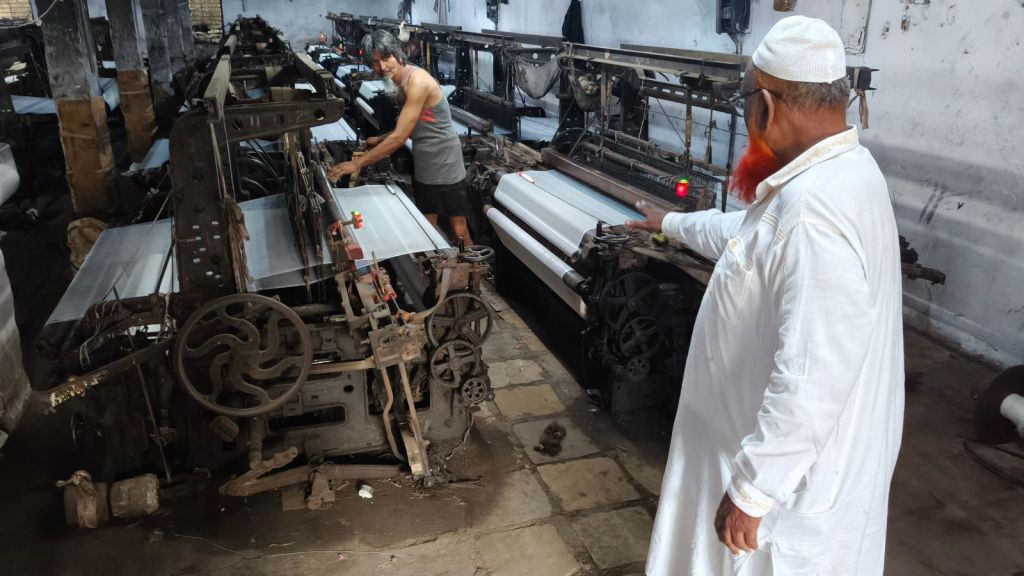


 Powerloom factory lane at Udhna. (Express Photos by Hanif Malek.)
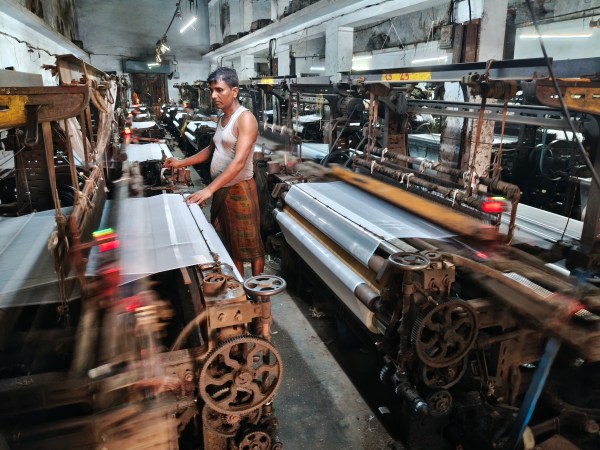 Govindnagar industrial estate lane where seiries of multistorey building where powerloom machines runs in Udhna, Surat. (Express Photos by Hanif Malek)
