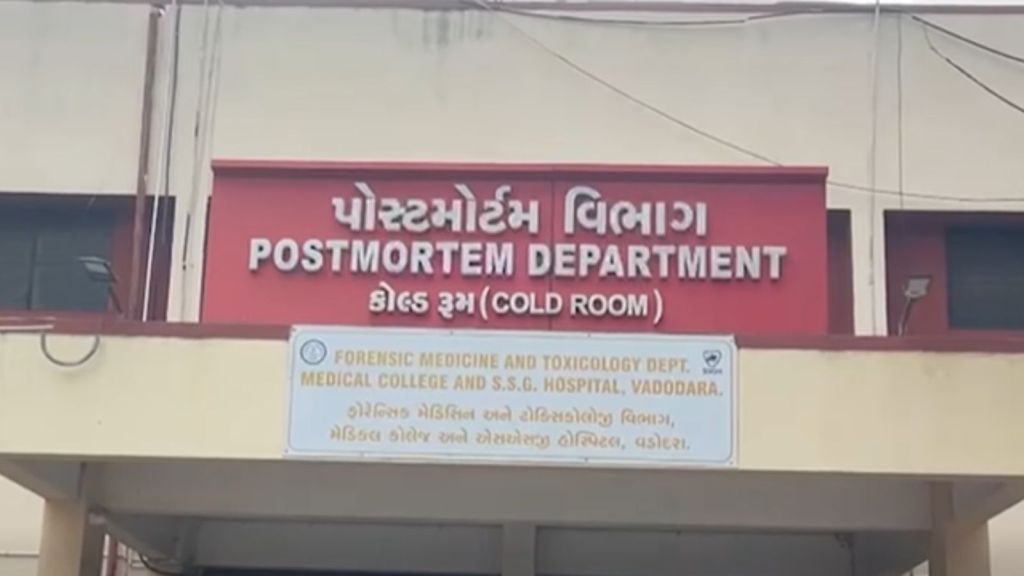
A body, a Rs 1,500 demand, and a video: Questions at Gujarat hospital
An alleged demand by an outsourced worker at Vadodara’s SSG Hospital to clean and pack a body has triggered an inquiry after a relative recorded the exchange on video.
4 min readVadodaraUpdated: Sep 25, 2026 05:27 PM IST
The incident has also brought renewed attention to earlier complaints concerning workers in the post-mortem department of Vadodara's SSG Hospital. (Express Photo)
The family had already endured the autopsy of their loved one. What came next was unexpected.
As they waited to take the body home to Bodeli, an outsourced worker at state-run SSG Hospital in Gujarat’s Vadodara allegedly asked them for Rs 1,500 to clean, pack, and hand it over.
A relative recorded the exchange on video, which allegedly shows the worker, identified as Jagdish Parmar, demanding Rs 1,500 and telling the family to take the body without the service if they did not pay.
Days later, the footage prompted the hospital administration to remove Parmar from duty and order an inquiry. The hospital has also asked the outsourcing agency through which he was employed to take him off the post.
‘Asking for a bribe’
Dr Ranjan Aiyer, Medical Superintendent, SSG Hospital, said the inquiry was constituted Friday and would be headed by resident medical officer Dr Hitendra Chauhan.
The inquiry headed by Dr Chauhan is expected to establish when the video was recorded, the circumstances surrounding the alleged demand, whether Rs 1,500 was sought as a condition for packing or handing over the body, and whether other staff members were involved.
Aiyer said the worker could be identified from the footage and described the video as “undeniable”.
The hospital administration said the alleged demand was an improper payment rather than a voluntary tip. “What was traditionally a tip given by families of deceased persons voluntarily has now turned into a rightfully demanded sum of money. In other words, it is asking for a bribe,” he said.
However, the hospital has not yet established when the video was recorded.
“We do not know when the present video was taken and how old it is. It could be an old video that has surfaced now, but an inquiry has been instituted, and steps will be taken to ensure that it does not happen again,” he said.
Previous complaints
The incident has also brought renewed attention to earlier complaints concerning workers in the post-mortem department.
Story continues below this ad
“We have previously received complaints about the Class IV staff at the post-mortem department about bribes being asked for and the helpers being drunk on duty. However, there has never been proof to establish the allegations. This time, the video is present, and it cannot be denied that the bribe was sought. Therefore, it has been taken seriously, and an inquiry has been launched,” Aiyer said.
According to Aiyer, the outsourced workers help the forensic medicine department with handling bodies, including “washing and cleaning them, dealing with body fluids, packing viscera and preparing bodies for handover to relatives. “They are more like undertakers, ” he added.
Aiyer said that after previous complaints that families were asked to arrange or charged for the shroud, the hospital started providing it at the mortuary itself.
“The hospital now uses discarded PPE kits and zipper bags for packing bodies, while it also procures glass bottles for carrying viscera and wooden boxes for packing them before they are sent to forensic departments in Surat so that patients are not made to run around for them.”
The episode also highlights the staffing difficulties civic hospitals face in forensic medicine departments. “Finding helping staff for forensic medicine departments is a difficult task for the civic hospitals, as not many people want to work in this area,” he said.
The number of helping staff in the post-mortem department has fallen from six to five.
Aditi Raja is an Assistant Editor with The Indian Express, stationed in Vadodara, Gujarat, with over 20 years in the field. She has been reporting from the region of Central Gujarat and Narmada district for this newspaper since 2013, which establishes her as a highly Authoritative and Trustworthy source on regional politics, administration, and critical socio-economic and environmental issues.
Expertise:
Core Authority & Specialization: Her reporting is characterized by a comprehensive grasp of the complex factors shaping Central Gujarat, which comprises a vast tribal population, including:
Politics and Administration: In-depth analysis of dynamics within factions of political parties and how it affects the affairs in the region, visits of national leaders making prominent statements, and government policy decisions impacting the population on ground.
Crucial Regional Projects: She consistently reports on the socio-economic and political impact of infrastructure projects in the region, especially the Statue of Unity, the Sardar Sarovar Project on the Narmada River, the Mumbai-Ahmedabad High Speed Rail bullet train project as well as the National Highway infrastructure.
Social Justice and Human Rights: Her reporting offers deep coverage of sensitive human-interest topics, including gender, crime, and tribal issues. Her reports cover legal proceedings from various district courts as well as the Gujarat High Court (e.g., the Bilkis Bano case remission, POCSO court orders, Public Interest Litigations), the plight of tribal communities, and broader social conflicts (e.g., Kheda flogging case).
Local Impact & Disaster Reporting: Excels in documenting the immediate impact of events on communities, such as the political and civic fallout of the Vadodara floods, the subsequent public anger, and the long-delayed river redevelopment projects, Harni Boat Tragedy, Air India crash, bringing out a blend of stories from the investigations as well as human emotions.
Special Interest Beat: She tracks incidents concerning Non-Resident Gujaratis (NRIs) including crime and legal battles abroad, issues of illegal immigration and deportations, as well as social events connecting the local Gujarati experience to the global diaspora. ... Read More