Rajkot Municipal Corporation (RMC) has cleared the decks to adopt the state government’s guidelines for controlling the stray cattle menace by fixing criminal and civil liability on cattle-herders whose animals cause human injuries or deaths and filing criminal cases against those hampering cattle impounding operations.
“Civil/criminal proceedings can be launched for seeking compensation/claims/damages against an owner if his loose cattle causes injury of life and property of citizens/passersby. Concerned municipalities will have the powers to decide matters related to monetary compensation payable in cases of serious injuries/deaths,” reads the proposal. The other key changes include hiking by three fold the penalties for letting cattle loose, declaring certain areas as no-cattle zones and auctioning off impounded livestock not claimed by their owners

During a meeting on Tuesday, the RMC Standing Committee approved the proposal of the civic body’s Animal Nuisance Control Department (ANCD) to adopt, with some modifications, the Guidelines for Animal Nuisance Control in Urban Areas (GANCUA), 2023. The proposal will now be forwarded to RMC general board for discussion and approval.
Once approved, all municipal corporations in the state will have adopted the guidelines issued by the state government, RMC Standing Committee chairman Jaymin Thakar said. “A proposal to adopt state government guidelines was on the agenda of the last standing committee meeting (on October 4). However, we had kept that agenda item pending, as the maldhari (cattle-herder) community demanded that they be heard first. We heard them and addressed their concerns and therefore, the standing committee cleared the proposal on Tuesday to adopt the guidelines.”
GANCUA, issued on August 21, came exactly a year after the state government withdrew the Gujarat Cattle Control (Keeping and Moving) in Urban Areas Bill, 2022 amid protests by the maldharis following the passage of the Bill by the Assembly in April 2022.
Once the guidelines come into force, it will be mandatory for maldharis to obtain a permit for Rs 250 from the RMC for keeping up to four cattle-heads instead of the current Rs 25 permit fee. The permit will be valid for three years as against the current one year. Keeping more than four animals will be treated as a commercial activity and a maldhari will have to obtain a licence by paying Rs 500 in licence fee in such cases.
A maldhari will have to get each of his animals registered with RMC by paying Rs 200 registration fee per livestock head. He will also have to get micro Radio Frequency Identification (RFID) chips placed in the animals at Rs 200 per livestock head, as against the current Rs 100, within two months of the guidelines coming into force. The fee will be Rs 1,000 after two months. “If a maldhari fails to get an RFID for his cattle in four months, such cattle will be liable to be impounded by RMC,” said the proposal.
The proposals also seek to declare certain parts of the city as no-cattle zones. “This is a comprehensive policy and maldharis already have the option of keeping their cattle in animal hostels that RMC runs,” Thakar said, adding, “Developing a dedicated settlement for maldharis away from the city limits is also a proposal under consideration.”
In addition, if any camel, cow, buffalo, bullock or horse is found let loose and impounded by the ANCD, its owner will have to pay a penalty of Rs 3,000, Rs 500 for daily maintenance and another Rs 500 for daily administrative charges. These figures are Rs 2,000, Rs 300 and Rs 300 respectively for a sub-adult he-buffalo or she-buffalo. In case of a goat, sheep, donkey, lactating calf of cow or buffalo and pig, the penalty would be Rs 1000, while the maintenance and administrative charges would be in the range of Rs 100 to Rs 200 each.
The new charges reflect a two to three-fold increase from the existing charges. The penalty would be hiked 1.5 times, two and three for the second, third and fourth repeat offence respectively.
The guidelines also propose to auction off milch animals not claimed by their owner after paying due fees within seven days of them being impounded. Young cattle calves and bullocks would be given to farmers free of cost and to recognised NGOs at fixed prices.
Currently, RMC charges a one-time administrative charge of Rs 500 per cattle head for keeping a cow or its progeny in its animal hostels where buffalos or other livestock are not allowed. But the new guidelines propose to hike this charge to Rs 1,000 for cows and their progeny and goats and sheep and Rs 2,500 for buffaloes.
The rules also prohibit sale of fodder on roadside and makes it mandatory to obtain a licence to sell fodder. It proposes to launch a “friends of cattle” scheme for people to deposit donations with the RMC, which in turn, will feed cattle on their behalf.

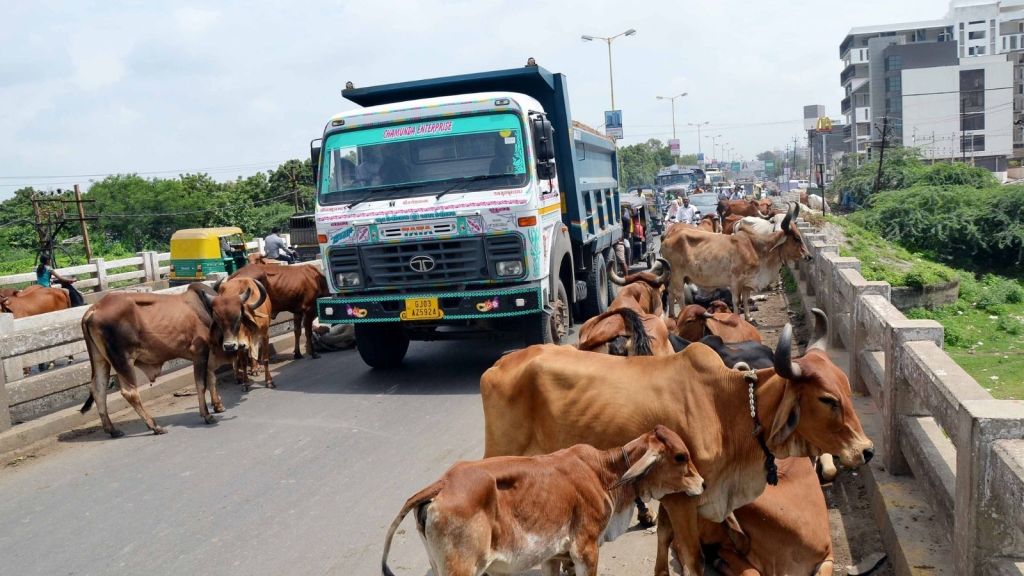 Currently, RMC charges a one-time administrative charge of Rs 500 per cattle head for keeping a cow or its progeny in its animal hostels where buffalos or other livestock are not allowed.File


 Share


