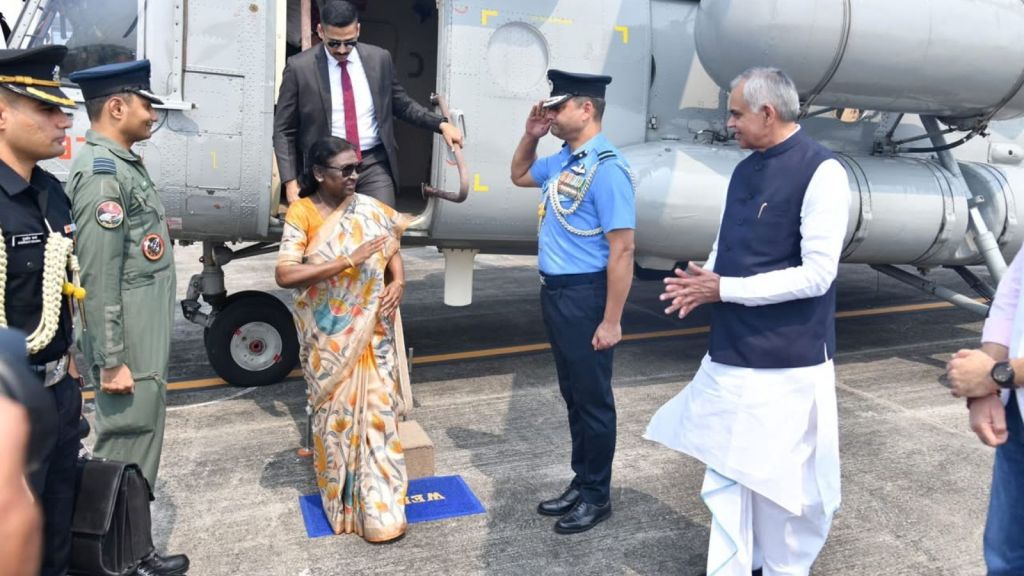
President Droupadi Murmu on Wednesday drew attention to the gap between women’s academic achievements and their workforce participation, saying the growing number of women winning degrees and gold medals did not translate into greater workforce participation because many women were raising and educating their children.
Addressing the 75th Convocation of Maharaja Sayajirao University of Baroda in Vadodara, President Murmu said the increasing number of women among degree and gold-medal recipients was a sign of a “changing India” and an indication of the country’s movement towards inclusive development. However, she added that many women drop out of formal employment despite being high academic achievers, as raising children is an important step in nation building.

“I am seeing this—not only this university, but across India, I have been invited to universities, whether they are universities of health, education, or technology. I am seeing that today, the kind of transformation that is visible here is that daughters are moving ahead in very large numbers. But in the workforce, daughters are not coming forward,” Murmu said.
President Murmu said, “It is not that they are not intelligent. It is not that they cannot work for the country. But they are working for the country by building the next generation… Sometimes people say daughters…have so many degrees, so many gold medals, but they are not in the workforce. They do not become professors, they do not become doctors… It is not that they cannot do it. They are making efforts to build the country, to make the country a developed nation.”
Stating that women who stay at home to educate their children and prepare them for the future also contribute to the country, she said, “Staying at home, educating their children and preparing them for their future—this is also work for the country. Therefore, I want to thank the daughters. Whether you are visible in the workforce or not, you are making efforts to take the country forward.”
The President’s remarks came as the university conferred degrees on around 12,600 students, with 202 gold medals to be awarded to 161 students across disciplines. President Murmu, the chief guest, presented gold medals to 30 students.
In her address, the President noted that she had seen women outnumber men among the students receiving degrees at the convocation. She said a similar trend was visible across many higher educational institutions in the country where she had visited.
Women outnumber men among gold medallists in most faculties
Story continues below this ad
The Faculty of Technology and Engineering had the highest number of gold medals at the convocation, with 33, followed by the Faculty of Medicine with 32 and the Faculty of Science with 25. While women outnumbered men among gold medallists in most faculties, the reverse was seen at Baroda Sanskrit Mahavidyalaya and the faculties of Journalism and Communication, Management Studies, Pharmacy, and Technology and Engineering.
President Murmu also urged the graduating students to use their education not merely for personal advancement but for the benefit of society and the country. She urged students taking up professional careers to develop technologies that improve people’s lives, view medicine as a service, seek solutions to problems in the interest of humanity, and “enrich society’s sensitivity” through their work. The President also cautioned students to exercise discernment while adopting rapidly advancing technologies. “Artificial intelligence could provide solutions, but asking the right questions remains a human responsibility, and you should ask questions. Technology can provide speed, but people have to decide the direction in which it is used…” she said.
‘Pressure from digital world’
Addressing a Brahma Kumaris programme in Vadodara later, President Murmu stressed the need to “equip India’s youth not only with knowledge, technology and skills but also with self-confidence, discipline, emotional balance and strong ethical values”, saying inner awakening would be crucial to building a developed India by 2047.
She said young people were facing “growing pressure from the digital world, information overload, competition, changing lifestyles and social expectations”.
Story continues below this ad
Developing self-awareness, concentration, emotional stability, and self-discipline would help channel their energy towards constructive goals, the President said.
President Murmu said “economic growth alone was insufficient” and had to be accompanied by human development and an education system that nurtured wisdom and discernment to help the world overcome “tension, violence, intolerance and social divisions,” among other challenges.