


Stay updated with the latest - Click here to follow us on Instagram

Journalism of Courage
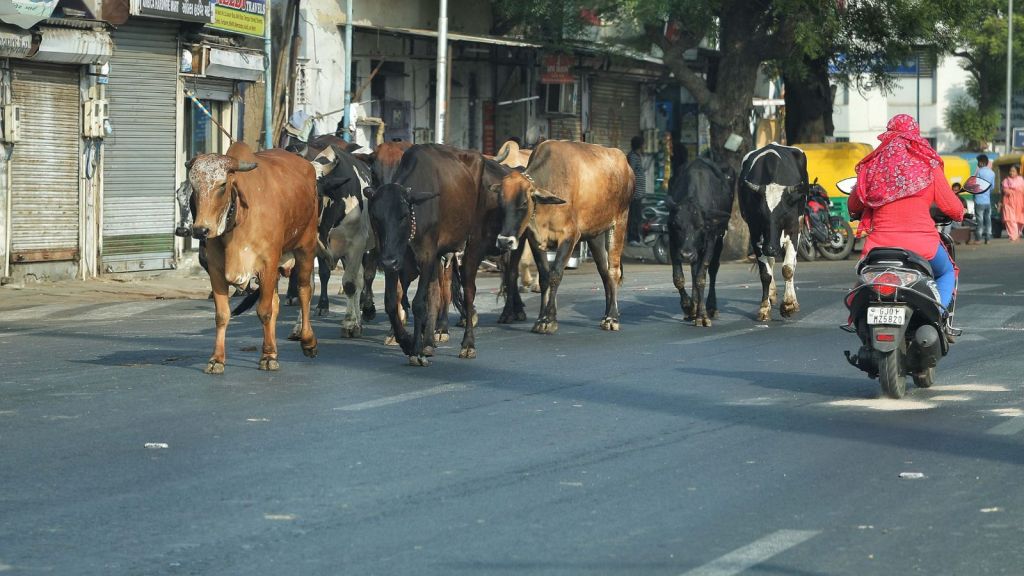 The general board of the VMC, which met Friday last week, has decided to impose a fine of Rs 1 lakh for serious injuries caused to victims involved in accidents with cattle and Rs 5 lakh in case of death. (Express photo by Nirmal Harindran)
The Vadodara Municipal Corporation (VMC), which has drawn much flak for accidents involving stray cattle, has passed a resolution enlisting the new cattle policy to be implemented in the city limits, based on the recommendations of the Gujarat government.
The general board of the VMC, which met Friday last week, has decided to impose a fine of Rs 1 lakh for serious injuries caused to victims involved in accidents with cattle and Rs 5 lakh in case of death. The amount will be paid to the victim by the civic body and later get it reimbursed from the cattle owners, the resolution on the new “stricter” cattle policy stated.
The resolution, which is in addition to the state government guidelines to “appropriately penalise cattle owners”, states that if the cattle owners “do not pay the penalties, the same should be added to their property tax bill. In case of escalation and non-payment, the water supply and drainage connection of the cattle sheds will be snapped by the VMC and finally, the sheds will be sealed”.
In addition to the penalties decided by the state government in the first, second and third cases of animal straying on roads, the VMC has resolved to disconnect the water supply and drainage connection and sealing of pounds in case of third offence while registering non-bailable FIRs against the owners of animals such as elephants, camels, cattle, horses, goats and sheep, mules, oxes, and pigs.
Earlier, the VMC had the provision to banish the habitual offenders under Gujarat Prevention of Anti-Social Activities Act (PASA), 1985, as well as have a Criminal Bond signed by owners against whom three FIRs had been lodged. Under the new policy, the cattle that has been involved in an accident or found astray in a third offence will also be impounded.
‘Action against those disrupting work of encroachment removal department’
The VMC has also resolved to take strict actions against those persons obstructing the work of the encroachment removal department or getting involved in brawls with the teams working on the ground. While the state government has recommended installation of cameras on the VMC vehicles used for impounding cattle and lodging police cases against “bikers gangs” of the cattle owners community that chase officials, the VMC in its resolution has stated: “Most of the two-wheelers, who are part of the bikers’ gang do not have number-plates or are broken off to hide the vehicles involved in obstructing the work… The Regional Transport Office (RTO) and the police teams must coordinate to initiate strict action against owners of such vehicles…”
Penalising owners who ‘destroy plastic RFID tags’ of cattle
Additionally, the VMC has also resolved to penalise those cattle owners who “destroy plastic RFID tags” of cattle to prevent the VMC teams from identifying the animals to be impounded.
“The Cyber Crime department must monitor and initiate action against such persons,” the VMC guidelines state. On the issue of “decentralised cattle pound”, the VMC has decided to create zone-wise modern infrastructure for cattle as against its original plan to create new cattle pounds in Khatamba and Jambuva on the outskirts of the city.
The civic body has resolved to make licensing mandatory for commercial cattle owners with more than five cattles, while the owners who are not involved in commercial business and own up to five bovines can seek simple permits, which will now be valid for a period of three years as against the earlier one-year validity. The permit renewal fee is decided at Rs 250 for three years and licence fee at Rs 500 for three years, as recommended by the state government while ‘Panjrapoles’, Gaushalas and other government-recognised institutions are exempted from the rules. A registration fee of Rs 200 has also been added, exempting the ‘Panjrapoles’, ‘gaushalas’ and other government-recognised institutions. These institutions will procure a licence issued by the VMC.
Radio Frequency Identification (RFID) tagging, which was earlier mandatory within two months of acquiring cattle, is now mandatory within a month. A late fee of Rs 1,000 per animal has been introduced in case the owner fails to have the tagging done in the stipulated time. Those who fail to comply with the requirement for over four months will see their cattle being impounded.
Earlier, the VMC had no provision to penalise people who had no cattle pounds or erected pounds on lands belonging to the VMC or the government. However, as per the new policy, the state government has recommended that such owners must remove their cattle from the city jurisdiction within two months and shift to any other location. The VMC has additionally resolved to “remove the encroachment from the land belonging to the VMC and also file a case under the Land Grabbing Act, if deemed necessary”.
The new guidelines also make it mandatory for the city and rural police teams to coordinate with the staff of the VMC to crack down on straying cattle and register case if necessary.
Stay updated with the latest - Click here to follow us on Instagram