ON DIWALI night, the smell of acrid smoke permeated the atmosphere, making driving through the roads of Ahmedabad treacherous not just due to fear of a stray firecracker finding its way to vehicles or the loud sounds of ‘sutli’ bombs startling drivers, but because the air was toxic and motorists were barely able to see more than 20 feet ahead due to the heavy smog settling at ground level, rendering even street-lights dim.
Against the WHO standard of PM2.5 levels at 15 μg/m3 (microgram per cubic metre), and PM10 levels at 45 μg/m3 in 24 hours average calculation, the average PM2.5 concentration in Ahmedabad reached 156 μg/m3 (10 times), and PM10 concentration reached 207 μg/m3 (4.6 times) in the 24-hour-period between 4 pm on October 20 and 4 pm on October 21.

The air pollution data collected from the Central Pollution Control Board (CPCB), through seven of the nine Ambient Air Quality Monitoring Stations (AAQMS) in Ahmedabad, showed that particulate matter (PM2.5 and PM10) pollution went through the roof in Ahmedabad on Diwali night on October 20 and their levels further peaked after 12 am, in the wee hours of October 21.
The seven stations are at Chandkheda, Gyaspur, Maninagar, Raikhad, Rakhial, ISRO Bopal, ISRO Satellite. Two stations that have not been used are the one at SP Stadium since it is non-functional and the one at SVP Airport since there are no pollution levels there as no firecrackers are burst on the premises.
Since specific AQI data is not available for Ahmedabad, experts said that major contributors to air quality index are levels of PM2.5 and PM10 pollutants in the atmosphere, leading to these measures being used here.
Particulate matter & air quality standards
Dr Ankit Viramgami, Medical Scientist in the Health Sciences Division, at the National Institute of Occupational Health (ICMR-NIOH), explaining the difference between particulate matters, told the Indian Express “Dust is measured in aerodynamic diameters and accordingly, we have two main types of particulate matter pollutants – PM10 and PM2.5. Compared to PM10, PM2.5 are more tiny in size(30 time smaller than our hair diameter) and they go deeper into lungs and over there, either retain in lung or mix into the bloodstream. They are more closely linked with severe respiratory illness, premature death and heart diseases compared to PM10. As PM10 are relatively larger than PM2.5, their large portions are filtered out in nasal and throat passage with natural lung defence mechanism.However, they are also linked with respiratory irritation and aggravations of illness like asthma.”
The World Health Organisation (WHO) recommends PM2.5 levels at 15 μg/m3 (microgram per cubic metre), and PM10 levels at 45 μg/m3 in 24 hours average calculation.
India, meanwhile, has adopted the National Ambient Air Quality Standard (NAAQS) where PM2.5 and PM10 value for 24 hours have been set as 60 μg/m3 and 100 μg/m3 respectively.
PM2.5 levels
In Ahmedabad, in the 24 hours between 4 pm on October 20 and 4 pm October 21, the average PM2.5 levels of the seven monitoring stations reached 156 μg/m3.
Of these, the highest PM2.5 levels in a 24-hour period were seen at Maninagar (192) and Chandkheda (184).
However, while the 24-hour average of the PM2.5 pollutant was already 10 times more than WHO recommended levels, the situation was worse in the eight hours of the intervening night of October 20 and 21, when the maximum amount of firecrackers were used in the city.
These include the last four hours (8 pm to 12 am) of October 20 and the first four hours (12 am to 4 am) of October 21.
The average PM2.5 pollutant level from seven stations for the time between 8 pm and 12 am on October 20 night was at 241 μg/m3. This increased to a whopping 676 μg/m3 between 12 am and 4 am on October 21.
The PM2.5 levels went up from 190 to 888 μg/m3 in Satellite, the highest in the city. This was followed by Rakhial where the pollutant level went up from 274 to 830 μg/m3. In Chandkheda, it went up from 360 to 727 μg/m3.
PM10 levels
In Ahmedabad, in the 24 hours between 4 pm on October 20 and 4 pm October 21, the average PM10 levels of the seven monitoring stations reached 207 μg/m3.
Of these, the highest PM10 levels in a 24 hour period were seen at Maninagar (310) and Bopal (237).
However, while the 24-hour average of the PM10 pollutant was already 4.6 times more than WHO recommended levels, the situation, in this case too, was worse in the eight hours of the intervening night of October 20 and 21, when the maximum amount of firecrackers were used in the city.
These include the last four hours (8 pm to 12 am) of October 20 and the first four hours (12 am to 4 am) of October 21.
The average PM 10 pollutant level from 7 stations for the time between 8 pm and 12 am on October 20 night was 380 μg/m3. This increased to a whopping 722 μg/m3 (5 stations) between 12 am and 4 am on October 21.
The PM 10 levels went up from 597 to 925 μg/m3 in Maninagar, the highest in the city. This was followed by Gyaspur where the pollutant level went up from 182 to 743 μg/m3. In Chandkheda, it went up from 454 to 738 μg/m3.
Reported & unreported medical emergencies
On the human impact of firecrackers pollution, Dr Sweta Purohit, Programme Director (Climate Change) at the Centre for Environment Education (CEE) Ahmedabad, said, “Increased particulate matter leads to atmospheric haze, reduced visibility, and altered sunlight penetration, affecting local climate conditions. PM2.5 and PM10 can trap heat and change meteorological parameters, influencing temperature and humidity. Street vendors, rickshaw drivers, and poor communities living on the streets inhale large volumes of polluted air due to their outdoor occupation/living. Studies show that these individuals experience more frequent respiratory infections and chronic cough after Diwali or similar large-scale firecrackers bursting during other occasions.”
However, the emergency ambulance service GVK-EMRI reported only slightly higher calls during Diwali against the average with regards to patients requiring transport to hospitals for breathing problems. While the average cases in Ahmedabad are 78, this number went up to 89 on the day after Diwali. On this, Dr Rahul K Jalan, Consultant Interventional Pulmonologist at Apollo Hospital said, “It is only the most critical patients who would go to hospitals in ambulances while most patients with a history of respiratory diseases would go to their doctor by themselves. My own Outpatient Department (OPD) cases have risen by 150 per cent in the three days of Diwali festivities (October 20, 21, 22). The situation is most likely more dire among the poor population who go to their local family physicians. This data is not available anywhere unfortunately.”
Speaking on the types of cases he saw during Diwali, Dr Jalan said, “On the day of Diwali, we saw an abrupt deterioration of air quality and as a result, in the last 2-3 days, we saw patients who had not visited in four-six months, coming back with breathing problems. We saw this effect more in patients with a history of respiratory ailments and especially those above 50 years of age. In normal patients sans comorbidities, we have also seen a rise in respiratory tract infections and shortness of breath.”
Impact of particulate pollution on the environment
Regarding the impact of particulate matter pollution on plants, Dr Purohit said, “The smoke from firecrackers coat leaves with soot and toxic chemical residues (lead, zinc and cadmium), directly inhibiting photosynthesis. It also results in damaged leaves, stunted growth, and premature dropping which is common, especially in urban trees and crops exposed to persistent pollution.”
Regarding the impact on land, she added, “Firework chemicals settle in city soils, leading to increased levels of toxic metals like lead, zinc, and cadmium, which can poison soil microbes, reduce bacterial diversity, and impair the breakdown of organic matter. Soot and metallic residues alter soil chemistry, hinder root growth, and potentially enter the food chain through plants. Urban gardens and agricultural soils are particularly vulnerable during Diwali.”
On impact on animals, Dr Purohit said, “As we all know, firecrackers distress pets, stray animals and wildlife, causing anxiety, panic, injuries and behavioral disturbances. Many animal injuries are reported every year due to Diwali pollution and noise. Birds, especially nocturnal species, lose foraging ability due to illuminated skies and may abandon nests, while respiratory ailments rise in both domestic and wild animals.”
Human health, post-Diwali
Dr Jalan predicts a rise in the number of patients with viral infection, indicating that the repercussions of firecrackers will be felt even after the festival. He said, “When there is excessive smoke, more mucus is produced and there is more inflammation, thus making a person more prone to viral infections. This peak will come one week post Diwali.
Dr Bhavesh Modi, Director of ICMR-NIOH in Ahmedabad, raised concerns regarding the continually raised levels of particulate matter in the air of Ahmedabad. He said, “While the rise of PM2.5 on Diwali night due to firecrackers is well known, it is concerning to see that levels of these pollutants remain high above the air quality standards round the year, irrespective of festivals. Stakeholders and the administration need to work together to ensure that these levels are brought under control.”

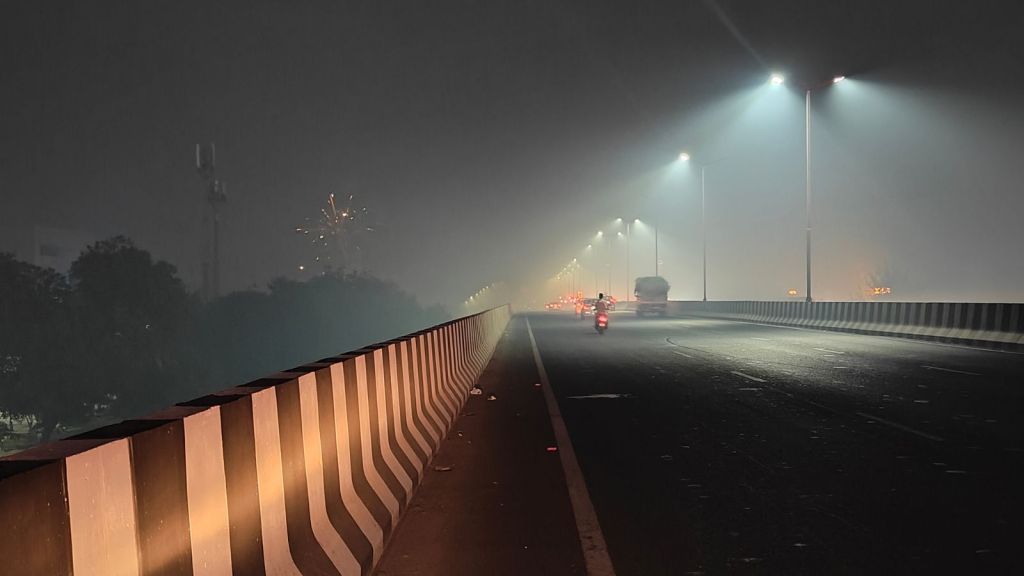 The PM 10 levels went up from 597 to 925 μg/m3 in Maninagar, the highest in the city. This was followed by Gyaspur where the pollutant level went up from 182 to 743 μg/m3 (Express Photo)


 Share


