With an aim to complete the Gujarat stretch of the Mumbai-Ahmedabad High-Speed Rail Corridor, popularly called the Bullet Train, by December 2025, the National High Speed Rail Corporation Limited (NHSRCL) is simultaneously completing construction of 11 unfinished river bridges of the 20 located in Gujarat, including the longest one — the 1.4-kilometre bridge on the Narmada River.
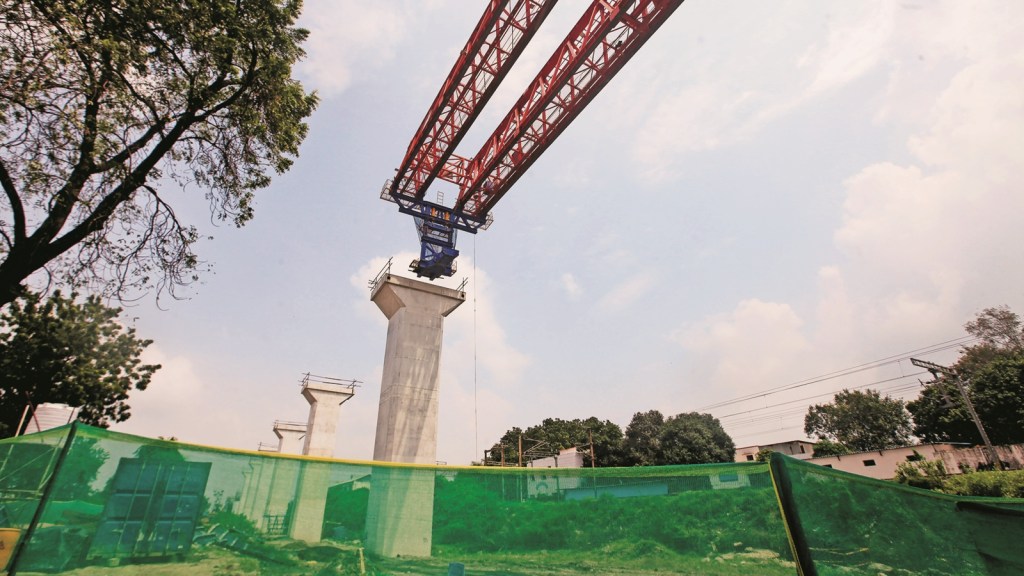
The construction on the Narmada river bridge is currently on and the NHSRCL is set to attempt girder-launching from both ends of the structure located between Surat and Bharuch railway stations, in order to expedite the construction. Of the 24 river bridges along the course of the bullet train from Ahmedabad to Mumbai, 20 are located in Gujarat.

Pramod Sharma, Director, Works, NHSRCL, who was in Vadodara Wednesday to check the ongoing work under the C5 package of the bullet train, told The Indian Express that the girder-launch work on Narmada bridge has already begun from one end. Sharma said, “Although Vaitarna bridge in Maharashtra will be the longest on the route, the Narmada bridge has its own challenges, especially since it has a total of 25 well foundation circular piers, of which five wells are deeper than 70 metres and four wells will surpass even the 72.5 metre height of the Qutub Minar in Delhi.”
To address the challenge of tilting and shifting of well foundation structures due to natural forces such as tidal waves, high river flow, and soil conditions at the sinking level, the Jack-Down method was deployed, the NHSRCL said.
Earlier, the construction was hampered due to the floods in Narmada River in September 2023. The NHSRCL said that the work on 19 of the 25 wells was completed last month, adding the work on the superstructure had also commenced simultaneously.
Apart from the Narmada bridge, Sharma said a major challenge they were faced with was the rockbed in Kolak River in Valsad district. Sharma said that the NHSRCL deployed the rock-socketed pile technology to drill the rocks and fill it with steel and concrete. “With homegrown technology after an MoU for technology transfer with our Japanese partners, we have been able to speed up the construction on most of the bridges,” Sharma said. Notably, Kolak river is the only river in Gujarat with a rocky bed.
The NHSRCL has already completed 11 of the 20 bridges located in Gujarat, including on Kaveri (120m), Purna (360m), Mindhola (240m), Ambika (200m), and Venganiya (200m) in Navsari district; Kolak (160m), Par (320m) and Auranga (320m) in Valsad district; Mohar (160m) and Vatrak (280m) in Kheda district; and Dhadhar (120m) in Vadodara district.
Sharma said the geological challenge was overcome across the elevated corridor by setting up “Asia’s biggest geotechnical lab in Surat”. Sharma said, “Of the 352 kilometres in Gujarat, 212 kilometres of viaduct is already completed… This has not been easy as soil conditions varied across the length of the project. The geotechnical lab set up in Surat worked day and night to dig borewells every 100 metres across the 508-km course of the project and conduct the soil analysis.”
Sharma said that the use of full span launching girders has also meant that the NHSRCL is able to work 10 times faster than the regular segmental construction approach. “As against four girders in one month, we are able to launch 40…We plan to begin trials of the bullet train between Surat and Bilimora in 2026,” said Sharma. The NHSRCL said that it is now preparing for the upcoming challenge of completing the high-speed rail corridor alignment across the existing Vadodara railway station with a total of 16 spans of 40 and 45 metres on portal piers, which will begin in early 2025.
Chief Project Officer, Vadodara, Pradeep Ahirkar said, “The corridor runs very close to regular railway traffic and so, safety is the biggest priority and challenge in this project.”



 Share


