More than a week after the Gujarat Police booked 21 protesting farmers here after effigies of Prime Minister Narendra Modi and Home Minister Amit Shah were burnt by them on the PM’s birthday on September 17, no notices have gone out or any further action taken.
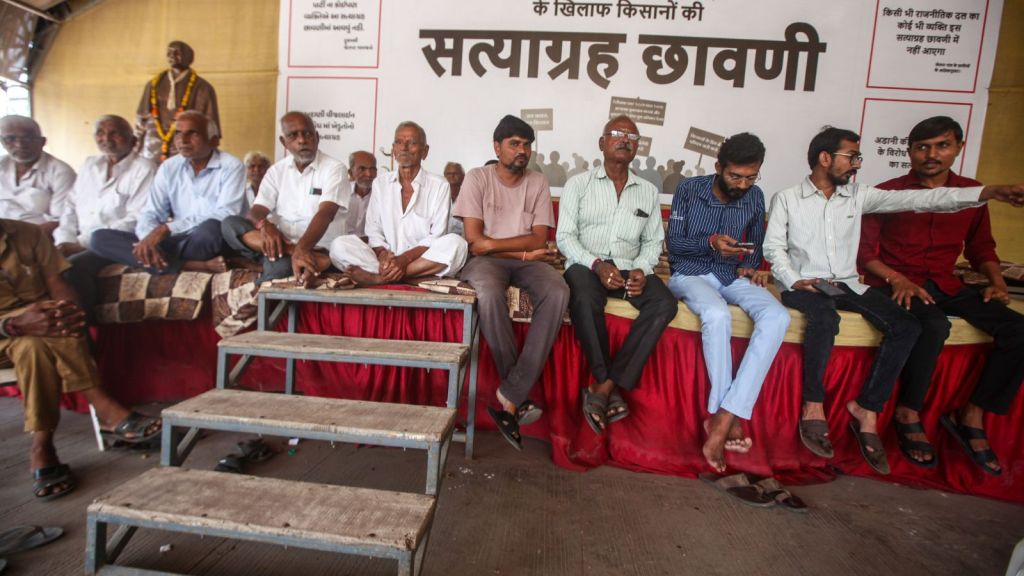
But, anger over the issue behind the protests simmers. On Friday, more than 9,000 farmers held a dharna at the Morbi Collectorate, joined by their counterparts from other districts.
The latest round of protests has been sparked by notices served to all landowners who either have transmission towers or line corridors of a 765 kV Halvad Transmission Line and an 800 kV Transmission Line passing through or over their fields. The notices, served on September 23, asked them to appear within two days before a Market Rate Committee (MRC) at the Collectorate, to nominate the valuer for their land, or the government would do it for them.
 765kV power transmission tower bases in Nava Devaliya and Juna Devaliya villages of Morbi (Express Photo by Bhupendra Rana)
For the farmer leaders, this fit a pattern they have been protesting against since July: of the State forcing their hand to take part in the compensation process for the transmission lines, on a percentage decided by it. The protest has brought work on laying the powerlines to a halt. They also claim that many of the 21 booked on September 17 were not even present at the site where the effigies were burnt. The case has been transferred to the Local Crime Branch of the Morbi police.
It began as a protest in Jetpar, largely against the 765-kV transmission line being set up by Halvad Transmission Limited, a Special Purpose Vehicle owned by Adani Energy Solutions. Now, it has burgeoned into a protest against all planned transmission lines by different companies across Morbi, and against the compensation policy itself, through MRCs.
Farmers said the September 23 notices also covered the 800-kV line being put up by Power Grid Corporation of India, which was a first.
“We called every man, woman and child to protest at the Collectorate,” says Nehul Dhirajlal Amrutiya, one of the young leaders of the agitation. His farm, on the edge of Jetpar and Nava Devaliya villages, has been dug up for a tower for the 765-kV transmission line.
Story continues below this ad
While several such towers stretch into the distance here, the power lines are missing in parts, as farmers hold out.
On the compensation formula, Nehul says: “It is 200% of the value of the area occupied by a tower base and 30% of that of the area under a RoW (Right of Way) corridor… But this does not cover the entirety of losses for farmers.”
Apart from more compensation, he adds: “We are suggesting that the power lines go through the Little Rann of Kutch (which is sparsely populated). And if that is not possible in certain districts, the lines be put underground. You cannot aim for a cheaper project at the cost of farmers.”
After the latest notice, farmers have raised another issue – that of time – saying two days to appear before officials is just not enough, particularly for those landowners settled outside, including abroad.
Story continues below this ad
Nehul asks what the government’s “hurry” is. “It is the business plan of a company, the compensation is to be paid by the company, then why is the government in their favour and not in that of the farmers?”
The fears and allegations are unfounded, says Morbi Collector Swapnil Khare. “The purpose of the September 23 notices was just to inform the farmers that the process is on. The valuation won’t be done in a day. Once the valuers are nominated, 21 days will be given for valuation. Those who are not able to come will get another chance to appear.”
On how many farmers in total are affected, the Collector says he does not have the exact number, as the issue involves different companies and many villages. However, the compensation process has been crawling, he admits. “We have set up seven MRCs and conducted the valuation of 102 survey numbers, with 44 farmers paid.”
While Gujarat Energy Minister Rushikesh Patel remained unavailable for comment despite several attempts, Morbi’s six-time MLA Kantilal Shivlal Amrutiya, who is also a Minister of State, says the farmers may be protesting, “but according to the new resolutions, they will get three times as much (compensation) than earlier”.
Story continues below this ad
At Juna Devaliya village, 12 km east of Jetpar, Vinod Baval Aghara was among those whose land was one of the first to be surveyed. A 765-kV tower was erected on his land in 2025, with the caveat that he would reserve his objections, he claims.
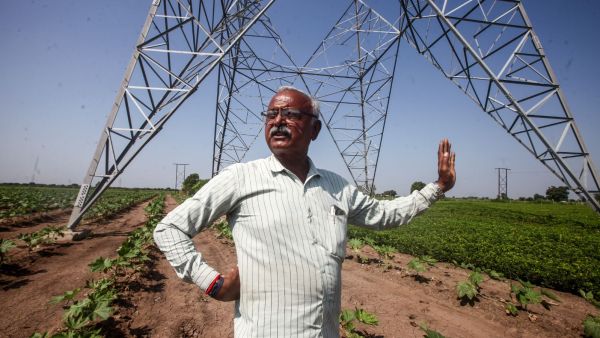
Vinod Baval Aghara in his groundnut farm in Juna Devaliya village of Morbi (Express Photo by Bhupendra Rana)
The 765-kV tower and power line corridor go through 10 out of Agahar’s 42 bighas of land, planted with groundnut, pomegranates and castor.
Aghara, who was one of the winners of the Krushi Na Rushi Award in 2011, for his “progressive farming techniques”, claims the value of his land has “fallen… from Rs 55-60 lakh to less than half”.
There are other fears. At Nichi Mandal village, located on Morbi-Halvad road, Naval Narbheram Kundariya filed a complaint on August 26 seeking legal action over the damage done to the land and standing crops of farmers in the village after a live high-tension line collapsed on it.
Story continues below this ad
Rajesh Panchotiya says his family too has lodged a complaint over a 220-kV line snapping in August in Sarambhada village, along the Morbi-Halvad road, causing damage to farm property and equipment.
Farmers say neither of these complaints has been converted into FIRs. Inspector N S Ghetiya of Morbi Taluka Police Station said that diary entries had been made in the complaints, and the same forwarded to the transmission company concerned for further action.
In Vaghpar village, which lies about 5 km west of Jetpar, Arun Magan Sanavada, who owns 10 bighas with a nephew, says their land had been surveyed for the 800-kV transmission line. “They keep praising the Gujarat model. But where is the Gujarat model when it needs to work for farmers?” he says.
Yogesh Manilal Kadivar points out that his situation is even more complicated. His 10 bigha cotton farm in Piludi has been surveyed for both the tower and corridor of the 800-kV line, and also falls in the corridor of the 765- kV line – the two projects accounting for over 70% of his land, he says.
Story continues below this ad
One striking feature of the protest has been the presence in it of Ratilal Shivlal Amrutiya, the brother of MLA Kantilal Amrutiya.
Says Ratilal: “We are not against a political party, but against those in the government who are responsible for this issue. We are only fighting for the farmers. Jetpar is my ancestral home.”
Ratilal adds: “Many youngsters today go and work in the ceramic industry. If there is a problem there, what will happen to them if they cannot come back to work on their farms?”
However, Kantilal rules out any change in the route of the power transmission lines. “The route will not be changed,” says the MoS. “If they want, the first tower can be put up on my land itself.”




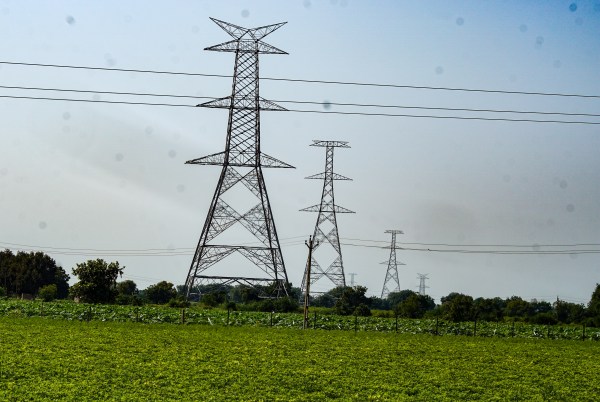 765kV power transmission tower bases in Nava Devaliya and Juna Devaliya villages of Morbi (Express Photo by Bhupendra Rana)
 Vinod Baval Aghara in his groundnut farm in Juna Devaliya village of Morbi (Express Photo by Bhupendra Rana)
