


Stay updated with the latest - Click here to follow us on Instagram

Journalism of Courage
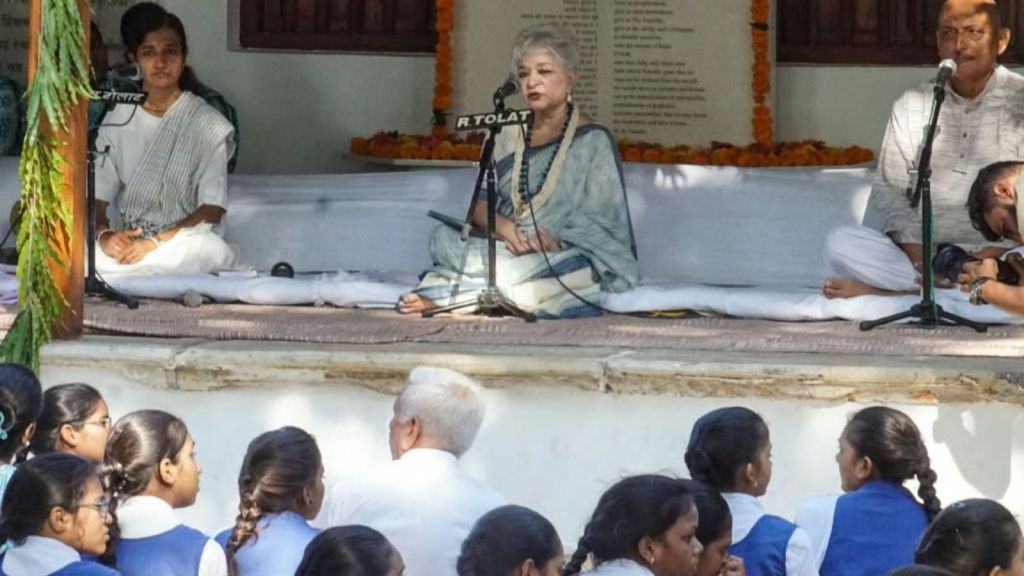 Tyabji emphasised that the national flag's "base material" was equally important to its creators. (Express Photo)
On Gandhi Jayanti, craft activist Laila Tyabji called for a protest against polyester in the Indian national flag and urged a rethink of how khadi is produced and promoted.
Speaking from the verandah of Hriday Kunj, Mahatma Gandhi and Kasturba Gandhi’s former home at Sabarmati Ashram in Ahmedabad, Tyabji criticised the 2022 amendment to the Flag Code of India that allowed machine-made polyester flags.
She said the move undermined the flag’s association with handspun and handwoven khadi, as well as the livelihoods of spinners and weavers.
“Let us all loudly protest the legitimised intrusion of polyester in our flags. Gandhi would have been aghast at the desecration of his beloved fabric of freedom and the tiranga”.
The Flag Code was amended in 2022 to allow machine-made polyester flags. The original 1947 code mandated flags made of handspun and handwoven wool, cotton or silk khadi.
Calling the Khadi and Village Industries Commission (KVIC) “a creaking ancient organisation that refuses to move forward,” the co-founder of Dastkar, an NGO working for revival of traditional crafts, said, “We need to take khadi and Swadeshi out of the hands of the Commission and rebel against the ridiculous prohibition of anyone else using the word ‘khadi’ to market it”.
‘Symbolic metaphor for India’
Tyabji, 79, recalled how on Independence Day, when the flag was hoisted in her home, every slum, office, and dwelling flew a flag. “However, it was difficult to find cotton flags, let alone khadi ones”.
Emphasising how the flag’s “base material” mattered as much as its design, Tyabji said, “In its design, the Tiranga, our national flag, was intended as a symbolic metaphor for India, its diverse communities, and people linked together by the sacred wheel of the Ashoka Chakra”.
Tyabji’s mother, the late Surayya, is credited with designing the Ashoka Chakra that would eventually replace the charkha at the centre of the flag. Surayya was the wife of Badruddin Tyabji, a lawyer, politician and a close associate of Gandhi.
Laila also recounted how Gandhi would often stay at their house on Warden Road in Mumbai.
“For Gandhi and successive post-Independence generations, the flag embodied our identity, our ideas, our hopes, and our vision for the future,” said Tyabji, adding that producing these flags gave work to “thousands of spinners and weavers” over the years.
“The Indian flag market is already flooded with synthetic flags, sold all over the country from street corners to sports stadiums. Ironically, most are from China, a country with whom we have an armed dispute on our borders, robbing already strained rural spinners, weavers, and tailors of the much needed employment and earning. And now this has been made legal and official,” said Tyabji.
‘Let’s bring khadi back’
Advocating for “revival and contemporising khadi,” Tyabji said that while khadi and village industries are part of India’s culture and aesthetic, “employing 57 lakh people and generating Rs 2,500 crore a year,” our “unique hand skills give us a huge advantage at a time when eco practices are being seen as an answer to climate change and pollution.”
Tyabji said while for some Indians khadi is a “philosophy”, for many others it is an “outdated, redundant production system of fabric that is highly priced and expensive to maintain”. “It lacks functionality and consumer appeal”.
She said khadi needs a “new perspective”; many connected with its production were so “emotionally committed” that they saw any change in traditional production, marketing, or promotion “as a threat to its intrinsic Gandhian social and philosophic value”.
“Let us contemporise it (Gandhi’s message) and bring khadi back into the mainstream. If we are to survive, it cannot remain static, locked in mindsets, production, and marketing strategies that are now redundant,” said Tyabji.
She added that there were many ways of producing “more and cheaper flags,” like setting up more production units, investing in, and streamlining production, “making handmade paper flags which are biodegradable,” or training women to stitch flags “and remove that absurd ban on anyone except KVIC marketing khadi”.
“Importing synthetic polyester flags is certainly not the answer,” said Tyabji.
Referring to campaigns by Prime Minister Narendra Modi, she said, “What happened to Aatmanirbhar Bharat and Make in India? And whatever happened to our pride and Swadeshi?”
Kartikeya Sarabhai, chairperson of the Sabarmati Ashram Preservation and Memorial Trust (SAPMT); Atul Pandya, director of Gandhi Ashram; and Jayesh Patel, trustee of the Sabarmati Harijan Ashram Trust, were present.
The event opened with an all-religion prayer meet and the singing of Gandhiji’s favourite bhajans, “Raghupati Raghav” and “Vaishnav Jana”. Many students were also present, including those from the Ashram Vinay Mandir school; some were seen spinning cotton thread on a charkha.
Stay updated with the latest - Click here to follow us on Instagram