Standing on Vadodara’s Asoj-Savli road is a unique seven-storey brick-and-lime plastered subterranean well, featuring a long corridor of steps that descends through dramatic arches beneath a canopy of banyan trees on the first level. Popularly known as the Asoj Vav (stepwell), it was a lifeline for local residents, who believe that Rabari Aso—from a group of banjaras (wanderers)—constructed the well over 500 years ago.
Facing neglect and abandonment for centuries, like most other stepwells, the Asoj Vav came alive on November 23 through a storytelling performance by Vadodara-based visual artist Kakoli Sen, who has been advocating the restoration of stepwells across Gujarat.

Sen wove a narrative around the rudimentary architecture, which has a unique aspect in the form of the banyan tree canopy. Artists performed on the uppermost level of the vav, using multimedia, lighting, music, and dance to bring the story of the stepwell to life in the first person. Asoj is part of her series of over a dozen performances at stepwells across Gujarat. In Vadodara, Sen has organised visual shows for stepwells in Navlakhi, Sevasi, Koyali, Hanumant Vav in Bhayli, and Asoj, along with the Adalaj stepwell in Ahmedabad.
Sen decided to animate the vavs through her stories as an extension of the project titled Soul of the Vav, part of the Bengaluru-based Centre for Internet and Society’s Maps for Change initiative. She explains, “As I grew up in Delhi, architecture was part of my canvas as an artist. I was drawn to the beauty of stepwells and decided to undertake mapping… But it turned into a project where I now personify the stepwells through stories to create awareness about the magnificent architecture built centuries ago that is facing neglect. These are the only architectures that are below the ground. We have over 60 stepwells in Vadodara, but most of them are lost and do not receive the same recognition as Rani ki Vav in Patan.”
Unique L-shaped design
In Vadodara, Sen has chronicled the magnificent 600-year-old Navlakhi Vav and the Vidyadhar Vav in Sevasi, which remain among the better-known spots. She notes that the Navlakhi Vav, the main source of water during the construction of the Lukshmi Vilas Palace, continues to supply water to the golf course built on the palace estate.
Sen says, “Navlakhi is the only remnant of Gurjar rule. It is located in the Lukshmi Vilas Palace compound and is more than 600 years old. The inscription in the vav mentions Zafar Khan as the governor of the province of Gujarat. He assumed his regal title, Muzaffar Shah, in 1407-08. A book, Baroda Nagri no Prachin Itihas, states that on one of the lower floors of the vav is a Brahmi inscription saying Suryaraj Kalchuri, a general of the Gurjar kingdom, built the stepwell when the city was known as Vatpadra. It’s said that the Vav was called Navlakhi because nine lakh gold coins were spent to build it. It was refurbished in the time of Muzaffar Shah…”
Facing neglect and abandonment for centuries, like most other stepwells, the Asoj Vav came alive on November 23 through a storytelling performance by Vadodara-based visual artist Kakoli Sen, who has been advocating the restoration of stepwells across Gujarat. (Photo from Sen’s 2019 show)
Sen adds that the Navlakhi stepwell is built on an L-shaped plan and features four pavilion towers and as many intermediate supporting frameworks, which is quite unique. “These are not only two-dimensional frames but three-dimensional networks of vertical and horizontal stone beams. The entrance staircase is set at right angles to the stepped corner. The right angle is covered with a platform and thus continues into an additional pavilion, crowned by a small canopy in the middle…”
The platform of the pavilion is supported by eight pilasters and eight pillars. This pavilion, located one storey underground, is also accessed by a narrow stairway on the western side. “The pillars and pilasters are of two types: one more simple and plain, similar to that in the stepwell of Sevasi, while the others are very ornate, resembling vases with emerging scrolls. The entablature in the pavilions and frameworks bears designs of hanging leaves and scroll patterns on their horizontal beams,” she explains.
The ceiling ornamentation inside the first mandapa consists of rows of half medallions adorned with flower petals, garlands, and leaf patterns. The ceiling is embellished like a vast flower saucer. An inscription in Persian mentions 1405 as the year of completion of the Navlakhi stepwell.
Rich in local legends
The Vidyadhar Vav is situated in Sevasi village, approximately 6 km from Vadodara city. Laid out to the east with its entrance facing west, the stepwell features five pavilion towers and five intermediate supporting frameworks. A round parapet wall of about half a metre high surrounds the stepped corridor and the well. The pavilion towers are supported by four pilasters and four pillars. The lintels of the pavilion towers are either decorated with rows of elongated leaf patterns or flowers, interspersed with carved garlands. The entablatures of the pillars bordering the middle pathway of kuta—a tower-like pavilion construction in a stepwell—are beautifully carved with sculptures depicting a horse led by its rider. The horses are adorned with bands, tassels, and ornaments, with one raised leg resting on a wave, a common motif in stonework. Some panels depict geese with scrolls hanging from their beaks and elephants.
Popularly known as the Asoj Vav (stepwell), it was a lifeline for local residents, who believe that Rabari Aso—from a group of banjaras (wanderers)—constructed the well over 500 years ago.
“A stone masonry at the entrance features a name inscribed in Devanagari script. The gate is adorned with two tigers carved on the left and two elephants on the right. Stepwells were used to store rainwater and became sources of legends. Locals say that young girls decked in gold were sacrificed at the Sevasi stepwell on full-moon nights for prosperity,” Sen says.
For Sen, documenting the stepwells has presented its own challenges. “People living around stepwells today are often unaware of their stories. In many places, locals discourage me from undertaking projects to revive the stepwells, as the ruins have become dens for anti-social elements… But these are ornate underground structures that have stories to tell. I believe that although we have modernised water supply, the stepwells continue to hold relevance for regenerating groundwater and must be restored to their former glory.”

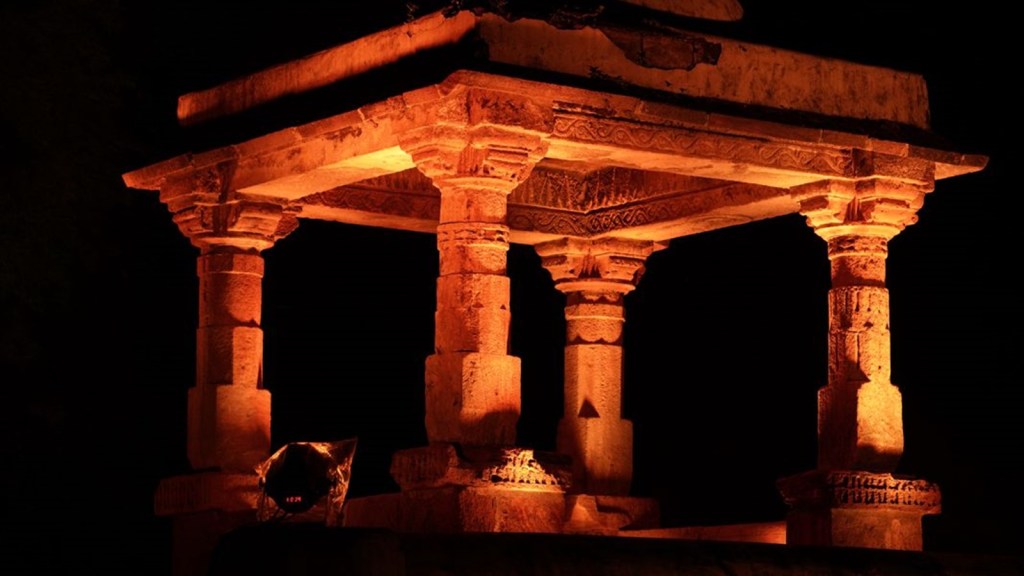 avlakhi Vav, the main source of water during the construction of the Lukshmi Vilas Palace, continues to supply water to the golf course built on the palace estate. (Photo from Sen’s 2019 show)

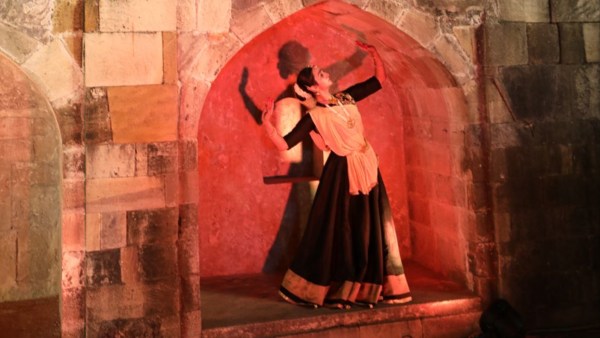 Facing neglect and abandonment for centuries, like most other stepwells, the Asoj Vav came alive on November 23 through a storytelling performance by Vadodara-based visual artist Kakoli Sen, who has been advocating the restoration of stepwells across Gujarat. (Photo from Sen’s 2019 show)
 Popularly known as the Asoj Vav (stepwell), it was a lifeline for local residents, who believe that Rabari Aso—from a group of banjaras (wanderers)—constructed the well over 500 years ago.


 Share


