In the day, one can shop for silver or gold jewellery at the Choksi’s, exchange torn currency notes at the Gupta’s store and buy traditional clothes and jewellery. By night, Manekchowk- a square at the centre of old Ahmedabad turns into a food court offering everything from greasy dosas to kulfis.
As the sun sets and the jewellers and others close shop and clear the makeshift parking lot, the space opens to the food court that runs till 3 am, catering to a range of clients from casual tourists to the ones doing graveyard shifts.
Shankarbhai Bhatt, whose family has been running a gold jewellery business for 50 years, will tell you about the story from the 15th century of Ahmed Shah badshah, who decided to establish the city and the hermit Maneknath, after whom the square takes its name. And how the Maneknath would advise the king to build a city here.
“Nowadays, you can see the craze of people visiting here for shopping and night street food”, says Bhatt.
Dhiren Siju, studying engineering in a college in Ahmedabad, is from Kerala and is a regular at Manekchowk food court.
“Manek Chowk is where we can buy anything we want at an affordable price. I prefer Manek Chowk with my friends for a night out rather than cafes because it is open till 3 am. It also fits our budget, and we greatly enjoy the food here.”
Siju and his friends come from the S G Road side on the far west of Ahmedabad to Manek Chowk across the Sabarmati river on the east to dine.
 Mukesh Darji, owner of the oxidised jewellery shop, believes you will earn whatever you sell in Manek Chowk. (Express photo)
Darshan Chokshi, who owns and runs V N Gold Palace jewellery shop since 1996, has seen how crowds here double during the festive season.
“It is better to go to Manek Chowk than to a restaurant as the food is prepared in front of you, and you can check the quality yourself. My favourite at Manek Chowk is the Bhaji pav. People from various cities also visit this place, especially for dinner. As per tradition, people buy gold during Diwali, but the amount people buy has decreased due to a super hike in gold prices.”
Kinjal Patel, who owns the Bombay Gulalwadi dosa shop, says how his was the second food store here after Kailash Bhaji Pav.
“After one week of Bombay Gulalwadi, the whole food court developed. Earlier, Manek Chowk was popular in the textile market, but nowadays, it’s about the gold and silver industry. The speciality of Manek Chowk is that the original taste of food is still the same. Numerous varieties of food are available so that customers can easily get any kind of food. Although the number of customers is increasing throughout the night and even customers can’t get enough space to park their vehicles, we try our best to serve our customers as fast as we can. So that others who are waiting can get food as soon as possible.”
Jay, who owns Bastiram’s rabri kulfi, another favourite at Manek Chowk, is a fourth-generation owner from a family migrated from Uttar Pradesh.
“Bastiram, my great-grandfather, initiated the idea of this shop in 1947 and I’m continuing our family business after graduation. As I’ve been running this business for the past 22 years, I’ve witnessed many changes in Manek Chowk. Most of the stalls here are preserved by their descendants. Many new food vendors also got involved recently as the new variety of food was introduced amongst the foodies. Previously, only pav bhaji, sandwich, dosa, bhelpuri – chatnipuri and kulfi were there.”
Jay, who owns Bastiram’s rabri kulfi, another favourite at Manek Chowk, is a fourth-generation owner from a family migrated from Uttar Pradesh. (Express photo)
Jay says, “Whatever the weather, the number of customers is, we always serve fresh food to customers, and we never compromise with the food quality. Usually, we bring limited materials as per the daily demand. Still, it’s our protocol to share the remaining baked food or serve it to stray animals, especially cows, after doing good business and baking new material for the new day.”
Atul Shivabhai Langariya, manager of Asharfilal Kulfi, a shop that has stood since Independence, began as a milk vendor and then took to kulfi production.
“Now we have 12 branches. In the whole of Ahmedabad, the original “matla kulfi” is only available here. We make items from pure milk and don’t use milk powders instead,” says Langariya. The whole of Manek Chowk is open for all 365 days but during vacation and festival seasons, the market’s charm is different, the businessmen say.
The food court Manek, literally meaning ‘jewel’, stands testimony to Ahmedabad’s history as it opens in front of the 104-year-old British-styled Ahmedabad Stock Exchange building where traders would scream their lungs out, till it shifted out to the new exchange across the river on the west side. Long-time residents will tell you how when the textile mills were running, people would go to the movies – there were 20 movie theatres around here – and then they would come to Manek Chowk to have kulfis. “During the day, one would see huge crowds below the stock market building, trading,” says Langariya.
A dying business in this market is run by Tarun Gupta, who has, for the last 28 years, exchanged torn and damaged currency notes. “We also provide change bundles for large value notes. Sometimes, the exchange rate is high due to festivals, although there is a high demand for bundles of ten rupees and 100 rupees. Their business runs till 8 pm, after which the food court remains open until 5 am on festival days.
Prahladbhai Modi, who has run the famous Mahalaxmi Dosa for 50 years, says, “The atmosphere here is completely different during Navratri and Diwali. The Manek Chowk food market is around 80 years old. Almost every food item is best here, but Gotado dosa is our special dish.”
The new addition in the past few years is the Jamun shots, which Chandubhai sells, besides other fruit juices.
“Jamun shots are most famous amongst the food court in Manek Chowk, popular among patients with diabetes. We have many flavours: guava, strawberry, kiwi, mango, paan, custard apple — of these are made from pure natural fruits. We have been in Manek Chowk for almost seven years in this business. Jamun shots are popular.”
Mukesh Darji, owner of the oxidised jewellery shop, will tell you how you will earn whatever you sell in Manek Chowk. He narrates the legend famous in this bazaar of how Goddess Lakshmi suddenly appeared before Ahmed Shah and asked him to wait till she returned to “test his patience.”
“She observed that the king was waiting eagerly for her, and blessed him saying nobody would return from his kingdom empty-handed. And that is how this became a marketplace for gold and silver”.
Kshipra Sen, a tourist from Japan, noted: “What I love most is the open-air dining experience. Amidst the festive decorations and twinkling lights, enjoying a meal feels like a magical experience. It adds a special charm to Diwali celebrations. I bought traditional clothes and some accessories from this market and then enjoyed the food here. The only inconvenience was that those waiting for a seat will keep watching you.”
Ritu Patel, a Mumbai-based design student at the National Institute of Design (NID), was in Manek Chowk for the first time.
“The atmosphere in the market is crazy. Everyone is on a mission to find the perfect Diwali outfit. It’s not just about the shopping; it’s a shared experience of joy and excitement. I tried the famous chocolate-pineapple ice cream sandwich, and this is the best.”

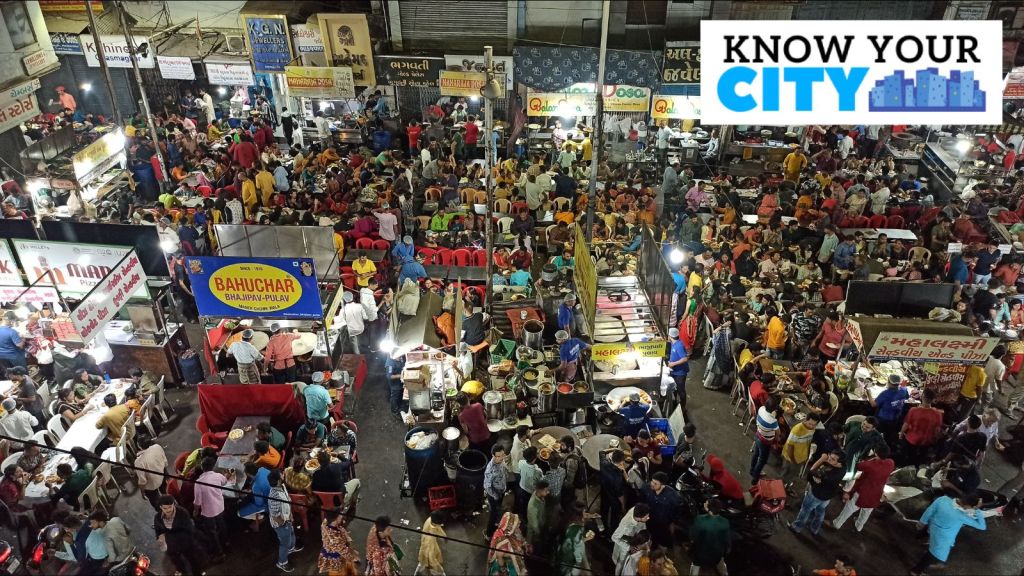 As the sun sets and the jewellers and others close shop and clear the makeshift parking lot, the space opens to the food court that runs till 3 am. (Express photo)

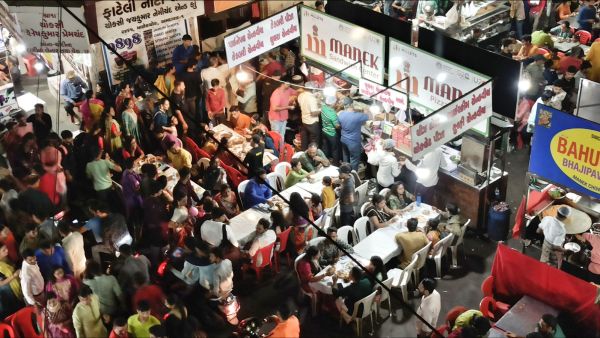 Mukesh Darji, owner of the oxidised jewellery shop, believes you will earn whatever you sell in Manek Chowk. (Express photo)
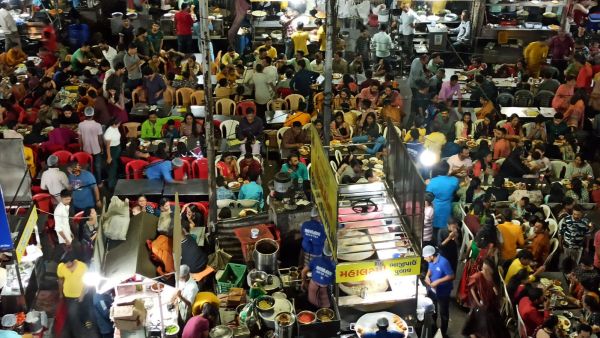 Jay, who owns Bastiram’s rabri kulfi, another favourite at Manek Chowk, is a fourth-generation owner from a family migrated from Uttar Pradesh. (Express photo)

 Share


