6 min readAhmedabadOct 18, 2022 06:04 AM IST
First published on: Oct 18, 2022 at 01:24 AM IST
Concerned over the criticism of appointment of judges and “attacks” on the judiciary on social media, the Chief Justice of India has stated that these should be controlled and strict action should be taken by the government, Union Law Minister Kiren Rijiju said Monday.
Mentioning that he has received a letter from the CJI — Rijiju did not name the Chief Justice — the minister said that he has not replied yet “soch samajh ke (deliberately)”.

“Kyunki agar jawab denge toh aage badhna padhega, aur aage badhenge toh phir desh ke liye kya hoga uska chintan manthan hoga (a reply would mean moving forward, and that would entail deliberations on what should be done for the country),” Rijiju said during ‘Sabarmati Samvad’, organised in Ahmedabad by Panchjanya, the weekly magazine published by the RSS.
“1993 se pehle ungli nahi uthate thhe kisi judge ke upar, ya court ke upar, kyunki uss samay judge log judges ke appointment mein hissedar nahi thhe; unka role nahi thha, woh dur-dur rahte thhe appointment process se. Tabhi toh uss samay judges ke upar mein logon ka jo alochana hi nahi hoti thhi. Aaj jyada ho rahe hain, mujhe bhi achha nahi lagta ki judiciary ke upar ungli utthe… (Before 1993, no questions were raised on any judge or court, as judges had no role in appointment of fellow judges; they were far from the appointment process. There was no public criticism of judges at the time; today there is a lot criticism — even I don’t like that fingers are raised on the judiciary and many are abusing them on social media,” Rijiju said.
Later in the day, while interacting with students of Gujarat National Law University (GNLU), Rijiju said the government was not happy with the decision of the Supreme Court striking down the National Judicial Appointments Commission Act (in 2015). However, he added, Parliament has the authority to enact or modify or amend this. “Many retired judges of Supreme Court, and many serving judges informally tell me and the government that NJAC was the best option and the government must take action to bring it back. I am not giving any definite word here because it is very sensitive (issue) and the government will definitely consider any step in the due course of time that is in the interest of the judiciary and the nation,” he said.
On the issue of pending cases and vacancies in judiciary, Rijiju said, “For high courts and the Supreme Court… I can clear only the names (that) come to me, if good names come to me. Courts do not have an apparatus like the government. We have intelligence sources, we have all the information and inputs that judges don’t have. So, that is why the pendency of vacancies and cases; these are all related.” The Centre is “worried” about the pendency of cases in the country, which is around 4.8 crore at present, he said.
Rijiju also noted that “the process (of appointing a new judge) is very opaque”. “Today, half of the time and mind of judges is spent on who is to be made the next judge, and not on their job,” he said. “In 1993, the Supreme Court defined the consultation mentioned in the Constitution as concurrence. Nowhere else consultation is defined as concurrence; only in case of judges appointment has SC defined it as concurrence,” he stated.
He said the Collegium system was expanded in 1998 and today, even the process followed by the Law Minister is questioned. “The system is such that the consultation process is wide and intense and not seen to people, the internal politics of the judiciary is not seen. There is intense deliberation in the selection process, there is even ‘groupism’ (gutbazi)… but on the question of collegium system and criticism of judiciary by the people, I would say that if any judge is not involved in the appointment of next judge, then he does not have the right to criticise. If a judge appoints the next judge as they come in an executive administrative process, then he can’t stay away from criticism. If you play an executive role, then you will be reviewed.”
On the infamous ‘uncle judge’ syndrome, he stated that it is natural for a judge to nominate or recommend someone he knows. “You won’t select someone you do not know. It is natural that when you are in an executive process, then the one you know or closer to you or associated with your family or persons around you, you will recommend them, nominate them,” he stated.
Replying to a question on considering the enactment of sports law in India, the Union Law Minister said that it may not be the right time currently to enact it at the central or state levels.
Citing the recent example of FIFA imposing a ban on the All India Football Federation following a Supreme Court order, Rijiju said, “…sports laws are important. But we need much more deliberations…We must have sports administration. The National Sports Code, 2011, is elaborate but it needs some review. When I wanted to review it, I could not carry forward some of my ideas because of the pandemic and later on my portfolio was shifted. In future, we can think about it,” he said.

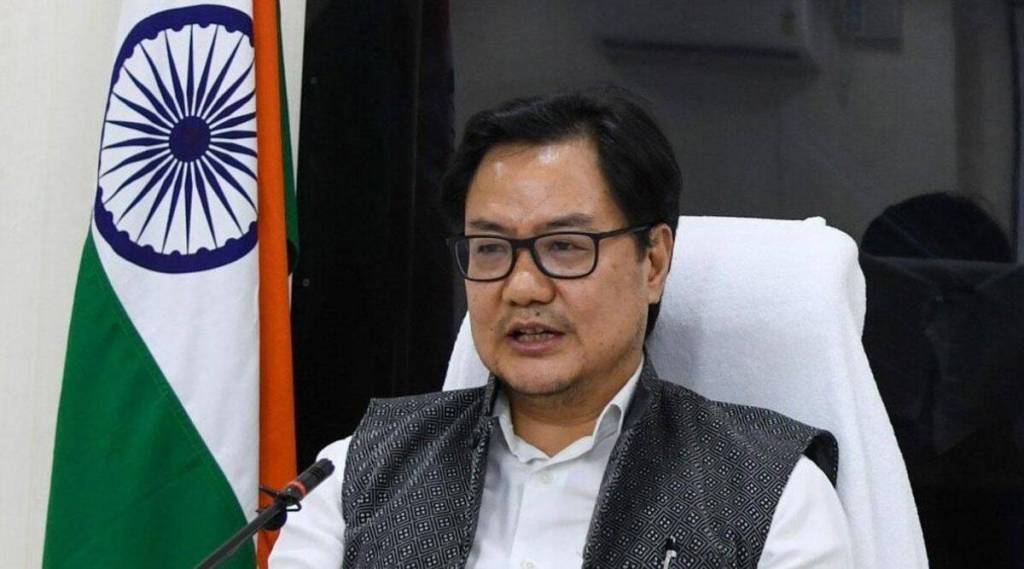 Replying to a question on considering the enactment of sports law in India, the Union Law Minister said that it may not be the right time currently to enact it at the central or state levels. (File Photo)




 Share


