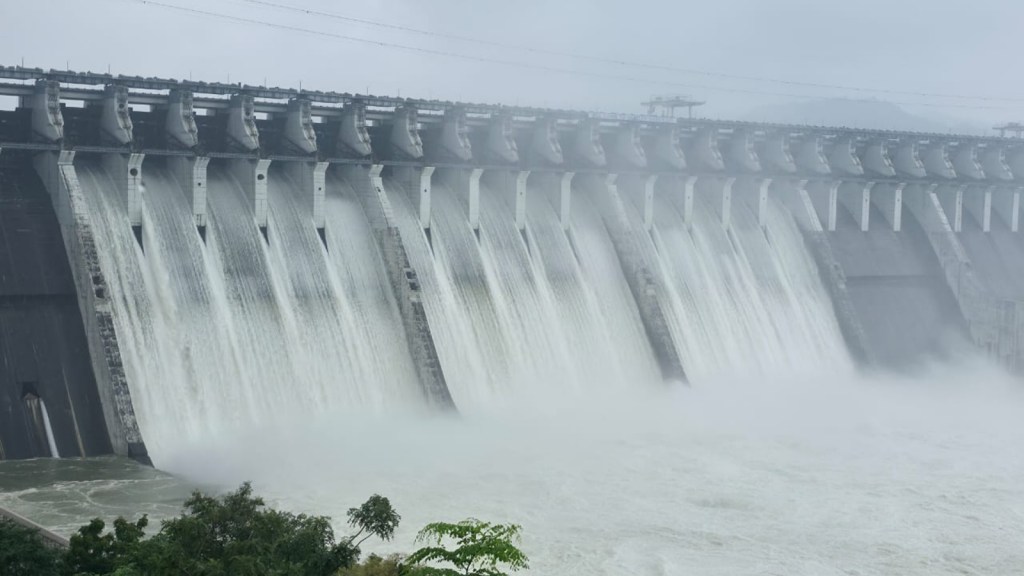
Gujarat reservoirs gain 3 per cent after 48-hr rain, remain 13 per cent below last year levels
The state's reservoirs gained 603 million cubic metres (MCM) of water in just two days of rain, even as the total storage remained in a deficit of 3,191 MCM compared with the reservoir statistics of last year.
Four days after the Gujarat Assembly discussed the possible drought situation in the state, with Opposition parties demanding relief measures for farmers, there was a ray of hope.
After the 48-hour rain since Sunday, water levels in the reservoirs of the state rose by over three per cent. Although the overall water reserve in the state was 13.88% lower than September last year’s figures, data from dams across Gujarat showed.
The state’s reservoirs gained 603 million cubic metres (MCM) of water in just two days of rain, even as the total storage remained in a deficit of 3,191 MCM compared with the reservoir statistics of last year.
As of Tuesday, Sardar Sarovar dam on the Narmada River was 95.42% full, 316 MCM over the last year’s figures; reservoirs in Saurashtra, however, remained less than half full. Waters of the Narmada feed a major part of the state, up to Saurashtra and Kutch.
The figures of the Narmada Water Resources, Water Supply and Kalpsar departments on Tuesday showed that Gujarat’s 207 reservoirs, including Sardar Sarovar, were positioned at 78.41% storage as against 91.04% on September 15, 2025. This is a shortfall of 3191.45 MCM or 13.88%.
On September 13, the 207 reservoirs held 19,200.30 MCM and, by September 15, the figure had risen to 19,803.37 MCM, an increase of 603.07 MCM or 3.14%. The number of completely filled reservoirs also rose from 17 to 23 in the period.
The state saw a dry spell for over a month, with districts such as Kutch, Devbhoomi Dwarka and Jamnagar reporting a higher deficit.
Story continues below this ad
Excluding Sardar Sarovar, the other 206 reservoirs gained 441.87 MCM, taking their storage from 10,334.40 MCM on September 13 to 10,776.27 MCM on September 15—an increase of 4.28% from an overall storage of 65.42% to 68.21%. But compared with September 15 last year, these reservoirs still carry a 24.56% deficit. The filling level has correspondingly dropped from 90.42% to 68.21%.
South Gujarat fares better
The regional picture is sharply uneven as the rainfall has been surplus in South Gujarat, where the 13 reservoirs are 82.40% full, with 7,089.49 MCM in storage. The region gained 366.24 MCM, or 5.45% from the recent rain alone.
Yet, South Gujarat is below its storage position of last year, with an 8.65% deficit in comparison. Its filling level has consequently fallen from about 90.21% last year. Notably, Valsad district reported a surplus rainfall of 47%, as of Tuesday, from the time the monsoon set in.
Saurashtra has seen a much smaller recent gain. Concerns of drought in this region became the focus of a discussion in the state Assembly on September 11, the last day of the monsoon session.
Story continues below this ad
Saurashtra’s 141 reservoirs rose from 1,257.85 MCM on September 13 to 1,285.13 MCM on September 15, an increase of 27.28 MCM or 2.17%. The filling level moved from 48.59% to 49.65%.
However, despite the small rise, Saurashtra’s storage remained 43.23% below last year’s levels. The region had a storage of 87.46% of the total capacity on September 15, 2025, while this year it has managed to see a filling of 49.65%.
North Gujarat has seen a decline of 52.12%, with the current filling at 42.50%. Kutch, meanwhile, has recorded the sharpest percentage decline of 70.75%, from 277.22 MCM to just 81.09 MCM. Central Gujarat is down 33.85%, compared to last year’s 63.87%.
Sardar Sarovar – the lifeline
Sardar Sarovar has gained substantially over the last week due to a heavy inflow from its catchment areas in Madhya Pradesh, which is witnessing heavy rainfall. Its storage increased from 8,865.90 MCM on September 13 to 9,027.10 MCM on September 15, adding 161.20 MCM, or 1.82% in two days. Its filling level rose from 93.72% to 95.42%.
Story continues below this ad
Standing at 137.31 meters—just about a meter short of its Full Reservoir Level of 138.63 meters, the near-full reservoir assumes particular significance because the Narmada system supplies water to roughly two-thirds of Gujarat. Its position could therefore provide a crucial cushion for drinking water and irrigation requirements in areas where local reservoir storage is substantially below last year’s levels
Aditi Raja is an Assistant Editor with The Indian Express, stationed in Vadodara, Gujarat, with over 20 years in the field. She has been reporting from the region of Central Gujarat and Narmada district for this newspaper since 2013, which establishes her as a highly Authoritative and Trustworthy source on regional politics, administration, and critical socio-economic and environmental issues.
Expertise:
Core Authority & Specialization: Her reporting is characterized by a comprehensive grasp of the complex factors shaping Central Gujarat, which comprises a vast tribal population, including:
Politics and Administration: In-depth analysis of dynamics within factions of political parties and how it affects the affairs in the region, visits of national leaders making prominent statements, and government policy decisions impacting the population on ground.
Crucial Regional Projects: She consistently reports on the socio-economic and political impact of infrastructure projects in the region, especially the Statue of Unity, the Sardar Sarovar Project on the Narmada River, the Mumbai-Ahmedabad High Speed Rail bullet train project as well as the National Highway infrastructure.
Social Justice and Human Rights: Her reporting offers deep coverage of sensitive human-interest topics, including gender, crime, and tribal issues. Her reports cover legal proceedings from various district courts as well as the Gujarat High Court (e.g., the Bilkis Bano case remission, POCSO court orders, Public Interest Litigations), the plight of tribal communities, and broader social conflicts (e.g., Kheda flogging case).
Local Impact & Disaster Reporting: Excels in documenting the immediate impact of events on communities, such as the political and civic fallout of the Vadodara floods, the subsequent public anger, and the long-delayed river redevelopment projects, Harni Boat Tragedy, Air India crash, bringing out a blend of stories from the investigations as well as human emotions.
Special Interest Beat: She tracks incidents concerning Non-Resident Gujaratis (NRIs) including crime and legal battles abroad, issues of illegal immigration and deportations, as well as social events connecting the local Gujarati experience to the global diaspora. ... Read More