Journalism of Courage



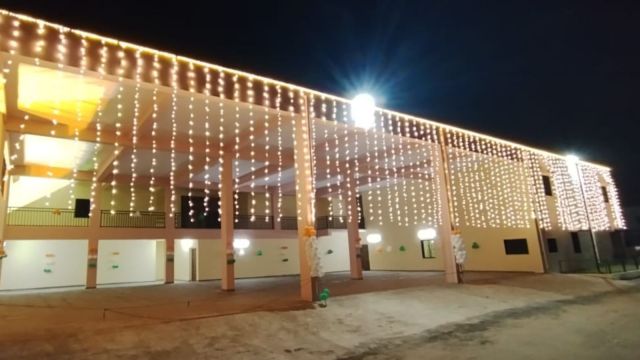 The first of the 32 model fire stations was inaugurated at Kheda’s Nadiad on August 14, 2024 (Archives)
BY APRIL 2026, the Gujarat government plans to subsume the fire services of all 150 municipalities across the state into the Gujarat State Fire Prevention Services (GSFPS). This is part of what Finance Minister Kanu Desai described in his 2025-26 budget speech as the new ‘Ek Rajya, Ek Cadre (One State, One Cadre)’ policy, to be adopted by the state government for the consolidation of the fire services.
According to the budget document, “To make the process of dousing fires more effective it is necessary to source help from different agencies. To make the process easier, and get the situation under control, the (fire) personnel have to take the help of police for which they need to be empowered to handle the obstacles in this process.”
However, a closer look at this upcoming consolidation system and the plans formulated by the Task Force to strengthen Fire and Emergency Services, shows that when implemented, it will still leave Gujarat with ‘One State, Two Systems’ because the 17 municipal corporations, including nine new ones, will continue to have their own fire fighting services.
A case in point is the huge blaze in the Gopal Snacks manufacturing unit inside Metoda GIDC on the outskirts of Rajkot on December 11, 2024, when the local fire services could not cope. The fire in the five-storey building with a basement filled with plastic packing materials was so massive that smoke could be seen from a distance of 7 kilometres.
While the fire services of the Metoda GIDC, as first responders, attempted to douse the fire, the blaze only grew stronger, thus requiring the Rajkot Fire and Emergency Services (RFES) — which dispatched four firefighting vehicles to the spot — to intervene.
However, since the blaze continued unabated, more firefighting teams had to be called in from various parts of Saurashtra. Teams from nearby nagarpalikas and industrial areas like Kalavad, Shapar-Veraval Industries Association, Gondal, Jetpur, and Lodhika GIDC to far off places like Morbi and Dhoraji, which are 80 km away, apart from teams from Jamjodhpur, Jamnagar and Reliance Industries, which are in excess of 100 km away, ended up being part of the operation.
The teams worked for 45 hours before the blaze was finally brought under control.
The recent fire at the busy the Shiv Shakti Textile Market in Surat, a municipal corporation area, continued for 36 hours. The building was claimed to have had a working firefighting system. The blaze, which broke out during the business hours on Tuesday and claimed one life, could be doused only by Thursday.
The ultimate goal of the uniform service, say officials, is to decrease the turnout time and ensure that firefighters do not have to rush from 100 km away due to the lack of resources and manpower in non-urban areas of the state.
A triumvirate fire service
Currently, the fire and emergency services in Gujarat are trifurcated into three major parts.
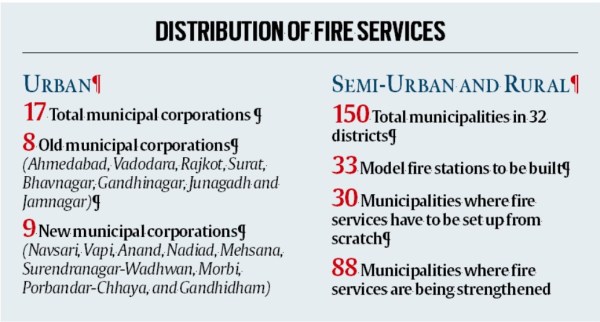
First, those run by the eight existing municipal corporations and those that will be developed in the nine new ones. Second, those run by the 150 municipalities under 32 districts (minus Dang), falling under six regions. Third, the GSFPS.
The budget document of the Urban Development and Urban Housing Department says, “It is proposed to create 346 new posts of different cadres in 32 District Model Fire Stations under One State One Cadre with a view to strengthening the State Fire Prevention Services. For this purpose, an amount of Rs 12.33 crore would be required during the financial year of 2025-26.”
The Indian Express spoke to officials involved in this restructuring plan who confirmed that the ‘One State, One Cadre’ policy will be applicable only to fire departments run by the nagarpalikas (municipalities) since this is a larger area of the state that caters to not just the semi-urban, but also the rural areas of Gujarat.
“While the municipal corporations are more or less functioning independently and we want to strengthen them, the functioning of the fire services in nagarpalikas leaves much to be desired. We also studied models from other states where, in most places, the state fire service model has been adopted,” said an official closely associated with this plan.
Why consolidate the nagarpalikas?
There are three main reasons behind the consolidation of the semi-urban and rural fire services. These include severe staff crunch, inability to meet turnout goals and inability to independently deal with major fires without help from cities.
Paresh Vyas, the Fire Advisor to the Gujarat government, said, “We are working towards the consolidation of the fire services in Gujarat and trying to ensure efficient delivery of services in the farthest reaches of the state by reducing response time to control fires and other emergencies.”
Staff crunch: There are significant gaps in the staffing for the fire services in the nagarpalikas. Currently, of 150 nagarpalikas in Gujarat, 32 will become district head quarters (HQs). Of the 462 sanctioned posts in 118 Nagarpalikas, only 62 are filled permanently. Others posts have been filled with temporary, contractual and outsourced staffers.
Turnout time: According to the Standing Fire Advisory Committee (SFAC), depending on the risk category, the recommended response time for first fire tender is five-seven minutes in urban areas and 20 minutes in rural areas.
Officials have admitted that the lack of staff, lack of staff quarters at fire stations and limited facilities hamper the turnout in rural areas, especially those located far from major cities.
Major fires: The nagarpalika fire services are unable to deal with major fires, leading to others from as far as 100 km having to deploy firefighting teams to contain industrial-scale blazes.
Consolidation in two phases
Explaining the short-term and long-term goals, an official said, “Starting with the staff at the 32 district model fire stations, (we) ultimately intend to take all the municipality fire staff and turn them into a state cadre directly under the control of the director of GSFPS. While the state has already provided funds to construct these model fire stations as district HQs, later on, the entire staff, vehicle, maintenance and infrastructure will directly fall under the UDD.”
This model, said officials, aims to turn the localised fire services into a more formalised structure like the police department headed by officers at the district, region and state levels. This will happen in two phases over the next one year.
Phase-I: A total of 32 municipalities will become District Fire HQs with model fire stations. While the Dang district had earlier been excluded as it does not have a single Nagarpalika, funds have been allocated to build a 33rd district HQ in Ahwa-Dang. Plans are also underway to make sure there is another District Fire HQ in the 34th “potential” district of Gujarat if Tharad is indeed carved out of Banaskantha.
Model fire stations are those built with a larger number of vehicle bays, a control room and staff quarters, all meant to reduce the turnout time to reach a blaze. This started in 2021-22. The first one was completed in Nadiad of Kheda district and inaugurated on August 14, 2024, while many others are on the verge of completion. However, out of 32 model fire stations-cum-district HQs, only 25 will be used by state fire services because seven have become municipal corporations. The GSFPS will have to identify 7 different nagarpalikas in these districts to set up new HQs. This work is currently underway.
The first phase will also see the GSFPS directly recruiting staff for the 32 District Fire HQs as employees of the state government. Here, the government has sanctioned 672 posts, at 21 staff per HQ. These posts are due to be filled shortly. This leaves 118 other municipalities. Of these, 30 municipalities have no fire stations or infrastructure at all. Therefore, these municipalities will get fire stations and those will be staffed directly by the GSFPS.
The 2025-26 budget has allocated Rs 32 crore for a “Model Fire Station at Dang” and fire stations at 15 municipalities for the purchase of the land and construction of the building.
Phase-II: In the second phase, the remaining 88 municipalities will be absorbed by the state service. This will ultimately lead the way to enact transfers of all Class-I and Class-II officials of the fire service in the coming years.
Municipal corporations to retain autonomy
Meanwhile, officials confirmed that the 17 municipal corporations will continue to run their own fire services under the 74th Amendment to the Constitution. This, in turn, also means that the nine new municipal corporations, upgraded last year, will have to considerably scale up the fire departments they inherited from their former municipalities.
Fortunately, seven out of nine municipalities that were upgraded to municipal corporations, excluding Kutch and Valsad, already have a sanctioned model fire station each, under construction planned earlier, that will help them set up their HQs.
On the other hand, this also means that the GSFPS will have to find other Nagarpalikas in seven districts to set up their District Fire HQs to meet the needs of semi-urban and rural areas.
Task Force
“However, this doesn’t mean that the municipal corporations will be left to their own devices. The State Task Force will continue to monitor their progress week after week and help out where necessary,” said an official of the UDD.
The Task Force, notified at the end of December 2024, includes the Director and Deputy Director of GSFPS, Fire Advisor to the State, Director of GSDMA, Assistant Director of DISH, CEO of Gujarat State Fire Academy, and either all the CFOs or the RFOs. Sources said that Ashwani Kumar, the Principal Secretary of UDD, personally supervises the weekly meetings of the Task Force.
Why the one-year-delay in consolidation?
When asked as to why the state government had not immediately notified the consolidation of the fire services, an official said that the one-year time span till April 2026 would be spent to set up recruitment rules, putting procurement and maintenance systems in place, and structuring the GSFPS Directorate to run the statewide force from Gandhinagar.
As part of this, the government has allocated Rs 2 crore to construct state HQs for the office of GSFPS at Gandhinagar. A further Rs 1.11 crore has been allocated to create 29 new posts for Head Office and Subordinate Offices of GSFPS.
To strengthen the fire services in the municipalities, the 2025-26 UDD budget has also included Rs 2.84 crore for the purchase of 700 PPE kits, Rs 3 crore for the operation and maintenance of fire vehicles for municipalities, Rs 3.5 crore for quick-response vehicles at Regional Offices and Rs 40 crore for the purchase of turntable ladders.
Long-term plans
Officials privately cede that true consolidation of the fire safety ecosystem would eventually have to include the major cities, being part of a statewide fire service, but this is not part of the plan for now.
Several officials are also of the opinion that in order to reduce turnout time, mini fire tenders at the upcoming fire stations must be placed in strategic positions, in remote areas, so that they can be the first responders, akin to the tactic used by the EMRI emergency ambulance service in Gujarat. However, this too, is yet to come up for consideration.

 11 min read