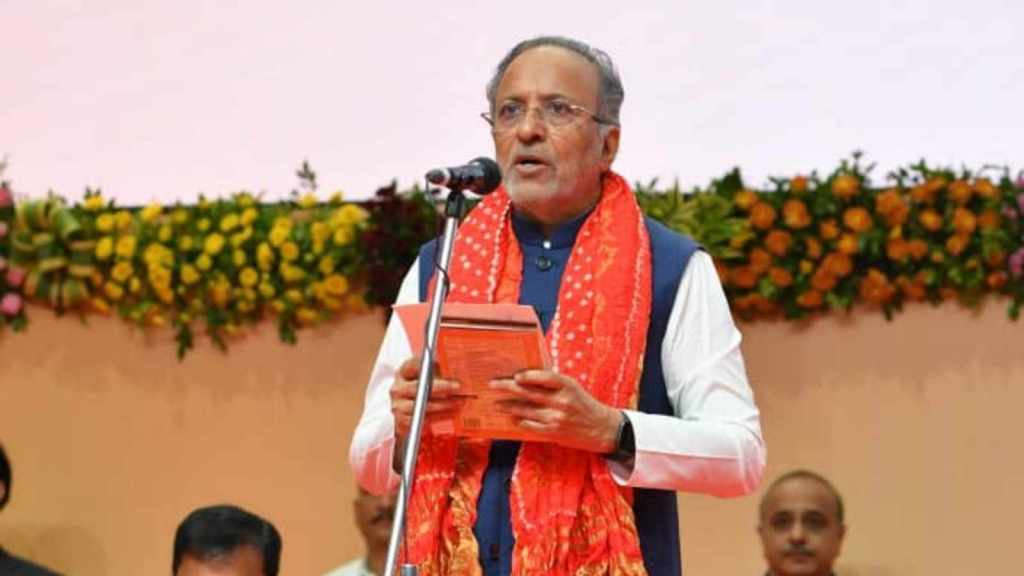
Ensuring Gujarat becomes a data centre hub that are largely powered by green energy and setting up high-tech surveillance systems in wildlife zones to prevent man-animal conflicts is one instance where the portfolios of Minister Arjun Modhwadia merge.
In an exclusive interview to The Indian Express, the Minister for Forest, Environment & Climate Change, Science & Technology talks about how Gujarat is readying to host six of the 12 semiconductor manufacturing facilities in the country and more.
It was very difficult. Since this is a high-tech project, nobody was confident that India would be able to achieve it. Also, the Covid pandemic caused the ecosystem to collapse. India was badly affected. The delivery system for automobiles, from cars to scooters, got stalled. Then Prime Minister Narendra Modi threw a challenge: Why don’t we manufacture semiconductors? Thus rose the need for an ecosystem.
However, everyone was afraid that no investors would come. There was a lack of confidence in whether we would be able to succeed. So, creating this confidence was very important. We did that, offered incentives, and created an ecosystem. Youths, including people from tribal communities, are being trained in Taiwan, Chennai and Bengaluru and employed here.
So, the challenge was not to attract large anchor semiconductor companies, but to create an ecosystem in which they can invest, operate and flourish.
What worked to Gujarat’s advantage?
Excellent logistics. Connectivity through ports, highways, airports, plug-and-play industrial corridors in Dholera and Sanand, and proximity to major consumption and manufacturing centres were a significant natural advantage for the semiconductor and electronics companies. Also, the state’s distinct advantage is the availability of high-quality and resilient power infrastructure, which is most critical to semiconductor manufacturing.
Where does Gujarat stand today?
Of the total 12 semiconductor manufacturing facilities being established in India, six with a project cost of more than 1.28 lakh crore will be in Gujarat. Among them, three, which were inaugurated by PM Modi, are already in the manufacturing stage. The fourth is Tata Electronics.
Tata Electronics alone is investing Rs 91,000 crore to build the country’s first commercial semiconductor fabrication facility in Dholera with Taiwan’s Powerchip Semiconductor Manufacturing Corporation (PSMC).
All top executives of these companies are those who went abroad on a student visa, completed their studies, took jobs there, were promoted to top executives and are now returning to India in a high position.
Story continues below this ad
So, I would say it was a political will with which we would succeed.
Two more semiconductor facilities—Suchi Semicon’s facility in Surat and Crystal Matrix’s in Dholera— have been approved by the India Semiconductor Mission.
How has the response to the Data Centre policy been?
The Viksit Gujarat Data Centre Policy 2026-29 targets 7.5 gigawatts (GW) of data centre capacity and is specifically designed to attract hyperscale, colocation and artificial intelligence-ready data centres. We have received 14 proposals with a combined proposed investment of over Rs 10.36 lakh crore and a planned capacity of nearly 10,000 MW (10 GW).
What is particularly interesting is the interest shown by major industry players, such as Reliance Industries, Torrent Power, Adani, Tata and Welspun Corp. A large number of proposals are coming to Dholera, highlighting its emergence as a preferred destination for next-generation digital infrastructure.
Story continues below this ad
Today, we have already received proposals for capacity higher than what we can allot. We are expecting a total of around Rs 6-7 lakh crore investment. They have demanded more, but the high-power committee will decide. But how much we can give will be decided on a case-to-case basis.
How will the Chief Minister’s visit to the US and Canada boost the Vibrant Gujarat Summit?
The CM has already met a lot of players. He visited Nvidia. The Vibrant Gujarat summit is being held after a gap of three years. So it will be big, no doubt about that.
Andhra Pradesh has less money, but it is offering more (as incentives). Chennai, Telangana and Andhra Pradesh are dealing with proposals on a case-to-case basis while we develop policies.
You said that Gujarat missed the IT bus when compared to other states. Why?
In the 1980s when the IT sector was emerging, our (Gujarat) focus was on other industries like textiles, chemicals and pharmaceuticals. We failed to create an ecosystem for IT here. But Karnataka, Tamil Nadu, Andhra Pradesh, Maharashtra, Gurugram and Delhi moved ahead of us. But this time, we are working with double force and will become a leader in the AI ecosystem.
Semiconductors are a part of this ecosystem.
Story continues below this ad
What is the reason for the ‘surge’ in incidents of lions attacking humans?
We have three recent incidents. In Chaturi village in Dhari taluka (of Amreli district), a child was snatched (by a lioness). We do not know if the lioness was teased.
In the second case, at Mount Girnar, the lion was teased. People pelted stones, shouted…beamed flashlights. First, it went away and then, at an opportune time, attacked a child.
The third incident was also reported from Dhari block. Three youths teased a lion (when it was mating). They flashed a torchlight and tried to take a selfie by getting closer to the lion. At that time, the lion attacked one of them while the two ran away.
In other incidents, we don’t know why people were killed and whether the attacks were by a lion or a leopard.
But the lion is a wild animal. If we treat it like a dog, it will react.
Story continues below this ad
Inside the Gir Sanctuary, not a single incident had happened in so many years until a ‘maldhari’ (cattle herder) was attacked. In revenue areas, the adaptation is not that good.
Where would you place the Bhavnagar incident wherein a man ‘petted’ a lion?
That is the best evidence of how they (lions) do not attack if not teased. Just imagine if you were in Kalu Bharwad’s place. (On July 7, Kalu Bharwad was attacked by a lion when he was feeding his cow at his home in Garajiya village of Bhavnagar district. It pinned him down from his legs. Videos show him stroking the lion on its mane. The lion eventually spared him. The entire incident was recorded on phone cameras and the footage went viral on social media)
The lion had made a kill (nearby) and it was teased. It was driven away from a prey and had come here (at Kalubhai’s village). They (Kalubhai and the lion) were face to face. The lion could have killed him. But Bharwad was experienced and courageous. Therefore, he lay quietly.
I had asked him where he gathered the courage from. He said, “I knew that one should not tease it.” This is the biggest example of coexistence.
Story continues below this ad
What is the government doing to sensitise people?
We (the people) have to respect lions. Because of that, their population has increased (in Gujarat), whereas in Africa, it is decreasing.
An immediate step we have taken is that we are increasing the number of trackers, who are locals. More incidents have happened in Gir East. So, we have increased the number of trackers there. We are also reaching out to people to sensitise them.
What are the changes on the ground?
We have prepared an SOP for Mount Girnar, under which it has been notified as a silent zone, meaning no sloganeering and no DJ music there. Any violation will attract a penalty. The number of trackers has been increased and new checkposts created. Also, to ensure that there is no stampede, we have introduced QR code-based entries and exits, to get an idea of how many people are upstairs.
We will regulate visitors.
What about not allowing movement after dark?
It is not possible. [The pilgrimage] cannot be done in the day hours. It is also very sunny in the daytime. People’s sentiments have to be respected.
Story continues below this ad
By when can we expect cheetahs in Gujarat’s Banni?
Under the supervision of the National Tiger Conservation Authority, we are creating an ecosystem and a prey base there. We are removing gando baval (Prosopis juliflora) and developing grassland. But the NTCA will decide on releasing cheetahs there… it should be done expeditiously.
Last December, an organisation called AC Bharat Sarkar, which rejects traditional institutions of authority, was accused of attacking government officials in a Banaskantha village. How is the government dealing with it?
They are not from our state. They try to mislead our tribal brothers and sisters, but such organisations do not survive for long. People (of tribal areas) know that the Government of India and the Government of Gujarat are doing maximum work in their areas. Many schemes have even reached the saturation point…Therefore, such organisations do not stay for long.
They cannot come in the name of Naxals, but some try to come while posing as judva bhai (twin brother) of Naxals… Today, Naxalism is not there anymore (anywhere), but it never entered our state because our tribal brothers and sisters are very intelligent and do not get misguided by anyone for long. This was a sporadic incident.