


Stay updated with the latest - Click here to follow us on Instagram

Journalism of Courage
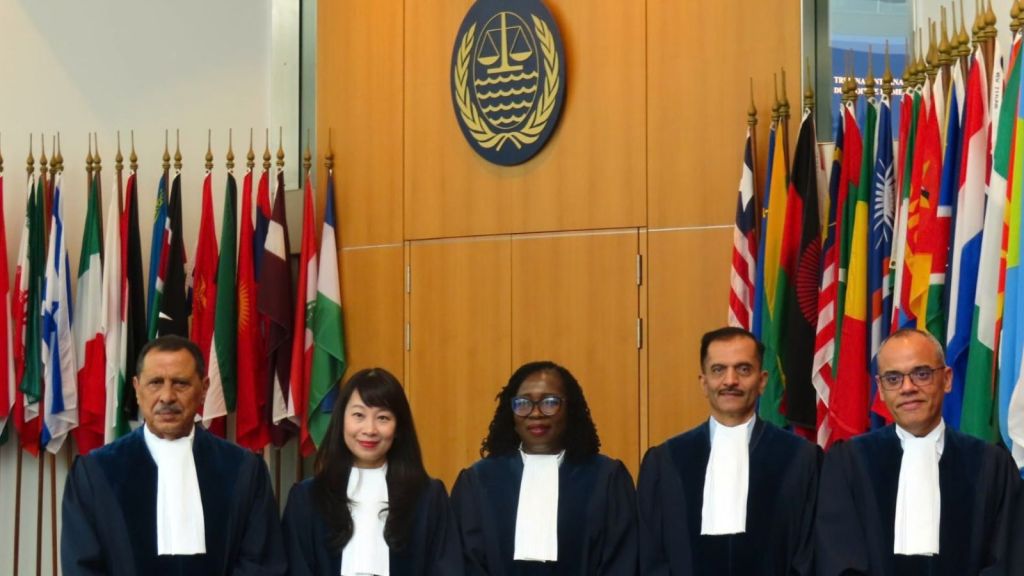 Bimal N Patel (second from right) assumes the international judicial office for a nine-year term. (Special arrangement photo)
Indian jurist and academician Bimal N Patel on Thursday took oath as a Judge of the International Tribunal for the Law of the Sea (ITLOS) at the Tribunal’s headquarters in Hamburg, Germany.
Currently the Vice-Chancellor of Rashtriya Raksha University (RRU), Gandhinagar, Patel assumes the international judicial office for a nine-year term. This marks a significant milestone in his career devoted to international law, law of the sea, ocean governance, maritime security, legal scholarship and public institution-building.
He assumes the office at a time when the international law of the sea has acquired increasing significance in addressing questions relating to maritime boundaries, freedom of navigation, marine environmental protection, sustainable use of ocean resources, deep seabed activities and peaceful settlement of maritime disputes.
Patel was elected to the post on June 18 at the Thirty-Sixth Meeting of States Parties to the United Nations Convention on the Law of the Sea (UNCLOS) held at the United Nations Headquarters in New York. Seven members were elected to the Tribunal at the meeting.
Members of ITLOS are elected by the States Parties to UNCLOS. The Tribunal comprises 21 independent members, elected with due regard to equitable geographical distribution and representation of the principal legal systems of the world.
Maritime governance in a changing global order also resonates with India’s evolving engagement with the Indian Ocean, the Global South and international maritime cooperation. In March 2025, Prime Minister Narendra Modi articulated Vision MAHASAGAR, “Mutual and Holistic Advancement for Security and Growth Across Regions”, as an evolution of the SAGAR vision, with emphasis on development, capacity-building and mutual security across regions.
Patel has made extensive contributions to the development, interpretation and study of international law, with particular emphasis on the law of the sea, maritime governance, international adjudication and State responsibility. He has served as a Member of the United Nations International Law Commission (ILC) and as Chair of its Working Group on Succession of States in respect of State Responsibility, contributing to the Commission’s work on the progressive development and codification of international law.
He is also a Member of India’s National Security Advisory Board; Member of the Committee on Antarctic Governance; Co-Chair of the Law of the Sea Interest Group of the American Society of International Law; Member of the High-Level Advisory Board of the International Committee of the Red Cross; and had been Lead Academic Adviser during India’s tenure on the United Nations Security Council in 2021–22.
He has also contributed to the development, interpretation and implementation of important legal and regulatory frameworks relating to India’s maritime domain, including areas concerning maritime anti-piracy, Antarctic governance, merchant shipping, private maritime security, deep seabed activities and admiralty jurisdiction.
Alongside his work as an international legal expert, Patel has made contributions to legal education and institution-building.
He has led and contributed to the development of premier national institutions, including Gujarat National Law University and Gujarat Maritime University, and currently serves as the Vice-Chancellor of Rashtriya Raksha University. His academic leadership has fostered international collaborations and capacity-building in international law, law of the sea, maritime law, national security and related areas.
A prolific scholar, Patel has authored or edited more than 25 books, besides numerous research papers and scholarly publications covering classical, contemporary and emerging areas of international law.
The International Tribunal for the Law of the Sea (ITLOS) is an independent international judicial body established under the United Nations Convention on the Law of the Sea (UNCLOS). Headquartered in Hamburg, Germany, the Tribunal adjudicates disputes concerning the interpretation and application of UNCLOS and matters specifically provided for in other agreements that confer jurisdiction upon it. The Tribunal is composed of 21 independent members and has jurisdiction over a wide range of matters relating to the law of the sea. These include disputes concerning maritime delimitation, navigation, marine resources, protection and preservation of the marine environment, and other questions arising under the Convention.
Stay updated with the latest - Click here to follow us on Instagram