


Journalism of Courage
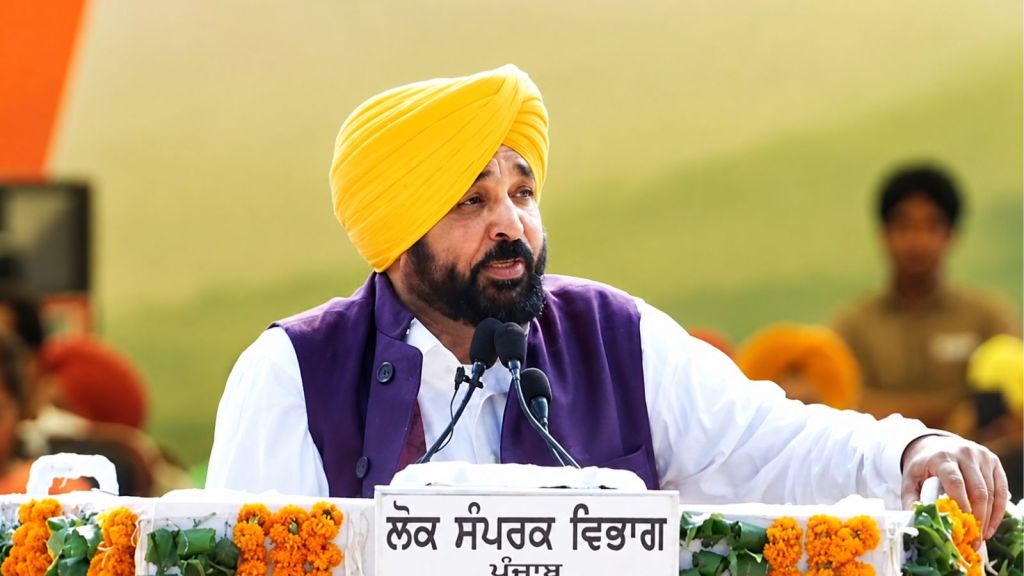 Punjab Chief Minister Bhagwant Mann
Punjab Chief Minister Bhagwant Singh Mann on Sunday said the provisions of life imprisonment and heavy fines for those who commit ‘beadbi’ (sacrilege) cannot be diluted but the state government was open to examining concerns raised over other clauses of the anti-sacrilege law.
“The spirit and core objective of the law must not be compromised while discussing its provisions with the panel constituted by the Akal Takht. The provisions prescribing life imprisonment and heavy fines for perpetrators of sacrilege constitute the core foundation of this law. Therefore, the law must not be weakened at any cost,” Mann said.
He made the remarks during a meeting with a seven-member committee the Punjab government has constituted to discuss amendments to the Jaagat Jot Sri Guru Granth Sahib Satkar (Amendment) Act, 2026. The meeting focused on the provisions of the law, the concerns raised against some of them, and the way forward through consultation and consensus with the panel formed by the Akal Takht.
Mann said the objective was to ensure that the law provides the strongest possible legal protection to the sanctity of Sri Guru Granth Sahib while also addressing legitimate legal and constitutional concerns.
“Sri Akal Takht Sahib is supreme for all of us,” Mann said, adding that the government would approach the entire process with “utmost respect and sensitivity”.
Mann said the law had been framed with the intention of creating a strong deterrent against incidents of sacrilege, which have repeatedly hurt the sentiments of the Sikh community. “For the first time, a strong sense of deterrence is being created among those who may contemplate committing such a heinous offence,” he said.
“Certain concerns were raised regarding some provisions of the Act. The government therefore constituted a seven-member committee comprising eminent intellectuals and legal experts to look into them. The proposed amendments will be discussed comprehensively so that an amicable resolution is reached after taking into consideration all legal, constitutional and other relevant aspects,” Mann said.
Mann said the government had chosen to amend the existing law instead of introducing a completely new legislation and the Bill had been drafted after extensive consultations with legal experts.
“Whenever an incident of sacrilege takes place, it causes deep anguish to the collective conscience and sentiments of the people, and this cannot be tolerated at any cost,” Mann said.
He directed Harjit Singh Sandhu, the nodal officer for the process, to ensure coordination between the two panels and provide all necessary assistance for their future meetings.
The Chief Minister said the committee should hold a series of meetings with the Sri Akal Takht Sahib panel so that any amendments, if required, could be finalised through mutual consultation and consensus.
The seven-member committee includes former Akal Takht Jathedar Giani Raghbir Singh, Baba Sahib Singh representing Damdami Taksal, Sant Baba Sewa Singh Rampur Khera, retired Justices Jaspal Singh and Gurbir Singh, retired IPS officer Jatinder Singh Aulakh and Law Officer Preet Inder Pal Singh. Damdami Taksal head Sant Giani Harnam Singh Khalsa joined the meeting through video conferencing.
Director, Punjab Bureau of Investigation L K Yadav and advocates G S Ghuman and G P S Ghuman, besides other senior officers, were also present.
The Punjab Assembly unanimously passed the Jaagat Jot Sri Guru Granth Sahib Satkar (Amendment) Bill, 2026, on April 13. It received the governor’s assent on April 17 before being notified as an Act shortly thereafter.
However, the Akal Takht raised several objections to the law, particularly related to the Sikh terminology, “custodian” of the religious text, and assigning unique numbers to the holy “Birs”.
Akal Takht Jathedar Giani Kuldip Singh Gargajj on June 29 directed the state government to address the objections concerning the anti-sacrilege law within a month.
On July 30, Gargajj rejected the Punjab government’s response as “unsatisfactory” and announced a five-member committee to engage with the AAP dispensation on the issue.