Ahead of paddy procurement, storage squeeze forces Punjab to ease rice milling norms

Cabinet clears proposal to allow rice millers who have delivered at least 90 per cent of rice due from their previous allocations to receive fresh paddy

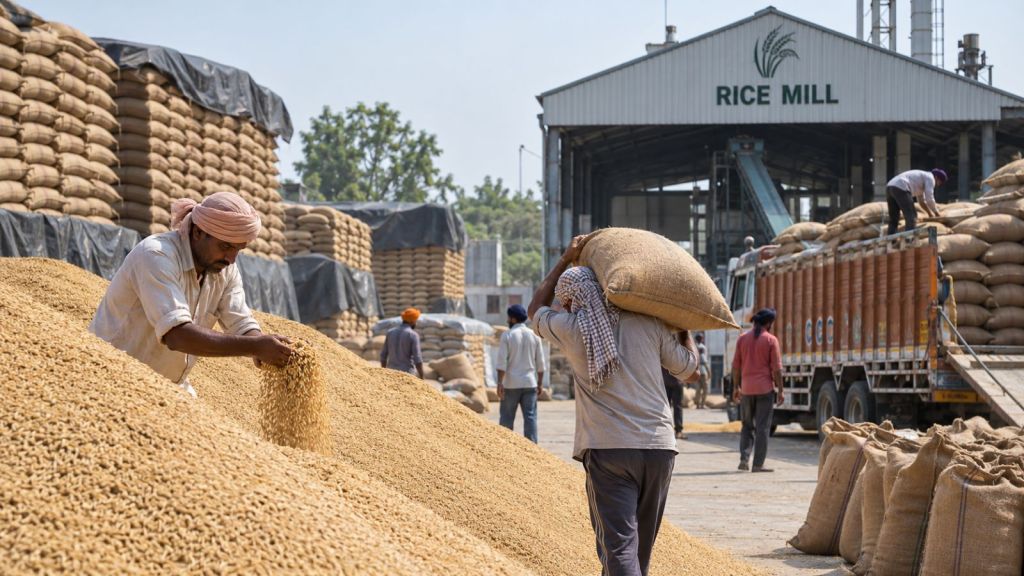
Officials and industry representatives, however, say the problem is no longer simply one of milling capacity, but the lack of space to store rice after it is milled and the slow movement of stocks out of the state. (AI generated Image)Officials and industry representatives, however, say the problem is no longer simply one of milling capacity, but the lack of space to store rice after it is milled and the slow movement of stocks out of the state. (AI generated Image)

With Punjab’s granaries and rice mills running out of space ahead of the new paddy procurement season, the Cabinet on Saturday approved a relaxation in the Custom Milling Policy for Kharif Marketing Season (KMS) 2026-27, allowing rice millers who have delivered at least 90 per cent of rice due from their previous allocations to receive fresh paddy.

The procurement is scheduled to begin on October 1 even as a substantial quantity of rice from the previous season is still awaiting delivery to government agencies. Under the earlier arrangement, fresh paddy could be allotted only to millers who had completed 100 per cent delivery of rice against their previous-season allocations.

With storage and evacuation already under pressure, millers say they are struggling to clear old stocks even as they prepare for another bumper procurement season.

According to the Punjab Food, Civil Supplies and Consumer Affairs Department’s district-wise milling report, 156.10 lakh metric tonnes (LMT) of paddy procured during KMS 2025-26 was stored with rice mills. At the prescribed 67 per cent out-turn, it was expected to yield about 105.63 LMT of rice.

By September 1, however, only 91.19 LMT, or 86.33 per cent, had been delivered to government agencies, leaving 14.45 LMT yet to be delivered. On the corresponding date last year, delivery had reached 99.96 per cent.

The backlog has also exposed the pressure on Punjab’s evacuation network. Around 49,819 wagons were pending for movement of rice as of September 1, while only about 32,062 MT was moved during the day.

Under the normal custom milling arrangement, millers are required to complete delivery of rice by March 31. This year, the deadline has been extended to October 31, giving them additional time to clear the previous season’s stocks.

Story continues below this ad

Officials and industry representatives, however, say the problem is no longer simply one of milling capacity. The bigger constraint is the lack of space to store rice after it is milled and the slow movement of stocks out of the state.

“The contracts are allotted by the middle of September. A miller cannot be expected to wait till October 31 to become eligible to receive paddy when the actual delivery against the previous allocation can be completed only by that date,” a source said.

The 90 per cent criterion, the source said, would allow the government to begin allocating paddy to millers who had substantially met their earlier obligations instead of waiting for complete delivery at a time when the storage and evacuation system was already under severe pressure.

Punjab’s overall storage position remains stretched. Against foodgrain storage capacity of around 180 LMT, stocks in the state are estimated at nearly 271 lakh tonnes, with large quantities of rice and wheat occupying government storage facilities.

Story continues below this ad

The situation has been aggravated by the slow movement of rice to consuming states. Chief Minister Bhagwant Mann has repeatedly taken up the issue with the Centre, seeking faster evacuation of stocks through railway rakes.

Rice millers too had flagged the space crunch last month, saying delays in moving rice were holding up milling operations. While milling had reached around 80 per cent in some major districts, it remained substantially lower in several other centres.

“The issue of storage space has been repeatedly raised. The old stock is still occupying space in mills and warehouses, while the new paddy season is about to begin,” said Prem Goel, president of the Arhtiya Association of Punjab and a rice miller.

Goel said mills were increasingly being required to operate almost throughout the year, leaving little time for maintenance or preparations between procurement cycles. Prolonged storage also raises concerns about damage and discolouration of stocks, higher broken-rice percentages and deterioration of gunny bags.

Story continues below this ad

The challenge is particularly acute this year. Paddy has been sown over a record 32.76 lakh hectares and the State has set a procurement target of 180 LMT for KMS 2026-27.

The procurement chain begins with government agencies purchasing paddy, which is then stored with rice mills for custom milling. The milled rice is subsequently delivered to government agencies and forms part of the Central Pool. Any delay at the final delivery stage therefore leaves both paddy and rice occupying space that will be needed for the next crop.

The Cabinet also approved the Punjab Foodgrains Transportation Policy 2027 and the Punjab Foodgrains Labour & Cartage Policy 2027, saying the measures were aimed at ensuring smooth and hassle-free procurement during KMS 2026-27.

The government reiterated that it would lift every grain offered by farmers during the coming season. The Cabinet also authorised Mann to amend provisions of the approved policies, if required, in view of administrative exigencies arising during the procurement season.

Kanchan Vasdev is a Senior Assistant Editor in The Indian Express’ Punjab bureau. She is a highly experienced journalist with 22 years of expertise covering high-stakes politics, governance, and social issues in Northern India. Professional Background Role: Primary reporter covering the Punjab Chief Minister’s Office (CMO), government policies, and the Aam Aadmi Party (AAP) leadership in the state. Experience: She previously worked with The Tribune and has played a key role in launching various city editions. Special Projects: Abandoned Brides: Authored a monograph on brides abandoned by NRIs as part of the Prabha Dutt Memorial Fellowship. Environment: Worked as a Centre for Science and Environment (CSE) fellow, focusing on the pollution levels in the Satluj river. Recent Notable Articles (Late 2025) Her recent reporting focuses on the legislative strategies and political maneuvers of the Bhagwant Mann-led Punjab government: 1. Legislative & Governance Standoffs "Punjab govt advances special Assembly session to pass resolution against VB-G RAM G Bill" (Dec 20, 2025): Reporting on the state's move to block the Centre's "Viksit Bharat" mission, which the state claims will undermine MGNREGA. "Punjab govt doubles down on special sessions, sixth in January" (Dec 19, 2025): Detailing the AAP government's use of special sessions as a legislative tool amid tensions with the Governor. "Punjab asks 'VIP teachers' working near Chandigarh to go back to border districts" (Dec 16, 2025): Reporting on CM Mann's move to end the practice of influential teachers avoiding postings in remote areas. 2. Political Analysis & Rural Polls "Punjab rural polls: Why Akalis are likened to dinosaurs in Punjab" (Dec 19, 2025): Analyzing CM Bhagwant Mann's rhetoric against the Shiromani Akali Dal (SAD) following local body elections. "AAP claims win in 78% Punjab zila parishads as counting continues" (Dec 18, 2025): Breaking down the results of the 2025 rural elections. "Rahul Gandhi and Sidhu alike, says Bhagwant Mann" (Dec 13, 2025): Covering the CM's critique of the Congress leadership. 3. Law Enforcement & Bureaucracy "Suspended Punjab IPS officer Ravjot Kaur Grewal awaits reinstatement" (Dec 10, 2025): Investigative reporting on the bureaucratic red tape involving the Election Commission and the state government. "Punjab declines to give parole to Amritpal Singh" (Nov 27, 2025): Detailing the state government's refusal to grant parole to the radical preacher and sitting MP. 4. Welfare & Economy "Punjab government's plan to add more freebies to 'atta-dal' scheme hits funds roadblock" (Dec 4, 2024): An analysis of the fiscal challenges facing the state's flagship food security program. "Mann leads Punjab delegation to Japan and South Korea for investor outreach" (Dec 2, 2025). Signature Beat Kanchan Vasdev is known for her insider access to Punjab's political executive. Her writing provides deep insights into how state policies are formulated and the friction points between the state government and central authorities. Her dual expertise in environment and law allows her to report on complex issues like the "Farmhouse Policy" (Dec 18, 2025) and river pollution with a unique policy-oriented lens. X (Twitter): @kanchan99 ... Read More


Advertisement
Loading Recommendations...
Advertisement
Advertisement
Latest Comment
Post Comment
Read Comments