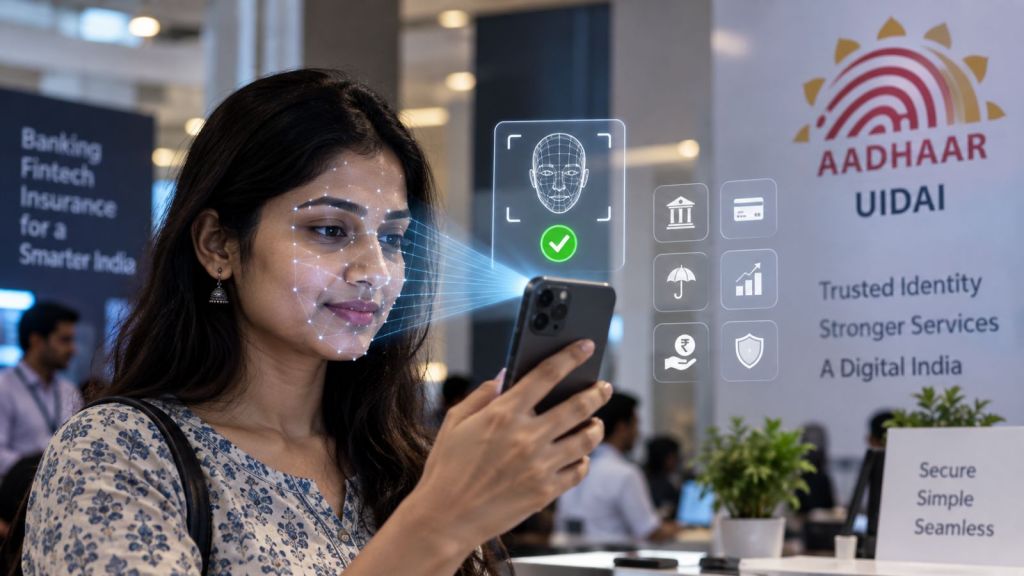
The Unique Identification Authority of India (UIDAI) on Wednesday launched a new Aadhaar Face Authentication Software Development Kit (SDK) and a dedicated sandbox, allowing banks, fintech companies, insurers and other financial-sector entities to integrate Aadhaar-based face authentication directly into their mobile applications.
The launch, which was announced at the Global Fintech Fest 2026, aims to make digital onboarding simpler by eliminating the need to switch between multiple applications while completing Aadhaar face authentication.

The new SDK brings UIDAI’s face authentication capability directly into native Android and iOS applications. This means that a customer using a bank, insurance or broking application can complete Aadhaar face authentication within the same application, rather than being redirected to a separate application.
UIDAI Chairman Neelkanth Mishra said the new SDK will allow partner banks and businesses to run Aadhaar authentication locally on their servers, rather than routing requests through UIDAI’s central systems. “The problem with removing geofencing is, then you are vulnerable,” he said. “It’s critical infrastructure. And of course, we see hundreds of attacks every day. We have safeguards.”
He described a model where authentication runs on the bank’s own server rather than UIDAI’s central infrastructure, so the bank secures its own local process and the exposure doesn’t pass back to UIDAI’s systems. This comes as Aadhaar authentication volumes climb sharply from seven crore transactions a day a few years ago to roughly 10 crores today with UIDAI preparing infrastructure to handle 25 to 30 crore daily authentications. More than 600 entities use the platform, with the Aadhaar app nearing 6 crore downloads, Mishra said.
New facility to benefit BFSI entities
Until now, a similar authentication journey required the presence of the FaceRD application, which worked in the background. According to UIDAI, this added an additional step to the onboarding process and made the experience dependent on the availability of the FaceRD app on the device.
The new SDK is designed as a ready-to-use tool for ecosystem partners. It incorporates artificial intelligence (AI) and machine-learning based liveness detection and anti-spoofing capabilities, and supports secure handling and encryption of authentication data.
Story continues below this ad
The technology is designed to work across consumer smartphones and is expected to make it easier for government departments, banks, non-banking financial companies, fintech firms and other organisations to deploy Aadhaar Face Authentication-enabled services.
The move is set to benefit the banking and financial services sector, where digital customer onboarding and identity verification have become crucial for delivering services remotely. UIDAI said the new facility would help BFSI entities create a more seamless and secure onboarding process within their own mobile applications.
Sandbox for face authentication testing
Alongside the SDK, UIDAI also launched an Aadhaar Face Authentication Sandbox. The controlled testing environment will allow organisations to integrate and validate the complete authentication process before deploying it in a live environment.
Developers and quality assurance teams can use the sandbox to test several stages of the authentication journey, including user provisioning and consent, face capture, liveness checks, authentication, error handling, and response validation.
Story continues below this ad
Notably, the test can be done without the need for an external biometric hardware. The sandbox also allows organisations to simulate a range of failure scenarios, including invalid digital signatures, network interruptions, timeouts, and spoofing attempts.
The launch addresses a long-standing requirement of the banking and fintech ecosystem for an authentication mechanism that can be embedded directly into an organisation’s digital application.
For users, the change is expected to reduce friction during onboarding. Instead of downloading and switching between different applications, a customer could use a single banking, insurance or broking app to complete the Aadhaar authentication process.
UIDAI’s face authentication technology, which was indigenously developed using AI and machine learning and launched in 2021, has already been adopted across government and private-sector services.
Story continues below this ad
UIDAI expands face authentication across services
UIDAI said the system has processed over 500 crore transactions and been adopted by nearly 200 entities. These include Union government ministries and departments, state governments, banks, NBFCs, telecom operators, brokerage firms, and certifying authorities.
The face authentication technology has also been recognised by the government. Its applications have expanded beyond conventional identity verification. Face authentication is currently used for services such as submission of Digital Life Certificates by pensioners under Jeevan Pramaan, onboarding of beneficiaries under Ayushman Bharat, direct benefit transfer schemes, Aadhaar-enabled payments and SIM activation through e-KYC.
It is also used for beneficiary authentication under various government programmes, including PM e-Drive, PM Awas Yojana and PM Kisan.
UIDAI also unveiled a “Playbook on Ease of Onboarding” at the event. The document will serve as a guide for entities in the banking, financial services and insurance sectors seeking to join the UIDAI authentication ecosystem.
Story continues below this ad
The playbook will guide BFSI entities on onboarding and using the UIDAI authentication ecosystem for identity verification of customers, employees, and other business partners.
The initiative comes as digital financial services depend on quick and reliable identity verification. By moving Aadhaar face authentication into banking and fintech applications and providing a testing environment for developers, UIDAI seeks to ease the authentication process for users, and simpler for organisations to deploy.