Citing national security concerns, the White House said that automobiles would be subject to 25 per cent tariffs starting on April 3 — a day after US reciprocal tariffs are set to come into effect — while auto parts would face similar tariffs “no later than May 3 2025,” unless such actions are expressly “reduced, modified, or terminated.”

An industry source told The Indian Express that Trump’s new tariffs would have a bearing on India’s auto component exports to the US, which stood at $6.79 billion in FY24, since auto components are the only segment where India has a significant presence in the fast-growing US market. The source said that selective relaxations of the tariffs could adversely impact Indian exports.
Indian auto exporters fear selective relaxations
“The White House said the tariff would apply not only to fully assembled cars but also to key automobile parts, including engines, transmissions, powertrain parts, and electrical components. That list could expand over time to encompass additional parts. As of now, engine components, powertrains, and transmissions are India’s largest auto component exports. From a competitive position, things remain the same. The problem will be if there are selective relaxations, if US demand slumps as goods become more expensive, or if China undercuts through opaque subsidies,” the source said.
The fresh tariffs are significant as North America — primarily the US — and Europe are the largest export markets for Indian auto components, showing significant growth in FY24, according to the Automotive Component Manufacturers Association of India (ACMA)’s annual report. Asia remains a key market, although its growth was stable, and Germany is also a notable export destination, according to the report.
Notably, India’s auto component exports — including drive transmission, steering, and engine components—reached $21.2 billion in FY24, reflecting 5.5 per cent growth. This was primarily driven by robust demand from markets such as North America and Europe, which contributed nearly 32 per cent each. The other key markets for Indian exports are Asia and West Asia. However, overall growth has remained flat compared to the previous year.
Why reduction of import duty may be counterproductive
Stressing that the Indian auto sector contributes nearly one-third of the country’s manufacturing GDP, a Global Trade and Research Institute (GTRI) report cautioned against reducing tariffs on passenger cars to avoid US tariffs, warning that such a move could prove counterproductive.
“The Australian experience offers a cautionary tale. When Australia reduced its import tariffs from 45 per cent to 5 per cent in the late 1980s, it paved the way for the eventual collapse of its domestic auto manufacturing industry. With the Indian auto sector contributing nearly one-third of the country’s manufacturing GDP, any similar misstep must be avoided. Preserving the stability of the Indian auto sector is vital,” the report said.
The US imported $89 billion worth of auto parts globally last year, with Mexico accounting for $36 billion, China for $10.1 billion, and India for just $2.2 billion, the GTRI report noted, adding that the new tariffs could also open up export opportunities for India.
Indian auto part manufacturers in the US
Several Indian companies that manufacture auto components also have a presence in the US through their subsidiaries or joint ventures, including Gurugram-based Sona Comstar, Pune-based Bharat Forge, the Motherson group, TVS Holdings, and JK Fenner.
The fresh tariffs could incentivise these companies and others to pursue expansion plans in the US; however, making competitive products is likely to be difficult.
“Making these parts in the US is not going to be possible. It will take far too long, and it will be far more expensive, even with the duty,” Vivek Vikram Singh, MD and CEO of Sona Comstar, had told analysts on January 23.
“The US automotive industry is fairly large and important to the US economy. If they will put duties on auto component imports from Mexico, China, and India, I have no idea how they will make cars. Or then, they’ll live with cars that are 15 to 20 per cent more expensive,” Singh said.

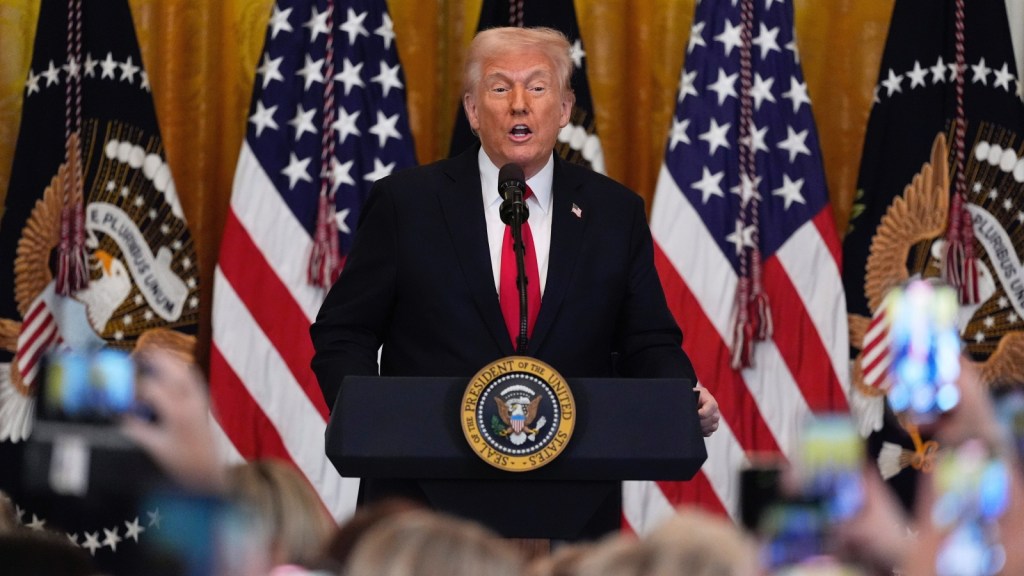 US President Donald Trump speaks at a reception celebrating Women's History Month in the East Room of the White House, Wednesday, March 26, 2025, in Washington. (Photo/AP/PTI)


 Share


