The Indian stock market continued its slump and fell to a near 3-month low on Tuesday as heightened turmoil in West Asia, rising crude oil prices and a busy IPO market kept the secondary market under pressure.
On Tuesday, the National Stock Exchange’s (NSE) Nifty 50 index ended the session at 23,635.10, down 144.05 points or 0.6%. The BSE’s Sensex closed down 0.7% at 75,577.58. Following a rally of around 4.2% in around a week till August 3, the benchmark indices have since fallen 4.6%.
“The most important reason is liquidity. The renewed conflict has led to higher crude prices that have spooked foreign players, so they are not investing much. And the IPO market continues to boom, which has sucked away a lot of liquidity from the secondary market to the primary market,” said G Chokkalingam, founder of Equinomics Research.
Global crude prices have spiked again to just below the $100-a-barrel mark, the highest since late July, as tensions between the US and Iran have intensified. After the US military struck Iranian oil tankers over the weekend, Iran threatened “economic warfare” against their American counterparts.
The escalation follows weeks of relative calm between the two sides, which had eased sentiment in the Indian market and shifted investor focus towards domestic factors such as the macroeconomic outlook and earnings growth. With diplomatic talks stalling between the US and Iran, however, renewed hostilities have brought crude and currency risks back into focus.
Since India is a massive importer of crude oil, higher crude prices due to the war put pressure on the rupee, and a weaker rupee then makes crude more expensive. The Indian currency ended Tuesday at 94.81 against the dollar, down 0.35% from its previous close. The fall was reportedly limited by intervention from the Reserve Bank of India.
 Nifty, Sensex hit 3-month low
While benchmark indices were in the red on Tuesday, the mid- and small-cap space saw some gains. Performance was mixed at the sectoral level, with sectors such as banking and financial services, and oil and gas losing up to 1%, while healthcare, pharmaceuticals, and auto ended higher.
The session, at the end of which the weekly derivatives contracts of Nifty 50 were to expire, also saw significant volatility in the closing auction session (CAS) — a trend that has been seen on expiry days since the new mechanism was introduced on August 3.
The Nifty 50’s indicative closing price fell as much as 1.8% during the 15-minute session before settling to its eventual close. Indicative prices indicate where the index is going to end at the end of the CAS window. To flush out this volatility, the Securities and Exchange Board of India is set to propose changes to settlement in the derivatives segment sometime this week.
Liquidity pressure, mixed views on IPO boom
The IPO market has gained momentum, as at least 34 companies are looking to collectively raise around Rs 45,000 crore before their regulatory approvals expire at the end of this month. At least 12 issues are set to start or have already opened this week, looking to raise around Rs 8,000 crore. Reports also suggest that NSE’s record Rs 30,000 crore issue is likely to be completed by this month.
Such strong momentum in the IPO market attracts capital from both institutional and retail investors, who may divert funds that could otherwise have gone into the secondary market, either directly or through investment vehicles such as mutual funds or alternative investment funds.
This has raised concerns about a temporary liquidity squeeze in the secondary market. However, analysts differ on the significance of the IPO impact.
Ajit Mishra, Senior Vice President of research at Religare Broking, believes this liquidity stretch is a temporary concern. “The IPO impact is more of a liquidity diversion than a fundamental concern — the broader correction is largely being driven by global uncertainties,” Mishra said.
Chokkalingam, on the other hand, sees the secondary market remaining sluggish as long as the IPO wave lasts. “The market may fall another 1-2% maybe over the next couple of months, till either crude prices fall significantly or the IPO wave slows down,” he added.
The divergence highlights the two forces currently weighing on equities: global risk aversion, particularly from the renewed West Asia tensions and higher crude prices, and the diversion of liquidity towards the primary market.
For investors, the direction of crude prices and foreign flows, along with the pace of IPO activity, will be key to whether the recent correction deepens or eases in the coming weeks.

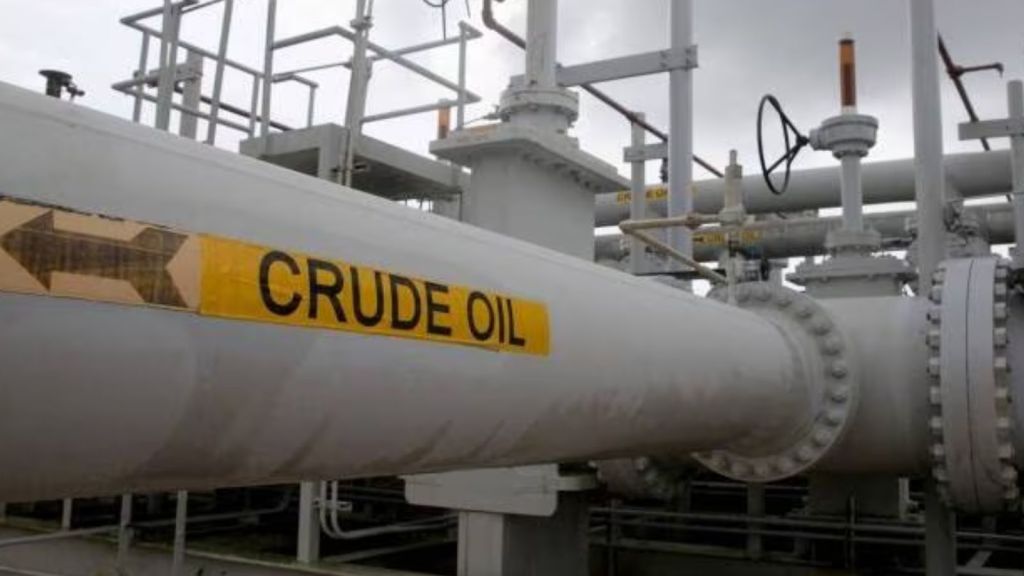 Global crude prices have spiked again to just below the $100-a-barrel mark, the highest since late July. (File Photo)

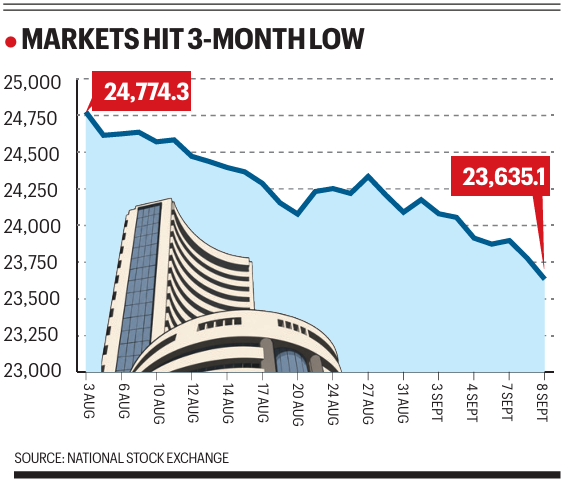 Nifty, Sensex hit 3-month low

 Share


