


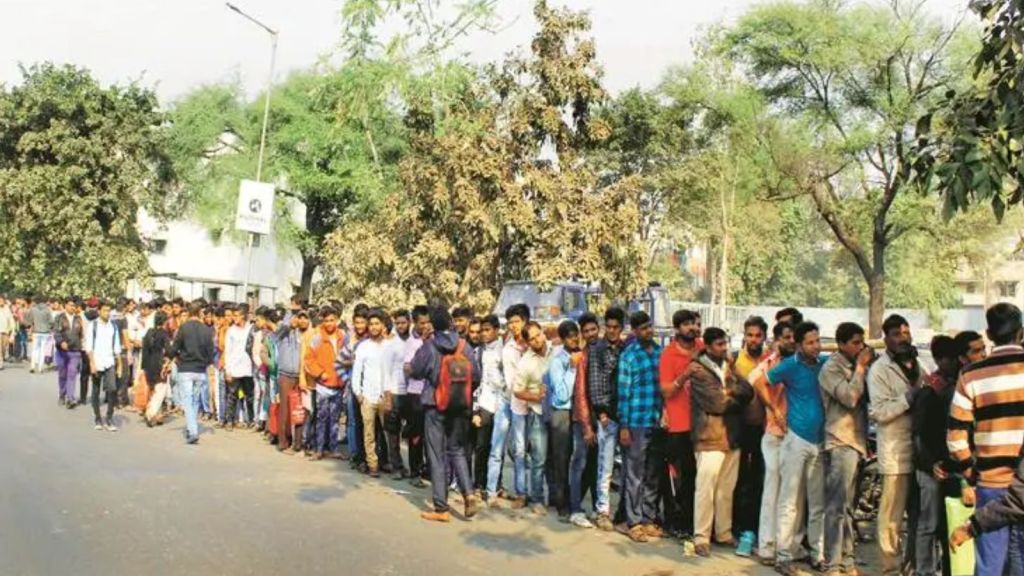
 More than half of young people aged 15 to 29 in Odisha’s Anugul and Kendrapara districts were neither employed nor studying or undergoing training in 2025, new MoSPI data shows.
More than half the youth – those between the ages 15 and 29 years – in two districts of Odisha were neither employed nor getting trained or educated in 2025, according to new district-level data released by the statistics ministry on Friday.
As per the figures, based on the Periodic Labour Force Survey for 2025, the district of Anugul had the highest share of youth in the country at 56.1% who were not in employment, education, or training – referred to as ‘NEET’. However, 81% of districts in Bihar had a youth NEET share of more than 25% – the highest in the country. For Odisha, it was 52%.
The all-India NEET rate among youngsters in 2025 was 25%. According to a NITI Aayog report released last month, around 8.7 crore Indians aged 15 to 29 were not studying, working or undergoing training in 2021.
NEET is a way of measuring progress in effectively integrating the youth in work and is often seen as a better indicator than the youth unemployment rate. This is because the number of young NEETs is far higher than the number of unemployed youth. As such, a youngster’s NEET status, according to the International Labour Organization, is a more reliable indicator of vulnerability than unemployment.
Kendrapara, also in Odisha, was second at 51.4%. Another Odisha district, Dhenkanal, was third with 45.3%. Rounding off the top-five were Tenkasi in Tamil Nadu (44.9%) and North Delhi (44.3%).
Interestingly, the district in India with the lowest share of youth not in employment, education, or training was also from Odisha: Nabarangapur with 4.1%. Nabarangapur was also the district with the second-highest Labour Force Participation Rate in the country, at 85.4%, behind only ‘Dohad, Narmada, Dang, Tapi, Chhota Udepur, Mahisagar’ of Gujarat. These were all clubbed together by MoSPI and had a Labour Force Participation Rate of 86%.
Labour Force Participation Rate refers to that percentage of people either employed or looking for work.
Among the most populous 100 districts of the country, Ernakulam in Kerala had the lowest NEET rate of 9.6%.
Of the 566 districts for which the Ministry of Statistics and Programme Implementation (MoSPI) released data on Friday, 251 districts had at least 25% of youngsters in the 15-29 age bracket not in jobs, education, or training. Only 18 had a youth NEET rate of less than 10%.
Data for another 18 districts had very high statistical errors, with MoSPI asking those numbers to be interpreted with caution.
This is the second set of district-level data from a large-scale national survey released by MoSPI. Last week, it had released district-level estimates based on the data collected from the Annual Survey of Unincorporated Sector Enterprises (ASUSE) of 2025. That had shown that 78% of informal sector workers in Nirmal district, in northern Telangana, were women – the highest of any district in the country. Nanded, immediately across the state border in Maharashtra, was ranked 288th in the country, with women making up only 31% of its informal workers.
The data released Friday showed that while 81% of districts in Bihar had a youth NEET rate of more than 25%, West Bengal was second at 75%, and Haryana and Andhra Pradesh tied at third with 70%. Uttar Pradesh was next at 69%.
At 17% each, Rajasthan, and Maharashtra were the major states with the smallest percentage of districts with a youth NEET rate of more than 25%. Jammu and Kashmir was at 13%.
In terms of the other key labour market indicators, 18 districts had an unemployment rate of less than 1%, with Madhya Pradesh’s Raisen and Bihar’s Saharsa on top with 0.3%. The highest was 16.1% in Arunachal Pradesh’s Papum Pare district.