


Journalism of Courage
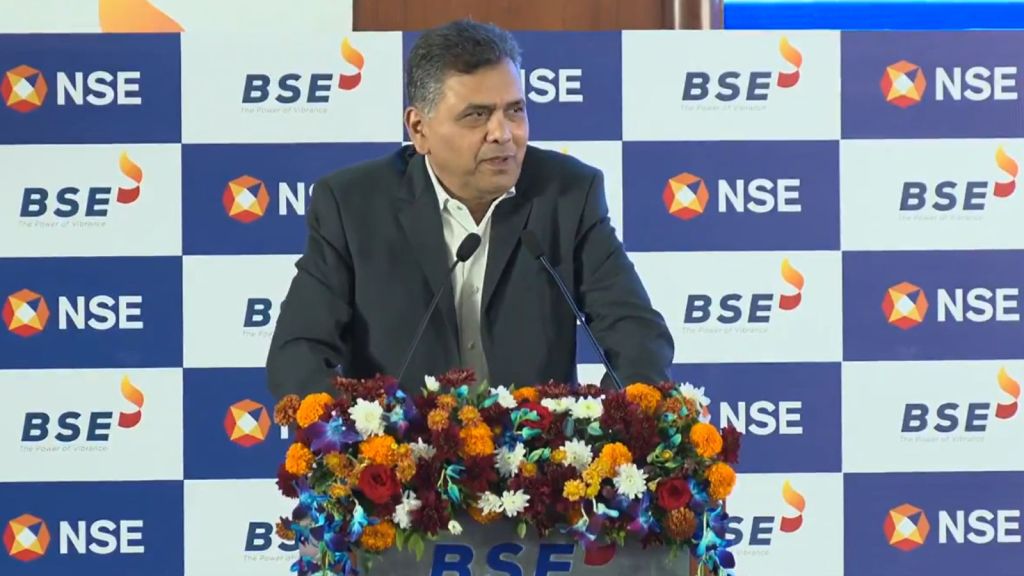 NSE Chairman Srinivas Injeti (Image: @NSEIndia/X)
The primary duty of the National Stock Exchange (NSE) is to ensure a safe and trusted market for investors even if it comes at the cost of business for the exchange, Chairman Srinivas Injeti said here on Friday, amid the ongoing tightening of regulations for derivatives markets which has been a “cash cow” for both the bourse operators, NSE and BSE.
“We can’t be distracted from our primary duty of giving you a market with integrity and a market where investors are protected,” Injeti said during a media briefing here, a day after NSE’s listing.
MD and CEO Ashishkumar Chauhan and other senior management of the bourse operator were also present.
On regulatory tightening in the derivatives segment, Injeti said, “This imbalance, excessive dependence (on the derivatives segment), you know, will have to be reduced. So, I think that is the big picture. And given this, there is no way, there is no jugglery, there is no way in which quarter to quarter you can do some magic.”
Before this tightening, NSE and BSE were deriving over 90% of their revenues from the derivatives segment at one point.
Diversifying revenue streams
NSE’s management emphasised the need to take steps to better protect retail investors and diversify its revenue streams going forward.
“Maybe if this domination in options was unquestioned, they (SEBI) may not have looked at the commodity. They may not have looked
at … what are the small, small things we can do to sort of get data connectivity, some money here, some money there, some data modernisation. All that is happening because of this imbalance, excessive dependence (on revenues from derivatives), you know, will have to reduce,” Injeti added.
A study by the Securities and Exchange Board of India (SEBI) last month showed that despite signs of retail participation in India’s equity derivatives (F&O) cooling for the first time in at least five years, nearly 9 in 10 individual traders continued to face losses in 2025-26, as the average loss per trader rose 2% year-on-year to Rs 1.17 lakh crore.
This was despite steps taken by the regulator such as limiting expiries to one per exchange and increasing lot sizes of derivative contracts, among others.
NSE has considerably reduced its revenue dependence on derivatives, and aims to continue doing so through more focus on the cash market, electronic gold receipts, and the commodity market, among others.
In fact, SEBI on Thursday permitted foreign investors to participate in physically settled non-agricultural commodity derivatives, a move expected to boost trading volumes in bullion contracts. This will also bring in significant capital for NSE, whose facilities have been used by FPIs for decades to invest in equities, the management said.
Time to reconsider self-listing norms
The NSE chairman also said that the SEBI should allow exchanges to list on their own platforms as the Indian market has matured.
While self-listing is permitted across various major markets, like in the US, the Indian market regulator continues to prohibit it, citing conflict of interest concerns.
“Prior to 2012, even listing was not allowed. A stock exchange or an MII could not list. In 2012, it was allowed,” Injeti said, adding that there is merit in aligning the Indian norms with global standards.
Similar concerns have also been raised by foreign investors, it added.
NSE’s shares listed on the BSE on Thursday at a premium of around 1%. The management said it had not yet approached SEBI for approval regarding its shares trading on its own platform through the “permitted-to-trade” route without listing.
The “permitted-to-trade” route enables a share to trade on an exchange without listing on it, leaving the regulatory burden to the exchange it is listed on.
This enables the stock to get into passive funds tracking indices specific to that particular exchange.