


Journalism of Courage
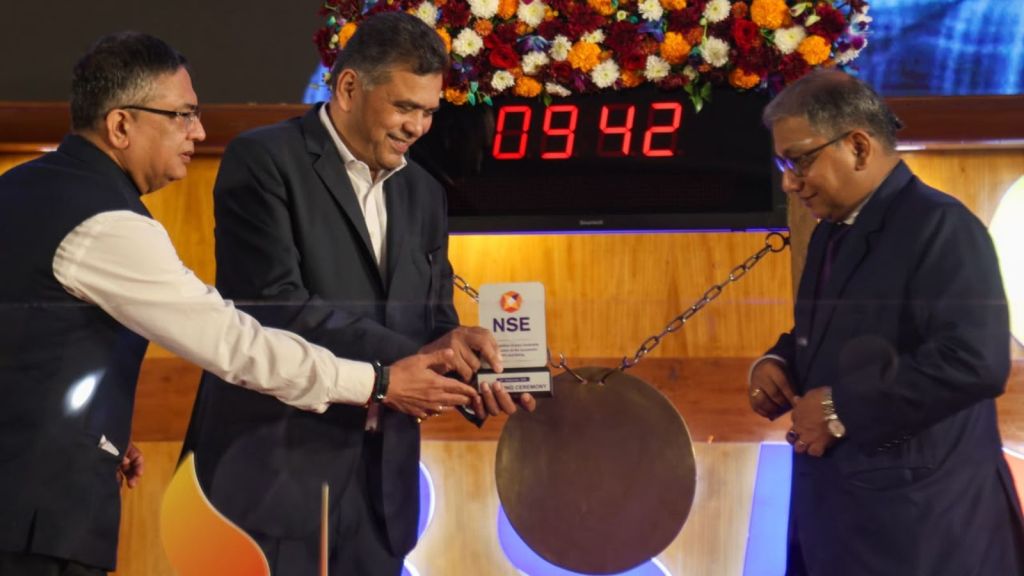 The National Stock Exchange of India Limited (NSE) marked its stock-market debut with a listing ceremony at BSE Limited in Mumbai on Thursday, September 24. (Express photos by Akash Patil)
The National Stock Exchange (NSE) made its historic market debut on Thursday, with its shares listing at Rs 1,800 apiece — an around 1% premium over its IPO price of Rs 1,785. Analysts had expected the shares to list at a 4-5% premium, based on their performance in the unlisted market over the past few days.
The stock gained further on listing, ending the session at Rs 1,818, up 1% from its listing price, even as the overall market slumped nearly 2%. In fact, the stock had gained as much as 4.3% from its listing price intraday, before paring back some gains.
“Finally, the day we were all waiting for has arrived. NSE does not belong just to its shareholders, directors, and employees. It belongs to the entire nation,” said Srinivas Injeti, Chairperson of the stock exchange at its IPO press conference on Thursday. Despite the challenging market conditions, the exchange swiftly launched its public issue after clearing regulatory challenges due to its focus on “inherent value” instead of “market valuation,” he added.
The exchange listed with a market capitalisation of Rs 4.45 lakh crore, significantly higher than BSE’s current market-cap of Rs 1.33 lakh crore. While listing-day gains remained relatively muted, the stock’s performance in the near-to-medium term also depends on the additional equity that may be available to trade once the lock-in period for current shareholders ends, an analyst at a domestic brokerage said.
According to current regulations, pre-IPO shareholders are not allowed to sell their shares for a period between 6-18 months after the public issue to protect investor interests. Notably, the NSE had reduced its issue size as many selling shareholders decided to hold onto their shares due to lower-than-expected valuations and growth potential post-listing.
Only about 5% of the exchange was sold during the IPO, with a large portion of it being lapped up by institutional and anchor investors, currently leaving a very slim portion to be freely traded in the open market at the moment.
MSEI access, IPO demand
While NSE’s shares got listed on the BSE, they were also admitted into the Metropolitan Stock Exchange of India (MSEI) through the ‘permitted to trade’ category. This category allows investors to trade a stock on a particular exchange without listing on it. The development came after NSE Managing Director and Chief Executive Ashishkumar Chauhan clarified it hasn’t reached out to the Securities and Exchange Board of India (SEBI) for permission for its shares to trade on its own platform. Under current regulations, the regulator does not allow shares of exchanges to trade on their own platform.
The much-awaited IPO saw high demand from investors and was oversubscribed by 5.71 times by the end of bidding for the issue. The retail portion of the issue was oversubscribed 1.39 times, while the institutional section saw even more demand, being oversubscribed by 12.68 times.
A handful of broking firms started coverage on the stock with a positive view post-listing. “While revenue grew at 25% CAGR in FY21- 26, we build a CAGR of 11% over FY26-29 due to shrinking share in index options. We expect EBITDA margin to recover to 76% by FY29 (vs 71% in FY26) as one-offs get adjusted, in-line with PAT CAGR of 11%,” Prabhudas Lilladher said in a report.
Despite shrinking volumes in the “cash-cow” derivatives segment, the firm expects revenues to be driven by listing services, colocation, data feed, and index licensing going forward.
Moreover, the markets saw a sharp slump on Thursday as participants grew wary of surging crude oil prices, the resultant inflationary concerns, and rising bond yield — all exacerbated by the West Asia war that has continued since late February.
The benchmark Nifty 50 index ended at 23,063.10, down 383.70 points or 1.6%. The Sensex slumped 1.7% or 1,247.71 points to close at 73,580.54. All sectoral and broader market indices ended in the red, with India VIX volatility indicator skyrocketing nearly 23%. This surge indicates that participants are plagued by uncertain market conditions, leading to volatility.