Delhi has topped NITI Aayog’s India Electric Mobility Index (IEMI) 2025 for the development of the e-mobility ecosystem and the adoption of electric vehicles (EVs) on Indian roads. It is followed by Maharashtra and Karnataka, the only two of the 17 large states to feature among the top performers in EV implementation, according to the report released on Wednesday.
IEMI is a composite Index, which assesses the policy framework and implementation outcomes for e-mobility at the state-level. NITI Aayog developed the index in collaboration with WRI India. The report covers three themes: transport electrification progress, charging infrastructure readiness, and EV research and innovation status.

According to the index, the composite scores on performance across all 36 States and Union Territories (UTs) ranges from 10 to 84, and a median score of 40. Delhi bagged the highest score of 84, followed by Maharashtra (78), Karnataka (73), Chandigarh (71), and Goa (65). When compared to the 2024 index, Delhi and Maharashtra maintained the top two positions, while Karnataka moved to the third place after overtaking Chandigarh, while Goa climbed ten spots to secure fifth position.
Notably, Madhya Pradesh recorded a substantial improvement, moving from the 23rd to seventh rank.
The index further shows that eight large states — Tamil Nadu, Madhya Pradesh, Odisha, Andhra Pradesh, Telangana, Haryana, Rajasthan, and Uttar Pradesh — have qualified as frontrunners, meaning they scored 50-64 out of 100. The other seven large states such as Chhattisgarh, West Bengal, Bihar, Kerala, Jharkhand, Punjab, and Gujarat were emerging performers with a score of 35-49.
EV progress and gaps
The report also shows that Delhi, Chandigarh, and Maharashtra were the only UTs and states to qualify as top performers in transport electrification progress, which is assigned the highest weightage of 50% in index calculation. It evaluates market absorption, consumer acceptance, and demand-side momentum by measuring how effectively EVs are being adopted and supported across the states.
In the Charging Infrastructure Readiness (30% weightage), Karnataka recorded the highest score nationwide at 97, closely followed by Goa (92) and Maharashtra (91). This captures charger-to-vehicle ratio, subsidies for charging infrastructure, building bye laws for charging, power availability among other metrics.
Story continues below this ad
Delhi also achieved the top score of 94 in the EV Research and Innovation Status (20% weightage) category. This covers EV startups, research and development initiatives, as well as patents.
The report said the limited charging infrastructure, dispersed settlements and a nascent innovation ecosystem are some of the identified barriers to progress.
“For most States and UTs, transport electrification progress remains the largest opportunity for improving overall performance, with only three qualifying for the top performer category in this theme. Charging rollout and EV adoption are moving at different speeds across the country, a sign that the transition is uneven. With the foundational EV policy in place for most States and UTs, the focus must shift from policy formulation to effective implementation,” the report said.
Why electrification matters
The need for EV is crucial since road transport accounts for roughly 12% of the country’s energy-related carbon dioxide emissions.
Story continues below this ad
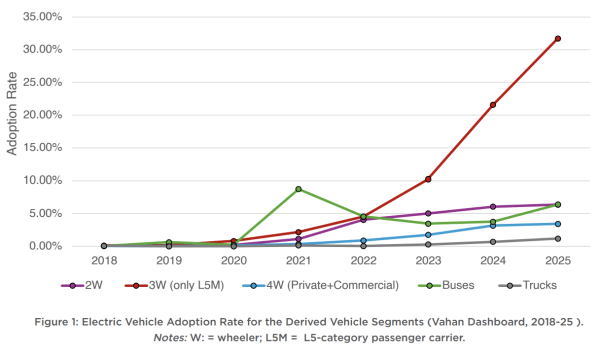
In India, the EV transition has gained momentum over the years. According to the report, by 2025-26, EV penetration, or share of EVs in total vehicles registered reached 8.25%, up from 0.5% in 2018. In 2025-26, over 8.7 million EVs were running on roads. Close to 2.5 million EVs were registered during 2025-26 alone, with a rise of about 25% over the previous financial year.
The two-wheelers accounted for most at 1.3 million units, followed by passenger three-wheelers, while passenger cars held a modest and rising share. Commercial goods vehicles saw the sharpest growth across the electric light, medium and heavy-duty segments, where their share climbed from 0.6% in 2024 to 1.4% in 2025. E-bus adoption in India has also gained momentum since 2021.
In 2025, electric cars accounted for around one-tenth of new car sales in the US, more than a quarter in the European Union, and over half in China.