


Journalism of Courage
 Bond yields tend to rise amid fears of rising inflation, which leads to central banks hiking interest rates. (File Photo)
The Indian stock market shed another 1.6% on Monday, falling to its lowest levels in nearly six months, as high crude prices in the wake of gloom in West Asia led to heavy selling pressure. The benchmark indices had tumbled around 1.7% last Thursday, which had led to the indices extending their losing run to seven weeks.
BSE’s Sensex crashed 1.5% or 1,124.02 points on Monday to end the session at 72,771.72. Nifty 50 lost 1.6% to close at 22,780.25. The fall wiped out nearly Rs 9 lakh crore of investor wealth in the process. “Bears remained firmly in control as the market breached a key psychological support level, reflecting growing investor caution amid deteriorating global macro conditions,” said Vinod Nair, Head of research, Geojit Investments.
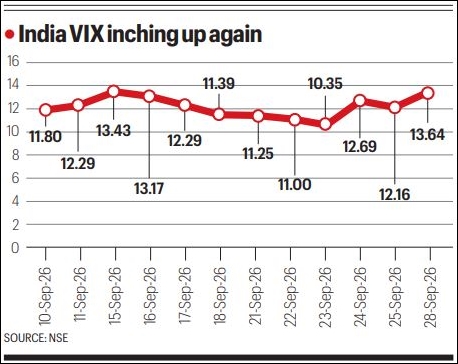
All sectoral, broader market, and thematic indices ended the session firmly in the red, as the India VIX — the market’s volatility indicator — climbed 12.5%. Banks, financial services, IT, oil and gas, and metals were among the worst hit during the session, all falling 1-2%.
As oil prices remained a thorn, the Indian rupee fell to its lowest level in over a week before reported intervention by state-owned banks, likely on behalf of the Reserve Bank of India (RBI), stabilised the currency a bit, according to Reuters. It eventually settled down 0.2% at 95.98 against the dollar.
Trump rejects peace proposal, crude shoots up
On Saturday, US President Donald Trump had rejected Iran’s proposal of a 7-day ceasefire, alongside plans to reopen the critical Strait of Hormuz due to the latter asking “too many concessions” without meeting its terms, making the hopes of a diplomatic resolution of the conflict bleaker.
However, Trump also told news portal Axios on Sunday that he expected US negotiators to engage in more talks this week, keeping diplomatic doors open.
Despite this, Trump’s rejection of an immediate resolution led to crude prices shooting up to over $108 per barrel on Monday, crushing any optimism in the Indian market. “Whenever crude is above $100 a barrel, it creates a selling pressure in the Indian market over the short-to-medium term. The current scenario is similar to what we had seen in the first couple of months of the war,” said Kranthi Bathini, Equity Strategist, WealthMills Securities.
For context, India is the third-largest importer of crude oil globally, and higher crude prices stoke fears of inflation, hurting both corporate growth and the spending power of consumers.
The Indian market had recovered a bit briefly during July and August as the conflict in West Asia had moderated a bit, turning focus towards factors like earnings growth and macroeconomic conditions. This had led to foreign investors turning net buyers in the Indian market over those months.
However, with the situation escalating again this month, foreign investors have dumped $2.2 billion of Indian shares so far this month, adding to the selling pressure. Furthermore, the booming IPO market during the month has also taken liquidity away from the secondary market, analysts said.
Bond yields climb further
Bond yields continued their upward trajectory on Friday, with the US Treasury yields rising above 5.2% — the highest level since 2004. Yields on bonds from other global markets such as the UK, Japan, and some other European nations have also been rising steadily.
Indian bond yields have also been moving in line, with the yield on the benchmark bond rising to 7.18% during the session — the highest since April 2024.
Bond yields tend to rise amid fears of rising inflation, which leads to central banks hiking interest rates. These potentially higher interest rates drive up yields, which move inversely to prices, as future bond issues become more attractive than the current ones. Higher yields are a negative for the market, as they provide a safer and more attractive investment avenue for investors.
The oversupply of liquidity has been another factor driving yields higher in India’s case. The RBI on Monday completed its biggest-ever annual net bond sale in more than a decade of Rs 1 lakh crore, absorbing some of the excess liquidity in the system but adding to the supply glut of bonds in the process. Reports also said the government’s borrowing calendar for October-March, released on Friday, unsettled traders by tilting issuance away from liquid five- and 10-year bonds and toward 15-year and ultra-long securities.
Higher-duration bonds are more prone to interest rate risks, making bond prices very sensitive to any potential policy action by the RBI, which increasingly looks likely as rising inflation remains a threat.