


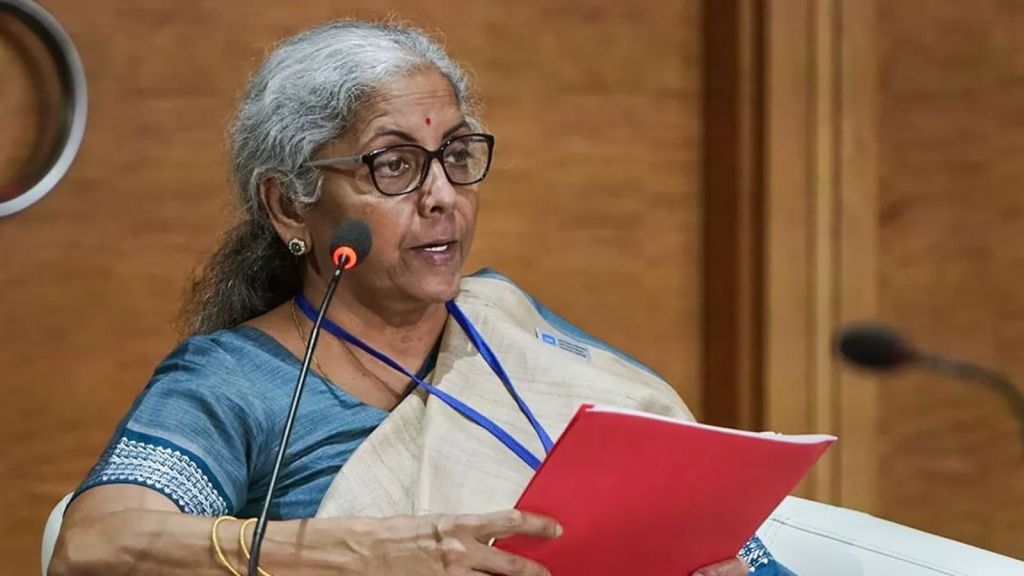
 Commenting on the RBI’s efforts to ease pressure on the rupee, Finance Minister Nirmala Sitharaman said on Tuesday that the central bank is “making a lot of effort” to make sure the rupee is stable. (File photo)
Finance Minister Nirmala Sitharaman sent stock markets soaring on Tuesday, saying that the debate on long-term capital gains (LTCG) tax is “healthy” and she is “keen” to hear about it. Speaking at the Bloomberg New Economy Forum, Sitharaman also said the Reserve Bank of India (RBI) “will continue” to stop volatility in the rupee but not “fix” a level.
Quizzed on comments by certain foreign investors that they are waiting for the removal of the capital gains tax so that they can invest in India, the finance minister said considering that work on 2027-28 Union Budget has begun, it may not be the best time for her to say “what I will or what I will not consider. So, I’ll tread cautiously on that”.
The finance ministry started its pre-budget meetings on October 12. The budget is usually presented in Parliament on February 1.
In her response, Sitharaman said both domestic and foreign investors ask and comment about the LTCG tax and the Securities Transaction Tax (STT) and the debate on “tax in the market” and the tax treatment for all asset classes “has been a very well discussed topic”.
“Two years ago, we had brought all asset classes similarly and people thought I’m increasing the tax. I wasn’t increasing the tax; I was bringing all of them to be at par with one another so that an investor is not speculating as to which one gives them greater leverage. So, these are things on which there’s a lot of debate. It’s healthy to have this debate and I will be keen to hear them,” Sitharaman said.
The finance minister made the comments during market hours. The Sensex and the Nifty extended gains after her remarks, closing the day 1.5% and 1.6% higher, respectively. India levies a 12.5% tax on long-term capital gains, which accrue when an asset is sold after one year of its purchase.
Last week, Soumya Kanti Ghosh, State Bank of India’s Group Chief Economic Adviser, said the government needs to “support the RBI in its quest” to stabilise the rupee, which was veering close to its all-time low of 96.96-per-dollar last week before the central bank announced measures early Saturday to dampen speculative forex market activity and made hedging forex exposures expensive.
“There is a serious need to relook at enhancing flows of patient capital in debt, as also equities tweaking the tax and capital gains structure suitably as the fight for capital is just getting murkier globally and non-AI heavyweights put us on the wrong end of the see-saw,” Ghosh said in a report on October 9.
Earlier this year on June 5, the government scrapped the withholding tax as well as long and short-term capital gains tax on foreign investors’ investments in government bonds to attract overseas funds. This came amid heavy pressure on the rupee, which had almost breached the 97-per-dollar mark in May amid continued dumping of Indian stocks and debt by foreign investors, with the West Asia war only exacerbating capital outflows.
Before the June 5 decision, foreign investors paid 12.5% tax on long-term capital gains, 30% on short-term capital gains, and around 20% withholding tax on interest income from their government bond holdings.
As per latest data, Foreign Portfolio Investors (FPIs) net sold Indian shares and bonds to the tune of $16.6 billion in 2025-26. The selling pressure has continued in the current fiscal, with net sales so far this year already at $14 billion.
Commenting on the RBI’s efforts to ease pressure on the rupee, Sitharaman said on Tuesday that the central bank is “making a lot of effort” to make sure the rupee is stable.
“These efforts from RBI, I understand, will continue, not to – as I said – fix the rupee. We would appreciate (it) if the rupee finds its own (level),” the finance minister said.
The rupee gained 1% on Monday and another 0.5% on Tuesday following the RBI’s measures over the weekend. It closed at 95.28-per-dollar on Tuesday.
Commenting more broadly on the exchange rate, Sitharaman said that a lot of capital outflows from India are happening because of the rupee’s weakness even though “every other factor is favourable”.
“I think the depreciation of the rupee, as it’s happening over the last one and a half years, is very significant and measures are being taken. But very many different factors add to it. I would believe most of it is because of the challenges outside.”
On domestic macroeconomic policy, the finance minister said the government’s fiscal discipline “is not going to be a matter which should worry investors”. “But as regards rupee and the way it is reacting to the ups and downs with the dollar, yes, that’s where the challenge is and we will be attending to that,” she said.