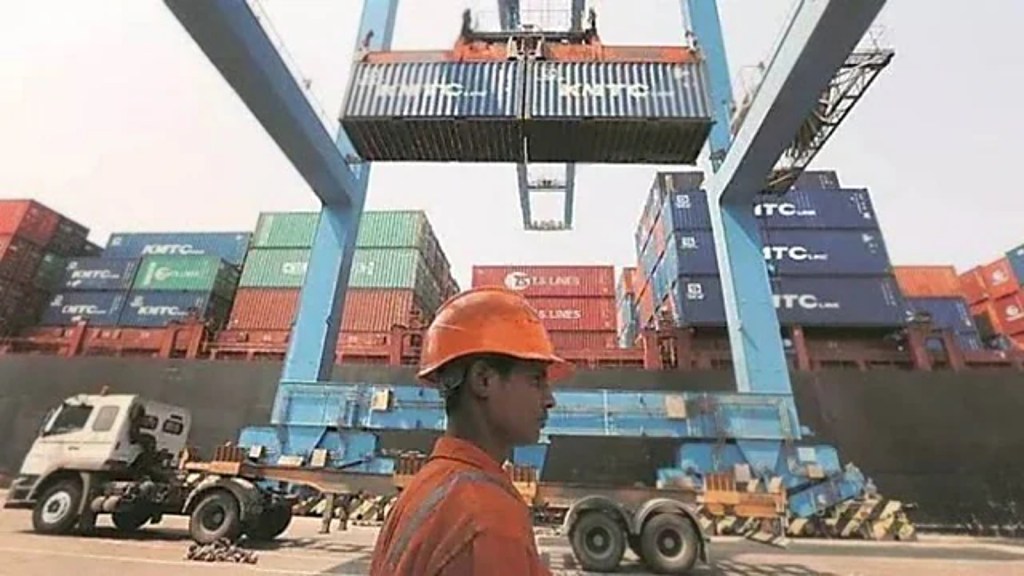
The concerns over reciprocal tariffs kicking off on April 2 seem to have resulted in a front-loading of shipments in March, with total exports to the US reaching an all-time high of $86.51 billion in 2024-25.
According to provisional trade data released by the Commerce Ministry, imports from China also surged to a record high of $113.45 billion in the last financial year.
Indian exporters shipped goods worth over $10 billion to the US in March alone, which represents a sharp jump of 35 per cent compared to March last year. Overall, total goods exports remained flat.
Simultaneously, imports in the same month from China jumped 25 per cent. This is much higher than the overall 11.52 per cent increase in imports recorded during FY25. Overall trade deficit was recorded at $94.26 billion, as imports also grew by 7 per cent to hit a record of $915.19 billion in the last financial year.
The data showed that goods exports remained flat at $437.42 billion in FY25, compared to $437.07 billion during the previous financial year.
In contrast, services exports logged 12.45 per cent growth, reaching $383.51 billion compared to $341.06 billion in the previous financial year. India maintained a healthy surplus in services trade, with imports in FY25 coming in at $195.95 billion. Former trade officer and head of think tank Global Trade Research Initiative (GTRI), Ajay Srivastava, said that India’s trade deficit with China has hit $99.2 billion in FY25, reflecting deeper structural dependencies, not just trade imbalances.
“China is India’s top supplier in all eight major industrial product categories. The PLI schemes are fuelling import growth due to their heavy reliance on imported components. What’s more alarming is that India’s exports to China fell 14.5 per cent, dipping to $14.2 billion — now lower than they were in FY14, when the rupee was significantly stronger. This signals more than a trade issue; it’s a competitiveness crisis,” he said.
Amid drought and high temperatures in Brazil, a key coffee producer globally, India saw the steepest surge of 40 per cent in coffee exports. New Delhi exported coffee worth $1.8 billion in FY25 — the highest ever — as prices of robusta coffee touched record highs in global markets.
With booming iPhone exports from India, electronic exports registered a 32 per cent jump to $38 billion. The Commerce Ministry said that India’s export share in the US and UK markets in 2024 went up by 13.73 per cent and 14.31 per cent respectively.
Exports of drugs and pharmaceuticals, fruits and vegetables, cereal preparations, and miscellaneous processed items also rose between 5 and 10 per cent. However, exports of gems and jewellery, handicrafts, and organic and inorganic chemicals declined by 2 to 10 per cent.
Notably, engineering goods shipments recorded 6.74 per cent year-on-year growth in FY25 compared to the previous fiscal. However, in March, the value of Indian engineering goods exports declined nearly 4 per cent year-on-year to $10.82 billion, compared to $11.27 billion in March 2024.
Engineering Export Promotion Council chairman Pankaj Chadha said that the additional duties imposed by the US on iron & steel and auto components are set to hit the engineering exports sector. “There could be a potential annual drop of $4-5 billion in engineering shipments to the US as a consequence. Besides, we are going to face massive competition from China in other markets as they vehemently push their products there while chasing new regions to de-risk from the US,” he said. Competition in markets such as Latin America, Central America, the Middle East, and Africa is set to heat up as exporters explore new markets and further penetrate existing ones, he said, adding that this could dent profit margins, leaving little funding for investment.
Meanwhile, the World Trade Organization (WTO) on Wednesday warned that the volume of world merchandise trade is expected to decline by 0.2 per cent in 2025 under current conditions — nearly three percentage points lower than would be expected under a “low tariff” baseline scenario.
“Services trade, though not directly subject to tariffs, is also expected to be adversely affected, with the global volume of commercial services trade now forecast to grow by 4 per cent, slower than expected,” the WTO said in a note.
WTO Director-General Ngozi Okonjo-Iweala said that the recent de-escalation of tariff tensions has temporarily relieved some of the pressure on global trade. However, the enduring uncertainty threatens to act as a brake on global growth, with severe negative consequences for the world — particularly for the most vulnerable economies.



 Share


