


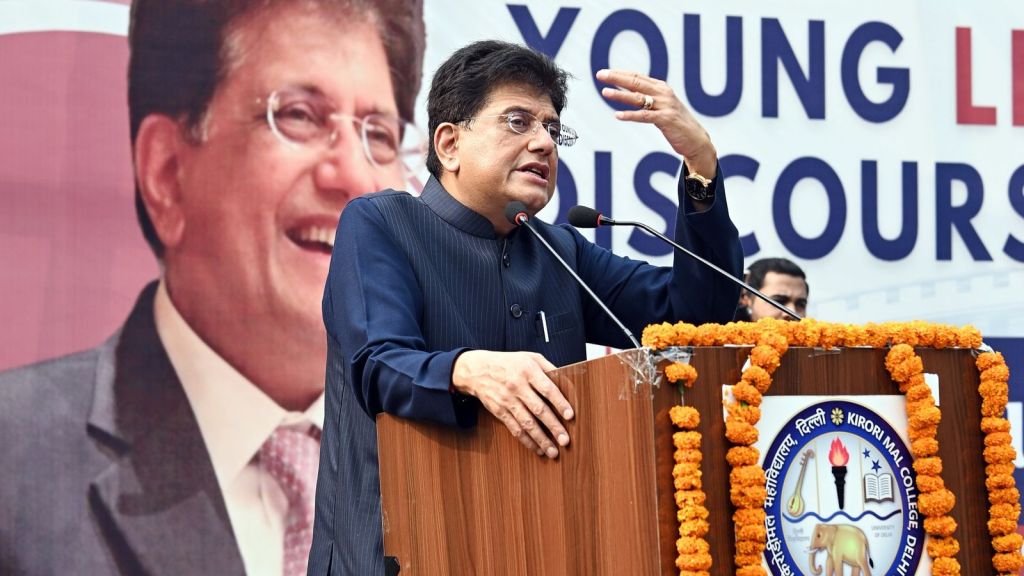
 Union Minister of Commerce and Industry Piyush Goyal addresses at the Young Leader Discourse Forum at Kirori Mal College, University of Delhi, in New Delhi on Tuesday. (ANI Photo)
Amid ongoing talks for a trade deal with the US, the Commerce and Industry Minister Piyush Goyal on Tuesday said India will not allow imports of genetically modified (GM) products or dairy products produced using calf meat. He said that if China restricts the exports of tunnel boring machines, the country will produce them domestically.
This comes as the US has been pushing for exports of GM products under the trade deal with India and has cited Indian regulations blocking imports of certain dairy products as non-tariff barriers. The United States Trade Representative (USTR), in its report on non-tariff barriers released in March 2025, had said that the country imposes “onerous requirements” on dairy imports.
“We are very sensitive to the opening of the dairy sector. Till date we have never opened the dairy sector for anybody. We are sensitive not to allow any GM products to come to India. We have never allowed it, and we will never allow it in the future. We are sensitive to our religious sensitivities. Very often in foreign countries, they use calf meat or rennet while producing their dairy products. We have never allowed it in the past, and we will not do so in the future. It has to be strictly certified,” Goyal said while interacting with students at the Kirori Mal College.
The USTR report had said that the country requires dairy products intended for food to be derived from animals that have not consumed feeds containing internal organs, blood meal, or tissues of ruminant or porcine origin, and that exporting countries certify to these conditions, which lack a discernible animal health or human health justification.
“This requirement, along with the recent dairy health certificate requirements, new facility registration requirements, and high tariff rates, continues to hamper market access for US milk and dairy product exports to India, one of the largest dairy markets in the world. The US government continues to press the Indian government, including through the trade policy forum, to provide greater access to the Indian dairy market,” the report had said.
China to restrict imports of tunnel boring machines
On a question about the country’s dependence on tunnel boring machines (TBMs) amid China’s plans to restrict imports of the product from November 18, the minister said that several countries tend to surrender to such moves, but India has a different view on the subject, and will produce the machine domestically if China decides to restrict TBM exports.
“India has a different view on the subject. A lot of countries surrender and do a deal giving rare earth, and we will do something (in return). We are not detonating our relationship with China. And if more hurdles don’t come in, the relationship will improve. But if China does not give us a tunnel boring machine, we will develop it in India. India is not a country that surrenders. When they stopped rare earths, we did not go to them with a begging bowl. I met with the startups in the field and said why can’t we make motors with our rare earths… our startups have begun producing motors with rare earths after China curbed their exports,” Goyal said.
This comes after China’s Commerce and Industry Ministry last month said that export operators would need to apply for a license in accordance with provisions of export control law and regulations on the export control of dual-use items and that the restrictions will go into effect on November 18.
TBMs play a crucial role in several construction projects, particularly for the country’s maiden 508-km bullet train project, the Mumbai–Ahmedabad High-Speed Rail Corridor. The project also includes a 7-km-long undersea rail tunnel.
These machines are used in several countries across Europe, Canada, the US and Australia, as they are known to ensure a much safer excavation process, especially since the tunnel passes through a densely populated area where conventional blasting methods would pose risks.