3 min read


© The Indian Express Pvt Ltd



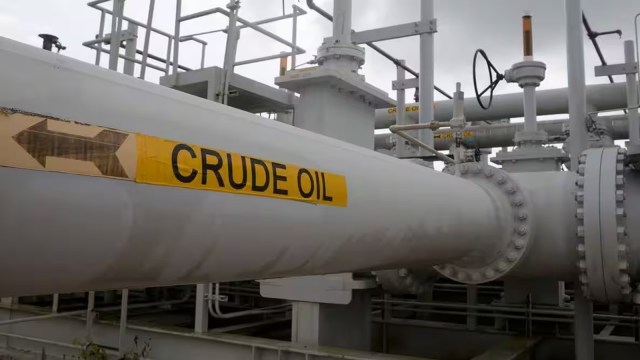 Although companies that take the strategic reserves on lease can use the facility to store their crude and even trade those volumes (in the case of international players), India retains the first right of use on the crude oil stored in strategic reserves in an emergency like a massive supply disruption or war. (File image)
The Centre has decided to lease out around 1 million tonnes of vacant strategic crude oil storage capacity to Indian and international companies, instead of spending government money on filling up the available capacity in the caverns, India Strategic Petroleum Reserves (ISPRL) Managing Director LR Jain said Tuesday. The government had allocated Rs 5,000 crore for 2023-24 (FY24) to fill up vacant capacity in the underground caverns. However, in the Interim Budget for FY25, the allocation was reduced to nil.
A petroleum ministry undertaking, ISPRL has built underground storages for crude oil at Visakhapatnam in Andhra Pradesh, and Mangalore and Padur in Karnataka to store a total of 5.33 million tonnes of oil for India’s emergency use. The Abu Dhabi National Oil Company (ADNOC) has leased 1.25 million tonnes (of 2.5 million tonnes) at the Padur reserve and 0.75 million tonnes (of 1.5 million tonnes) at Mangalore.
While the ISPRL filled the remaining 1.25 million tonnes at Padur, 0.75 million tonnes capacity at the Mangalore reserve has been vacant. At the Visakhapatnam reserve, around 0.25 million tonnes is vacant. The vacant capacity at Padur and Visakhapatnam reserves will be leased out and ISPRL will soon invite expressions of interest for it, Jain told reporters on the sidelines of the India Energy Week in Goa.
Although companies that take the strategic reserves on lease can use the facility to store their crude and even trade those volumes (in the case of international players), India retains the first right of use on the crude oil stored in strategic reserves in an emergency like a massive supply disruption or war.
While the caverns in the strategic crude reserves’ first phase—totaling 5.33 million tonnes—were executed by the ISPRL, the second phase with a cumulative storage capacity of 6.5 million tonnes will be built in the public-private partnership mode. Currently, land acquisition is being done for the second phase of the strategic petroleum reserves.
India’s current strategic petroleum reserve capacity can meet around 9.5 days of the country’s oil demand. The additional capacity of 6.5 million tonnes after the second phase is expected to augment India’s energy security by 11.5 days
India is the world’s third-largest consumer of crude oil and depends on imports to meet over 85 per cent of its requirement. Given the heavy reliance on imported crude, the country is looking to expand its strategic petroleum storage to mitigate against any supply disruption.