


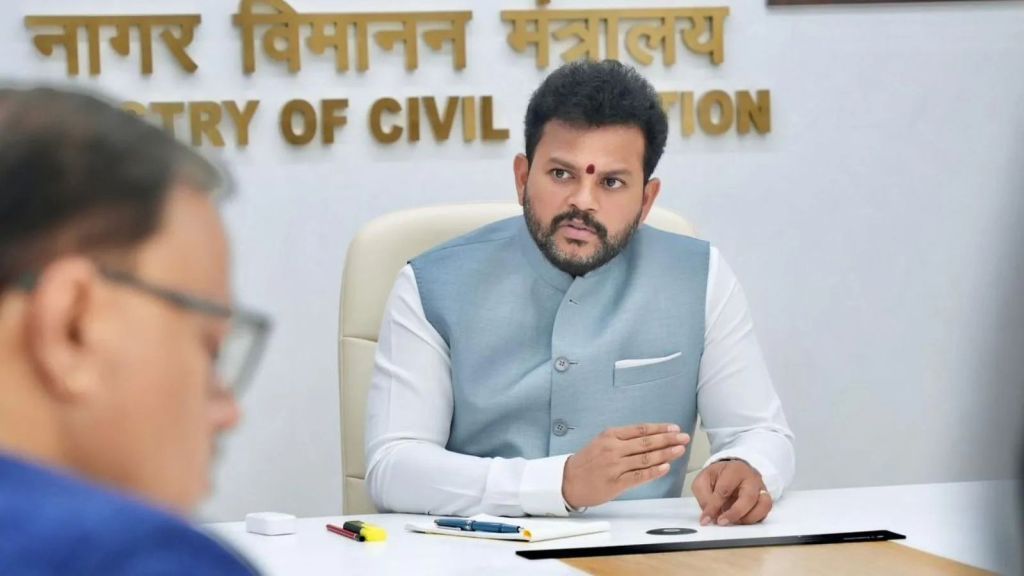
 Union Minister of Civil Aviation K Rammohan Naidu said that no decision has been taken and the matter is under deliberation. (File Photo)
The government will weigh all the pros and cons and will focus on maintaining market balance while deciding on the issue of cross-ownership between airlines and airports, Civil Aviation Minister K Rammohan Naidu said Tuesday. Naidu’s comments at an industry event came in response to a question on whether the government had decided on the Adani group’s request for a waiver from cross-ownership restrictions as it was evaluating participating in the airline business. Naidu said that no decision has been taken and the matter is under deliberation.
“…one thing from the government is clear: that we need more airlines to come into the picture. Now, operating airports and airlines together needs some deliberation. We are going to see the pros and the cons of it…You see the first idea is to provide the passenger with more airlines as an option and if there is someone who is interested to do it, then the government supports the idea. But when the (airport) operator only has to do it, then what are the cons also that might come out? We need to create a system where the cons are also taken care of,” Naidu said.
He also reiterated the government’s stated position that there was no blanket policy restricting airport operators from holding substantial equity in airlines, although cross-holding restrictions are part of contracts for some airports operated by private sector players, like in the case of Mumbai airport operated by the Adani group. Last month, the Ministry of Civil Aviation (MoCA) informed Parliament that the state-owned Airports Authority of India (AAI) had received a request seeking a waiver of the cross-holding cap provision, but didn’t name the Adani group.
The government has been calling for more airlines in the Indian skies, given the duopoly of IndiGo and the Air India group, which have a cumulative domestic market share of over 90%. But allowing airport operators to run airlines can have pitfalls, specifically those related to fair competition and non-discriminatory access to carriers, according to experts.
In a letter addressed to the AAI chairman in June, Adani Airport Holdings’s CEO Arun Bansal had sought a waiver or clarification in the Mumbai airport’s operation, management and development agreement (OMDA) to pave the way for the group to directly or indirectly invest in, acquire, promote, or control a scheduled airline, it is learnt. Bansal also sought similar waivers, approvals, and clarifications for all existing and future airports, given that the conglomerate may in future operate more airports, according to sources. However, Adani group flagship Adani Enterprises had said in July that it was not evaluating any proposal to enter the airline business.
As per the OMDA for Mumbai and Delhi airports, scheduled airlines and their group entities can’t hold more than 10% stake in the airport operator. This also effectively restricts the airport operator and its group entities from investing in or promoting a scheduled airline. The Adani group has 74% stake in the Mumbai airport, while GMR has 74% in the Delhi airport.
Sources had earlier indicated that the Adani group was weighing having its own airline and MoCA was learnt to have initiated preliminary discussions internally after the conglomerate sought relaxation in June. Any change on this front will also require the approval of the Union Cabinet, sources had said.
The Adani group operates eight airports in the country and has a major presence in other segments of the aviation sector, including ground handling, maintenance, repair and overhaul (MRO), and pilot training. The conglomerate also plans to set up an aircraft manufacturing facility in India in partnership with Brazil’s Embraer.
In the letter to the AAI chairman, Bansal is understood to have written that allowing the waiver would facilitate the emergence of an additional large-scale airline, thereby enhancing competition and reducing market concentration risks, apart from enhancing regional connectivity.
The airline sector in India has seen a number of airlines fail due to a difficult operating environment, fierce competition in a highly price-sensitive market, and global supply chain woes. The government wants strong corporate groups with deep pockets to foray into the sector given the challenging operating environment in the world’s fastest-growing major aviation market.
While concerns pertaining to a growing duopoly in the Indian skies had been around for a few years, IndiGo’s network-wide operational crisis in December exhibited the adverse impact it can have. The airline, with over 65% domestic market share, had mass cancellations early December, bringing the country’s aviation sector to its knees.
According to industry insiders and experts, if the Adani group indeed moved ahead with a plan to run an airline, there is bound to be stiff resistance from existing airlines and other stakeholders due to potential conflict of interest situations. These could include preferential treatment and slot allocation to the airline opened by the operator. If the government does allow airport operators to own airlines, it must ensure stringent regulatory oversight as well as mandating the airline and airport operations to be run independently, experts said.
IndiGo’s Managing Director Rahul Bhatia had said in July that any move by the government to allow airport operators to own airlines will create a “massive conflict of interest” and will be against the interest of consumers. “We are reading news as you are. All I can say is that, if the news has any merit, one, it has no global precedent…and typically (it will create) a massive conflict of interest. Over a period of time, it would actually be against the interest of consumers,” Bhatia had said.
In his letter to the AAI chief, Bansal wrote that airport neutrality can be preserved through existing and enhanced safeguards like International Air Transport Association (IATA)-compliant slot allocation process and oversight from the Directorate General of Civil Aviation (DGCA), and Airports Economic Regulatory Authority of India (AERA), and MoCA, it it learnt.
Additionally, safeguards like transparent and non-discriminatory airport operating procedures, information barriers and ring-fencing arrangements, independent governance structures, and regulatory monitoring and compliance mechanisms would help ensure airport neutrality and non-discriminatory access, Bansal is understood to have written.
Notably, Jeet Adani, who looks after the conglomerate’s aviation business, had said in December that the Adani group was not interested in the airline business as running a carrier didn’t fit the group’s capital discipline and philosophy, which was about investing in assets in high-margin businesses and sweating those assets. The airline business is the opposite of that, Jeet Adani had said in a televised interview in December ahead of the Navi Mumbai airport launch.
But the thought process might have changed since then, largely due to two factors — the government’s push for more airlines in a bid to increase competition and check market concentration, and Adani’s own venture to set up a final assembly line (FAL) of Embraer’s passenger jets.